Nepal-Bhutan May 2026 #5

Post #1 | Post #2 | Post #3 | Post #4 | Post #5

Bhutan
What an enchanting country! Land of the Thunder Dragon, where Gross National Happiness (GNH) is officially more important than gross national production, a land devoted to (mostly Tibetan) Buddhism brought south by the venerated Tibetan Lama Guru Rinpoche in the 8th century CE, but with its own little twists – mainly from the Tibetan Lama Zhabdrung, the founder of the modern nation in the 17th century. These two figures often make a trio of statues, in the Temples here, with the Buddha in the middle.

Here, although there is also clearly some poverty, the country seems better off than Nepal.  The roads and the buildings I see beside them certainly give that impression – and everything has a definite Bhutanese style, which is evident the moment one arrives. 

1/6/26
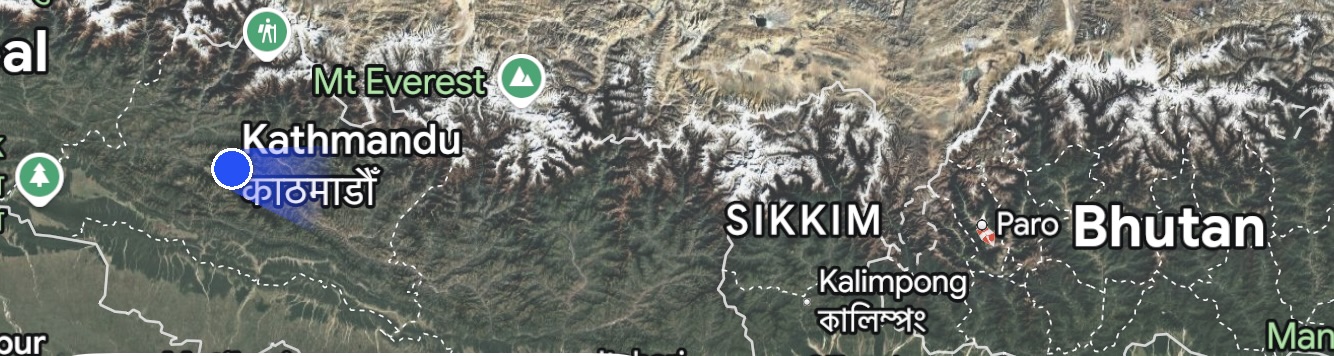
Kathmandu to Paro

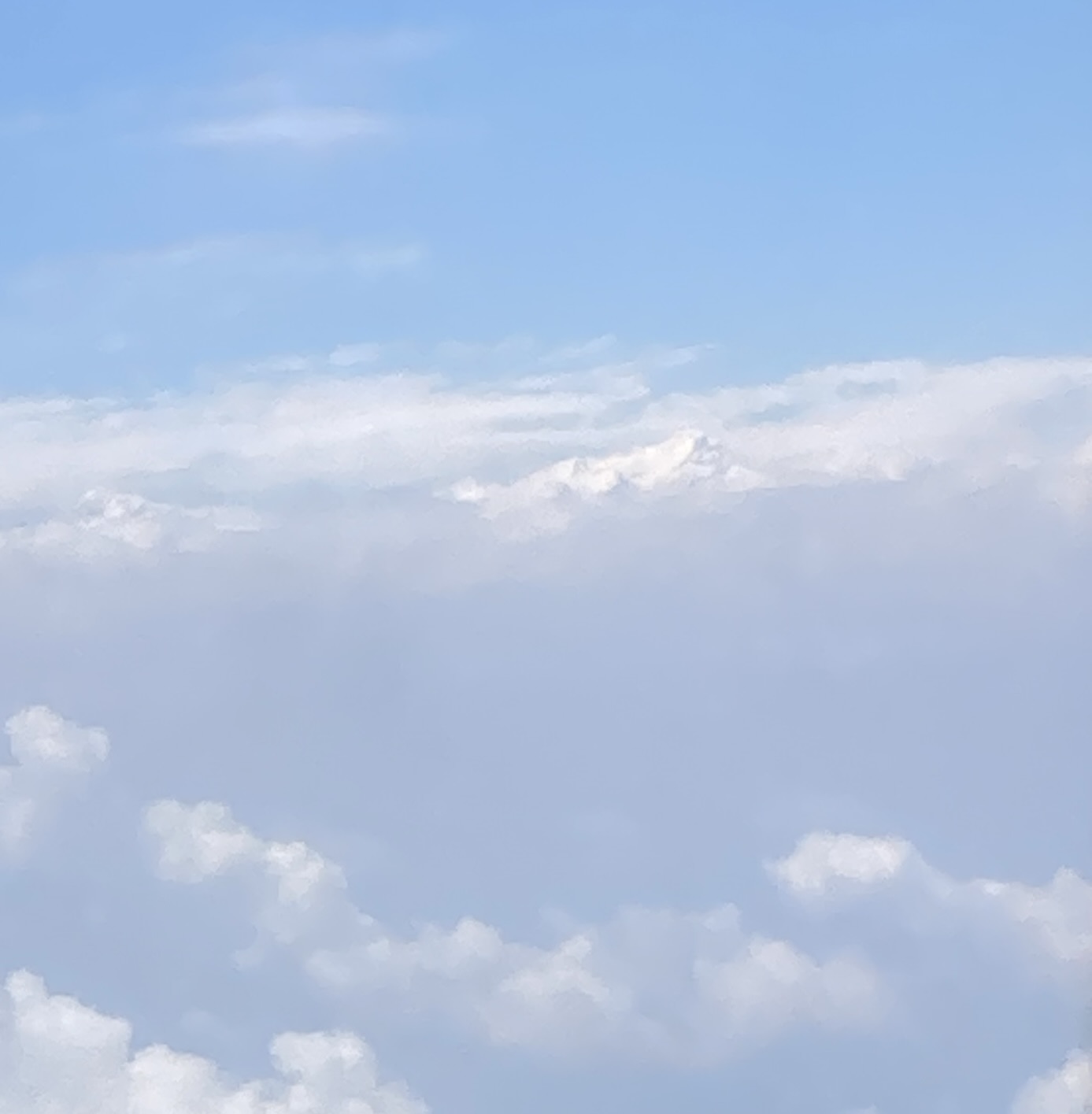
The journey from Kathmandu to Paro – Bhutan’s only International Airport – passes several of the highest mountains in the world, including the iconic Everest.  I am truly blessed with a beautiful morning and an extraordinarily good view of the mountain peaks, from my seat on the left-hand side of the plane (arranged by my tour operator!). 
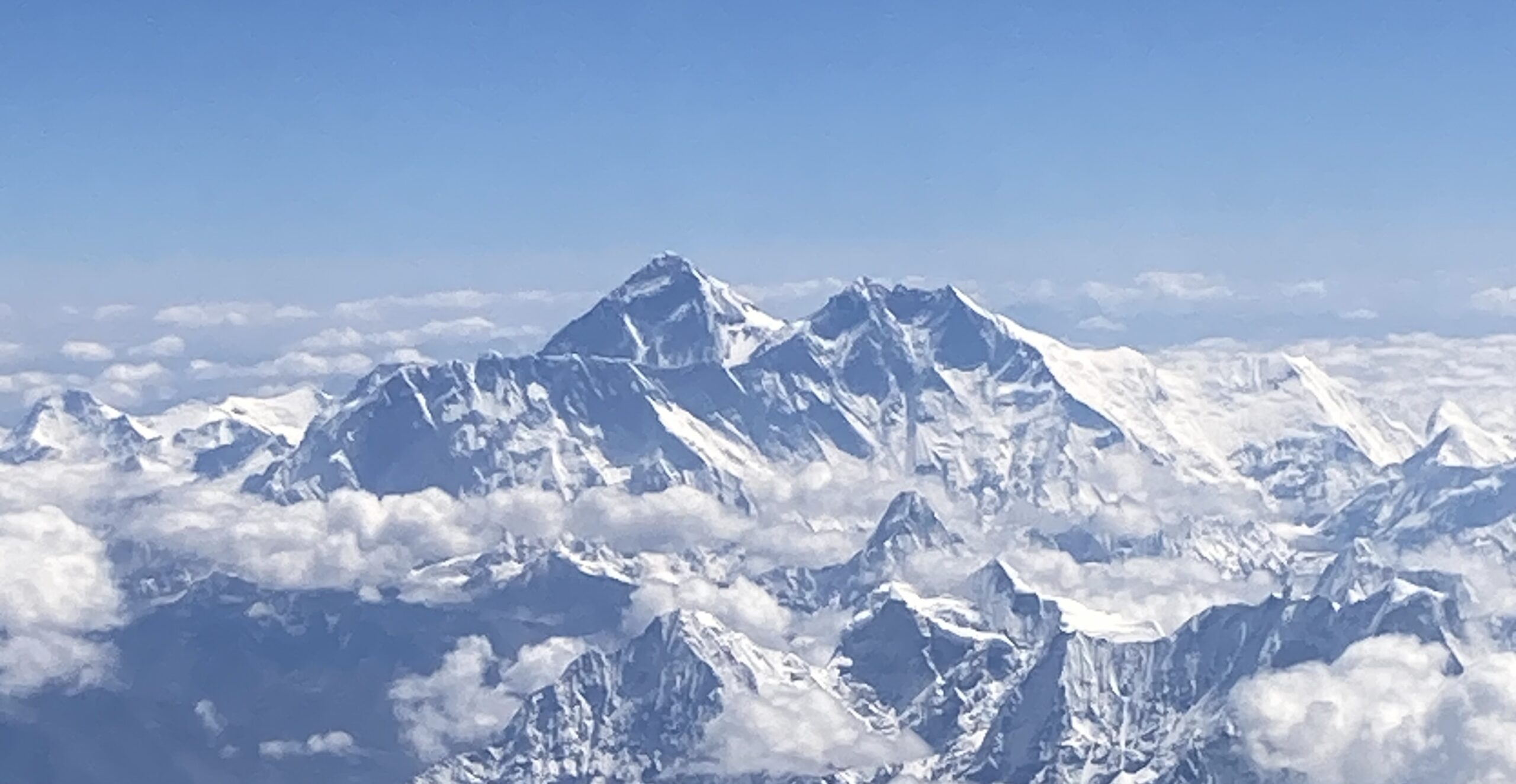
Everest
Mount Everest – from the plane

The final approach, moreover, is like something out of a movie, where the plane swerves and turns through a series of valleys on its way down to land – fine if you’re in a jet fighter but in a Boeing 737 it was an amazing ride!  Apparently there are only about 25 pilots qualified to make this landing at any one time.  I’m not surprised!
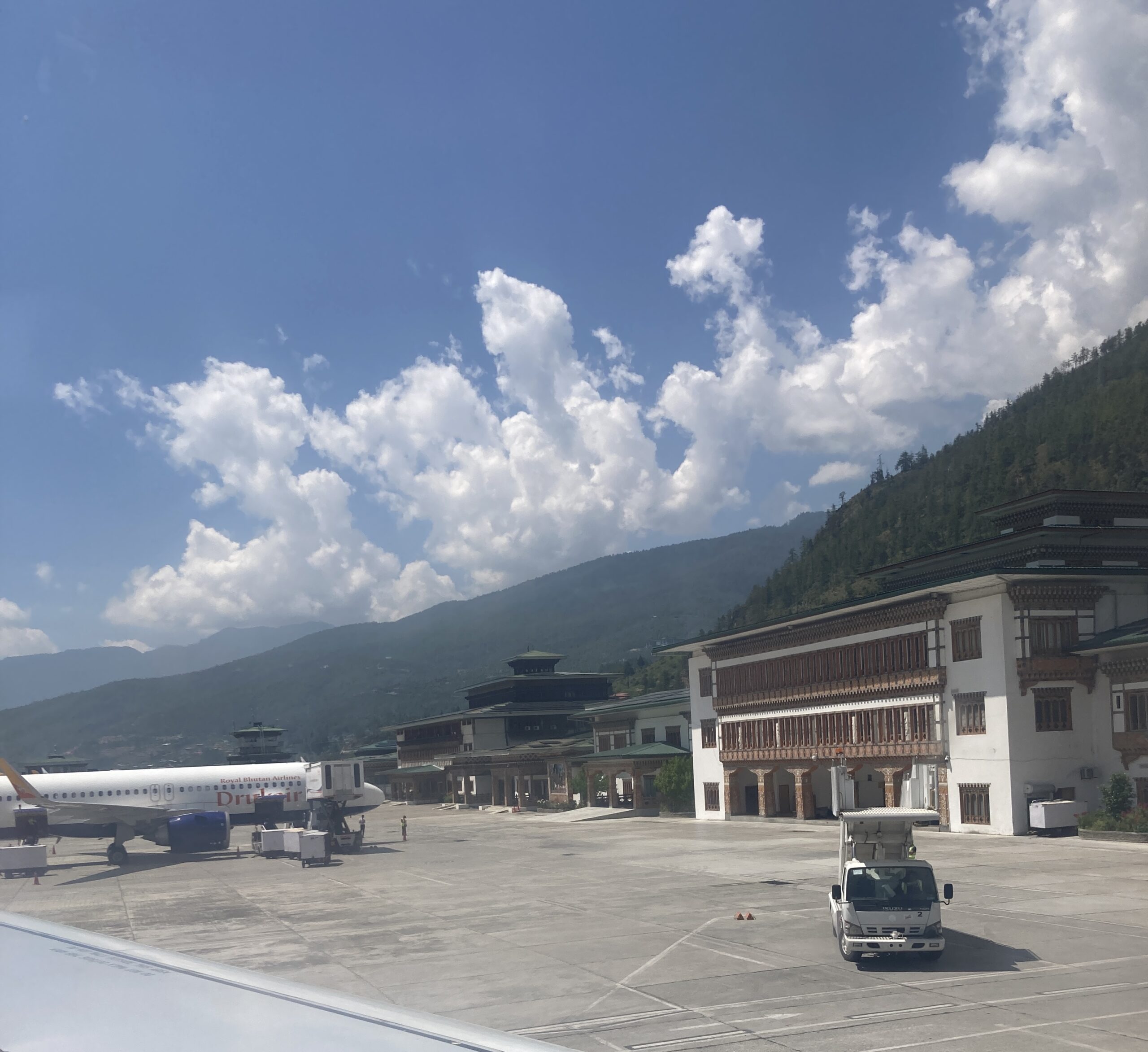
Paro Airport
Paro Airport

Paro Airport is the introduction to the wonder of Bhutan: as in most developed countries, planning permission and construction standards are required for any new building.  Here in Bhutan there is also a requirement to adhere to the national character, with carved wooden facades and everything else (as much as possible) in wood and stone.  Although arguably it makes all the buildings look rather similar, it also means that there is little (if any) of the brashness of global branding, ugly concrete blocks, or half-built brick blocks with steel reinforcements sticking out, as is so prevalent across Nepal.  It makes for a very beautiful place.  When, amongst all the newer buildings, you discover the medieval ones, in the same style, but much older, you appreciate what they have done here.  It is also true that fire and earthquake have destroyed some of the medieval buildings, but they have been completely rebuilt in the exact same style.  Bhutan’s tourism, moreover, follows a policy of high-value/low-impact.  There is a hefty tax all tourists pay just to be here. This keeps out most backpackers, and keeps down the numbers.  The places to visit, moreover, could clearly not handle high volume tourism, in any case.  It all makes for a sense of an exclusive holiday, and I feel truly fortunate.

Dressed in Gho
Dressed in Gho

Sonam, my guide, tells me a great deal about the country, about its history, and about its religion, the highlights of which I shall try to share in this blog.  He and his young driver, Doji, are – like most of the men I see here, attired in the national dress, which is a Gho – a robe which is hitched up in the middle with a tight sash, and arms that fold back on themselves with white cuffs tucked over them.  The robe thus makes for a kilt-like feel above the knee, with long black socks below. They look cool and quite practical in the heat here, and on the spur of the moment I include men’s national dress in the short list of souvenirs I tell Sonam I would definitely like to acquire, hopefully with his advice on where best to get good quality examples.  I, of course, also want some “organs” as he describes them.  For one of things that most fascinates me about Bhutan is that the old religion here, which remained strong right up the 8th century CE when Buddhism arrived, was centred around the Phallus. 
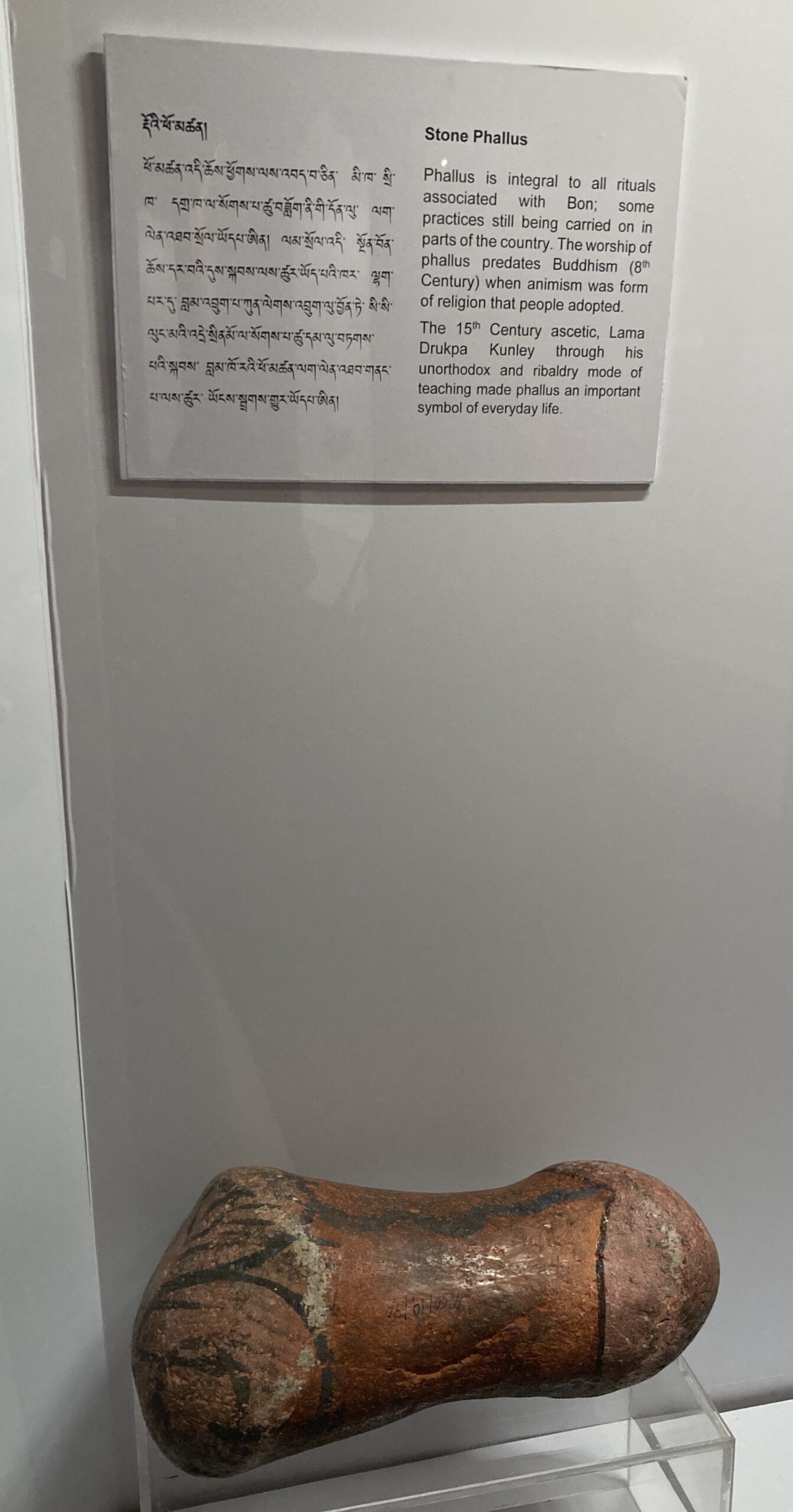
Medieval stone phallus

It was called Bon, and Bonpo Buddhism is a not unrelated development out of it.  But the Tibetan Lama Drukpa Kunley, who came south to teach here in the c15th CE, brought the fascination with the phallus into Buddhism, too, such that representations of it, in paintings on buildings and in wooden and stone sculptures of it, are absolutely everywhere you look.  I love Bhutan. Land of the Thunder Dragon!  The white dragon on the national flag signifies purity, with a yellow triangle and an orange triangle signifying the administration of government twinned with the hierarchy of monastic life.
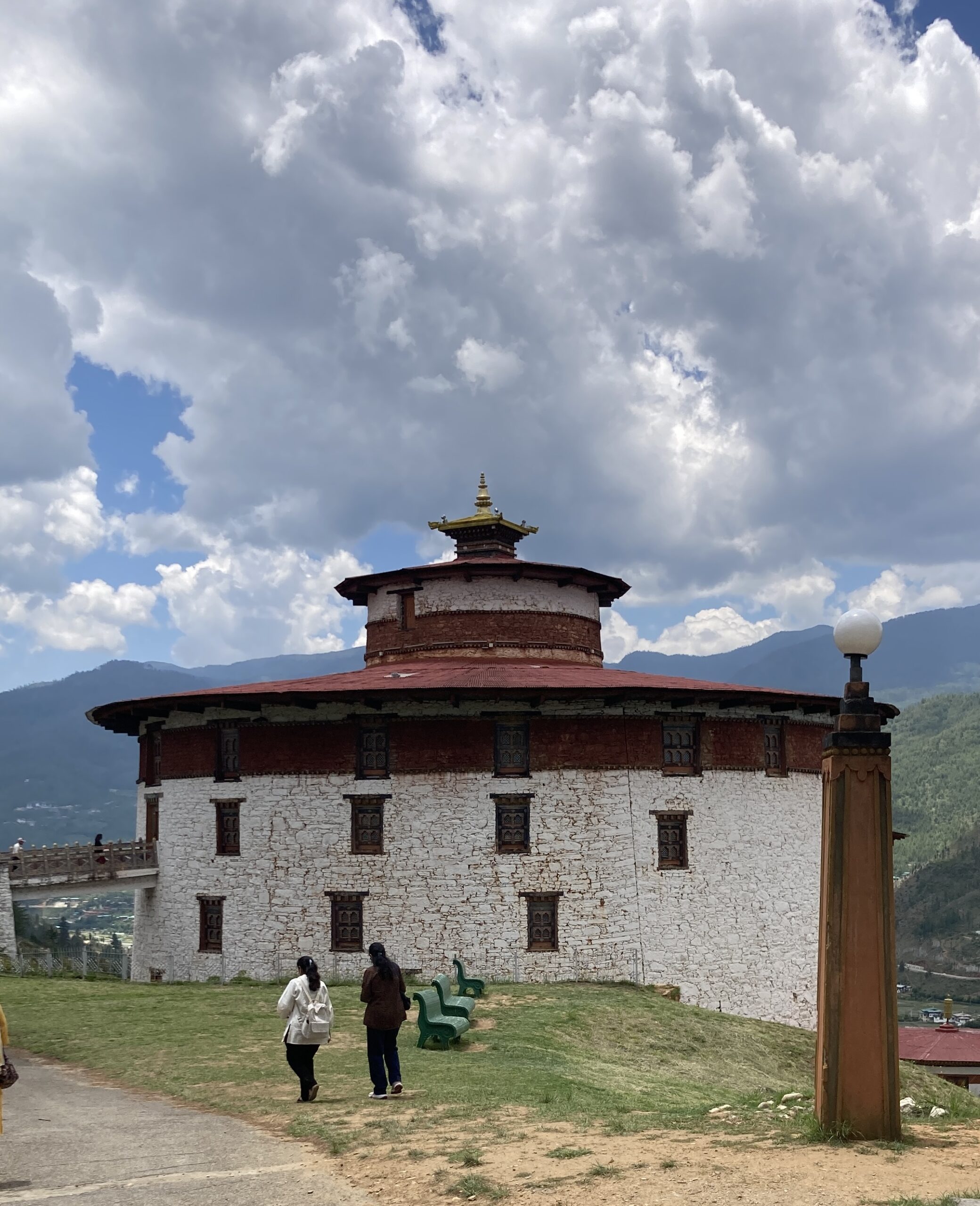
National Museum
National Museum

We visit the Taa Dzong (National Museum) first, which is a medieval building on seven floors filled with artefacts and information plaques, and Soram tells me many stories about the things we see.  It is a fascinating immersion in Bhutanese history and culture.  I am struck by the many Thangka paintings, and delighted by the many varied artefacts we see.  I am also – by the end of it – exhausted by all the stairs, up and down, (having been awake since 4.30am, and up since 5.30am, to get here).  Below the National Museum, the Rinpung Dzong medieval fortress, converted in modern times into an administrative centre for the Paro district and monastic centre, is a stunning building, with a really lovely Buddhist temple, and Soram takes me through explaining all the various statues and their mudras.  
Ironlink Bridge
Ironlink Bridge

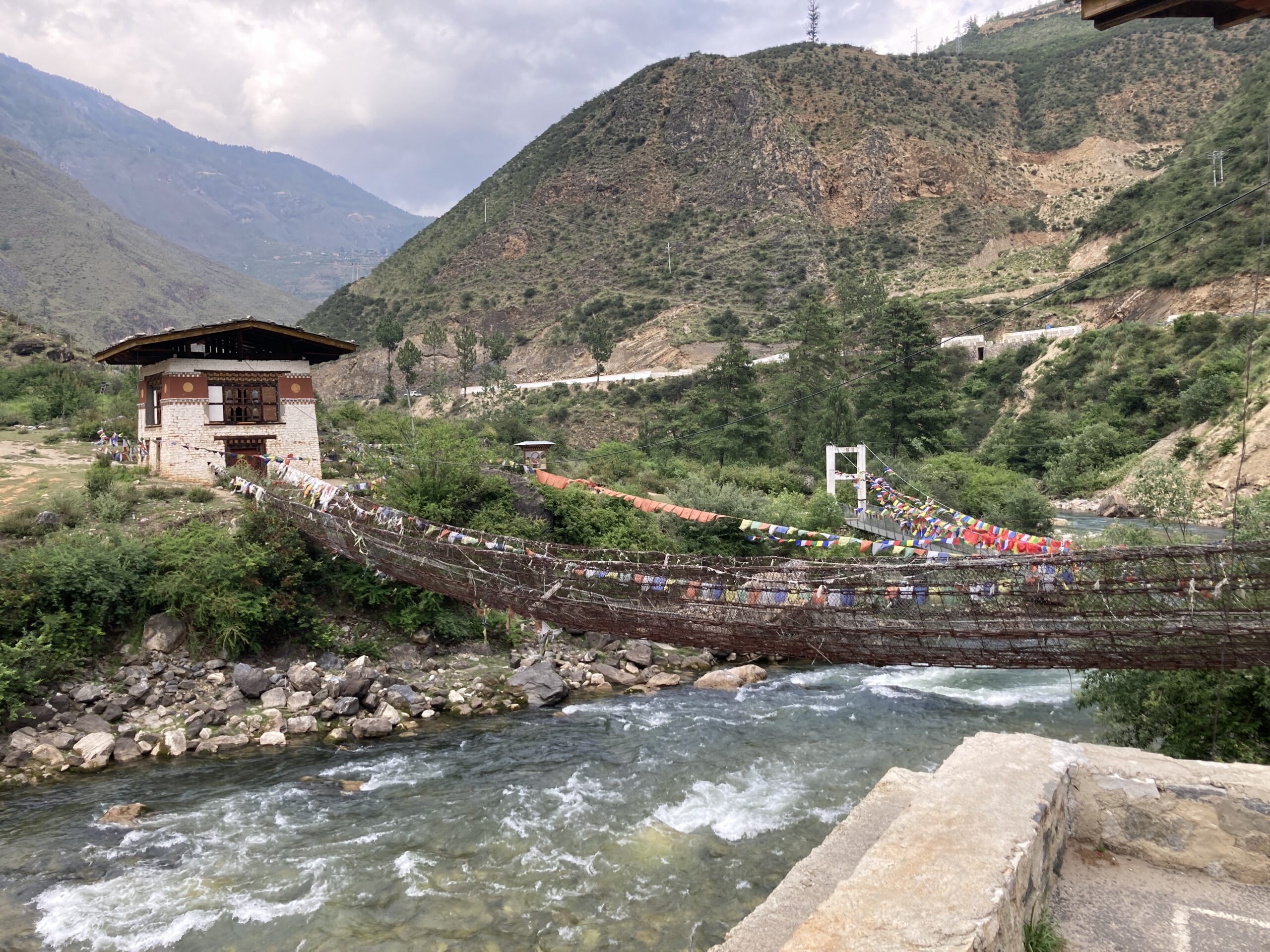
On the drive, then, from Paro to Thimpu, we stop off at two smaller temples – Dungtse Lhakhang and Kyichu Lhakhang.  The first is a place where there is a small Buddhist temple inside a stupa – very unusual!  Bhutanese Stupas are square with a wide roof, but inside this one is hollow and incorporates four Buddhas facing in each direction.  The second is perched on a hillside above where two rivers meet, across an iron-link bridge.  The Lama Zhabdrung, who came from Tibet and brought the knowledge of finding iron ore and making iron rings, with which numerous bridges were made across the many rivers, is a very fondly remembered character in Bhutanese history.  He was also responsible for building many temples, and fortresses.

2/6/26
Zhabdrung Ngawang Namgyal

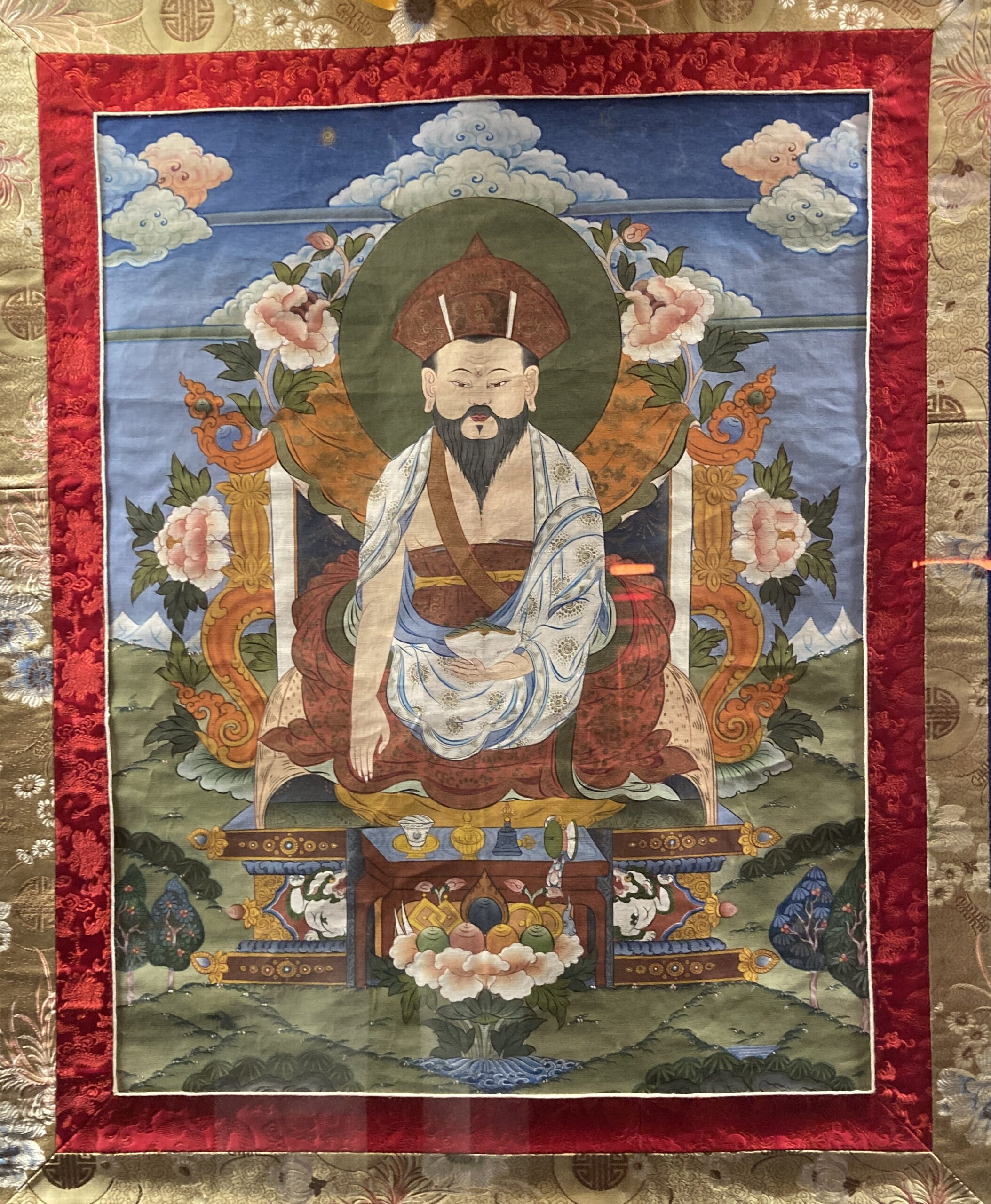
After a lovely stay at Terma Linca Hotel – where I tried some authentic Bhutanese food (very spicy!!) today’s sightseeing took in the Memorial Chorten, the Buddha Dordenma Statue, the Takin Reserve, a Handmade Paper Factory, and the crossing of Dochula Pass.  After breakfast, Soram helped me to dress properly in the Bhutanese Gho I bought yesterday, and all day I am complemented with smiles and appreciation both from the Bhutanese and some of the many Indian tourists that we meet along the way.  With my long white beard, I am frequently told I resemble closely the highly venerated founder of Bhutan, Zhabdrung.  This Lama, my guide tells me, in the 17th century CE, was head of a district of Tibet called Druk, and held that position as a reincarnation of a particular boddhisatva. But the prime minister of Tibet, and a challenger who claimed that he was the reincarnation, and not this Lama, conspired to force him out of his role.  To the south, one of the many small chiefdoms in the area that is now Bhutan gave him sanctuary.  He then was given the leadership of that chiefdom, and began to fight many battles to gradually unite all the chiefdoms into one, new kingdom.  Whilst these battles were underway, however, the usurper of the Druk region of Tibet discovered that the precious relic that was the most sacred possession of that district’s governor had been taken by the Lama when he fled south.  With his ally the Tibetan prime minister, he then began to invade south.  So as well as fighting battles to unite the chiefdoms, he also had to fight off the Tibetan armies invading from the north.  In the end he was successful in both endeavours, and established the new kingdom of Bhutan – which is another word for Druk (the name of his former Tibetan district), which means Dragon.  He held this new kingdom – the land of the Thunder Dragon – together for 85 years, including 50 years after he had died, when his immediate circle kept his death a secret, and only the power of his name kept chaos in check.  Eventually the truth got out, and, as expected, the kingdom quickly fell apart into separate chiefdoms again.  But the precedent had been set, and about another 120 years later, in 1907, a second founder united the kingdom once again and established a new kingdom under the Wangchuk Dynasty – the fifth generation of which is now the ruling monarch.  This new kingdom was set up as a dual space, half monarchy, half monastic order – a diarchal system – which, although essentially a Tibetan form of government, is only extant now in Bhutan, with Tibet itself under Chinese control since 1959.  The King and the head of the religion sit side by side in matters of state, so in some senses it appears like a theocracy – but perhaps not dissimilar to that of the United Kingdom, where the King is also the Head of the Anglican Church and Bishops sit in the House of Lords.  The third king, who modernised Bhutan in the 1960s and 70s, building roads and hospitals and joining the UN, was followed by the fourth and incumbent King who in 2008 stepped back from absolute rule and established the country as a constitutional monarchy, with a democratically elected parliament – and Gross National Happiness as the national measure.  But to prevent religious control of the parliament, the monks, nuns and senior clergy are not included in the franchise: they cannot vote.  Also to prevent corruption any politician campaigning for office found to have even offered sweets to entice voters can be banned from standing; whole parties can be disqualified if there is a whiff of graft.  The result, my guide tells me, is that the tourist taxes we pay don’t end up in people’s pockets, but are spent on the roads and hospitals and education that are all provided for free to the Bhutanese people.  
Tashichho Dzong
Tashichho Dzong

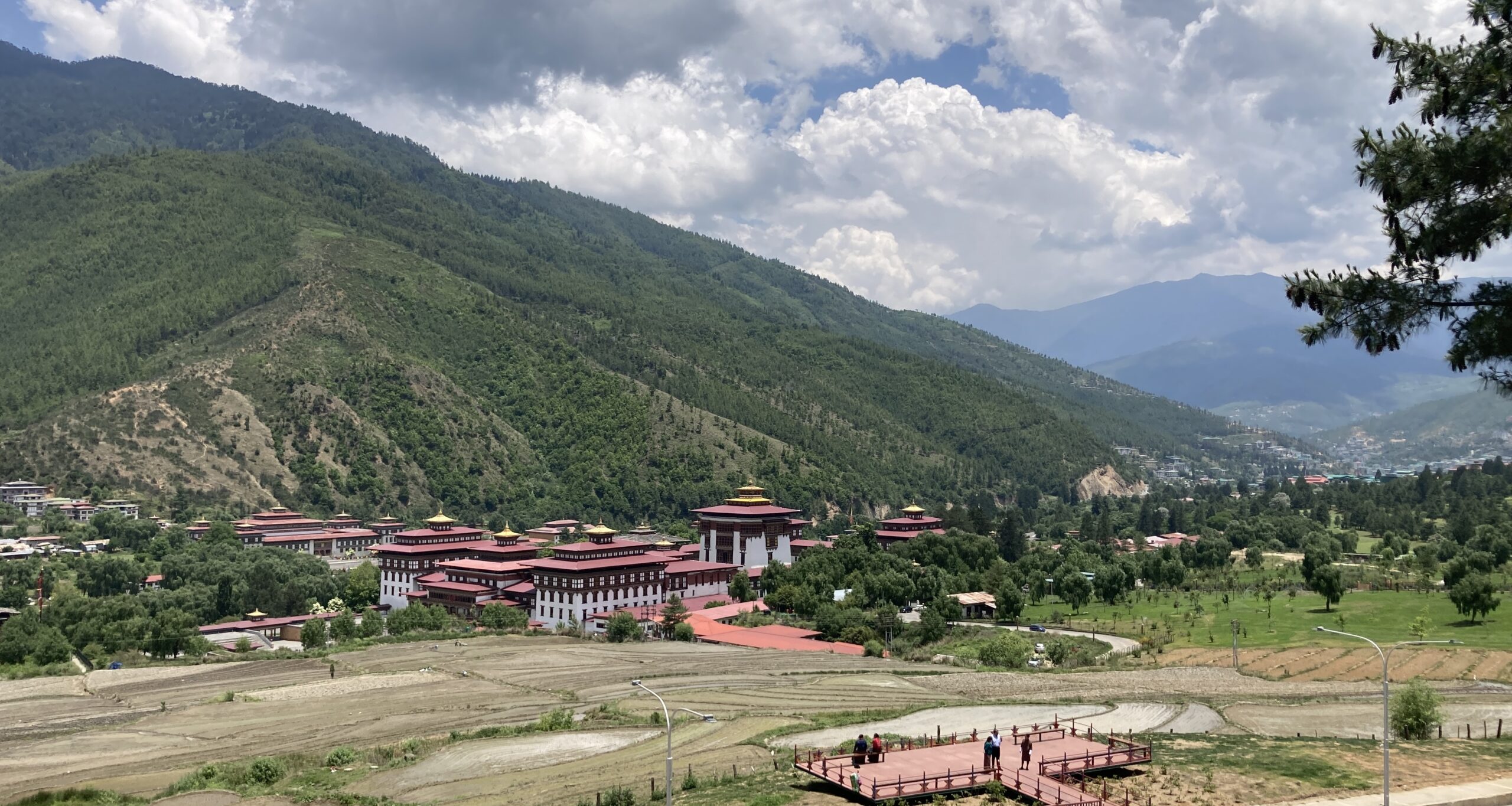
So, in my Bhutanese dress and with my long white beard, looking like the original founder of Bhutan is no bad thing.  The Bhutanese love their monarchy.  Most of the great fortresses, (Dzongs) that dot the landscape were built by him, in the late 17th and early 18th century, to fend off the Tibetans.  At Thimphu (the capital) we stopped to take pictures of the Tashichho Dzong along the way – a huge complex that now incorporates the Royal Residence, the Summer Palace of the head of the religion, the Parliament Building, and the Supreme Court.  On our journey we take in some breathtaking views on the way up, at the top, and then on the way down from the mountain pass.  
At the Memorial Chorten

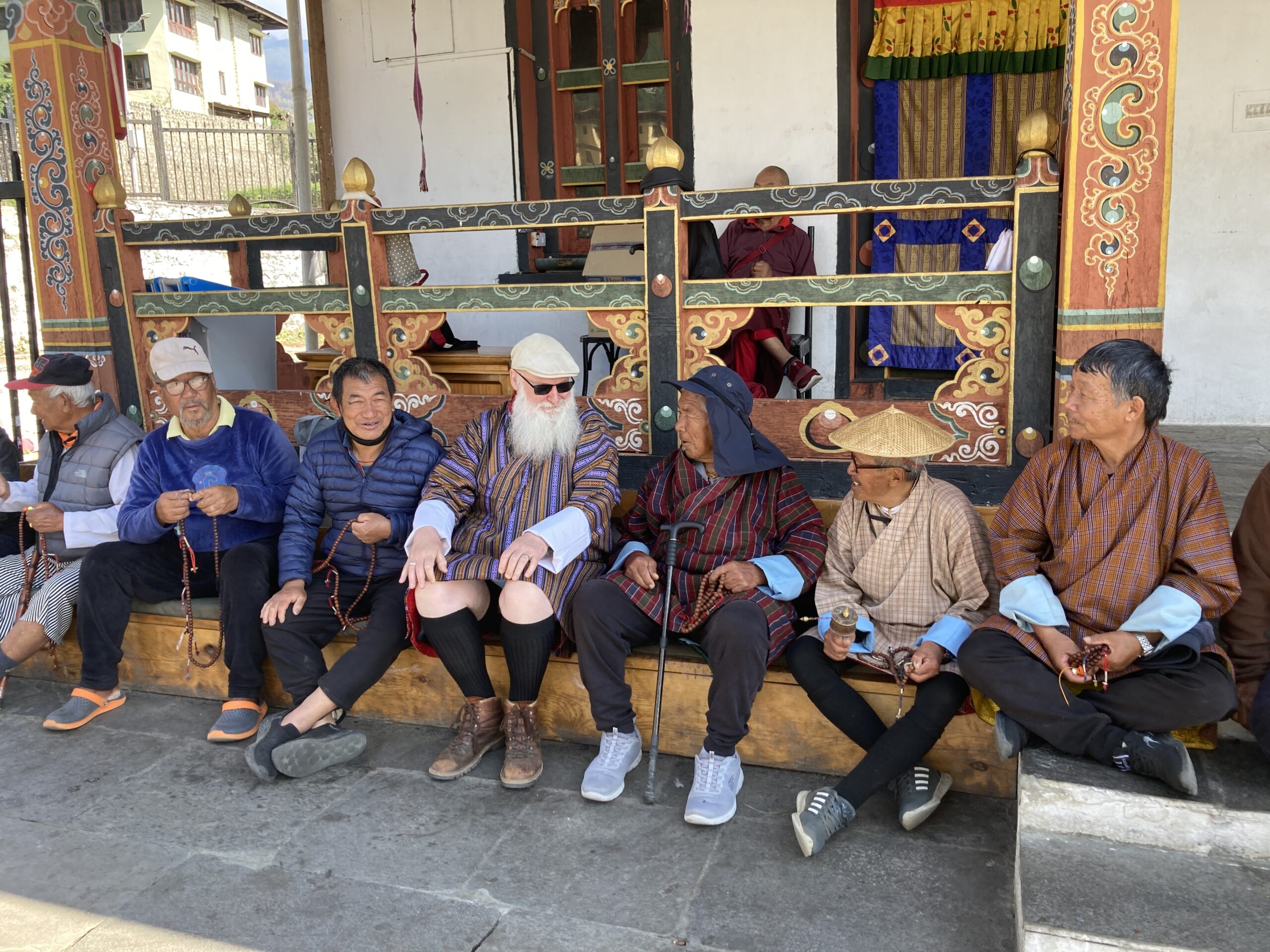
The Memorial Chorten, where we started the day, was built in memory of the 3rd King who died young, and is a place where many of the old folks of Thimphu gather, to sit in the shade during the heat of the day.  As everywhere else, it’s no shoes and no photography at these temples, so I am only able to tell you that the artistry, craftsmanship, and incredible stories represented in these places are breathtaking.  It is also true that, by now, I must confess I am starting to reach overload: there has been a lot to take in over the past days, first in Nepal and now in Bhutan, and my brain is getting saturated and less able to retain much of the information that I am being given by my very helpful guide.  All Bhutanese learn English at school, and speak it well, so Sonam and Doji are able to communicate with me very well, which helps! 
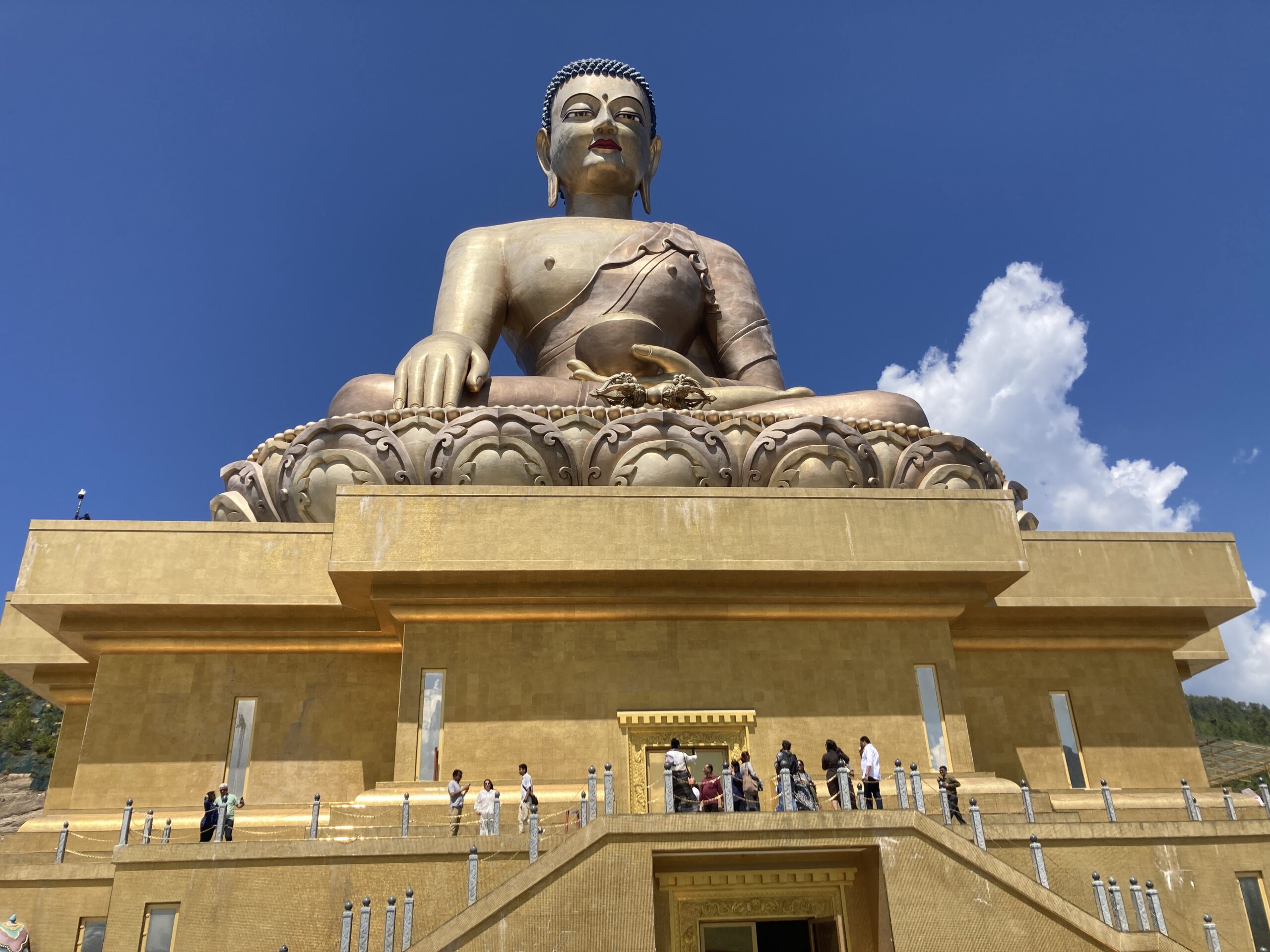
Dordemna Buddha
Dordenma Buddha

The highlight of the day, for me, however, was the Dordenma Statue – an absolutely huge Buddha, with a Dorje (the thunderbolt of indestruction) at his feet, inside of which is an incredibly ornate temple.  The entire project is still unfinished, costing some $100m,  with donations from many other Buddhist countries, and this incredible monument sits on a ridge overlooking the capital, Thimphu, a city which snakes from north to south along a wide valley. 
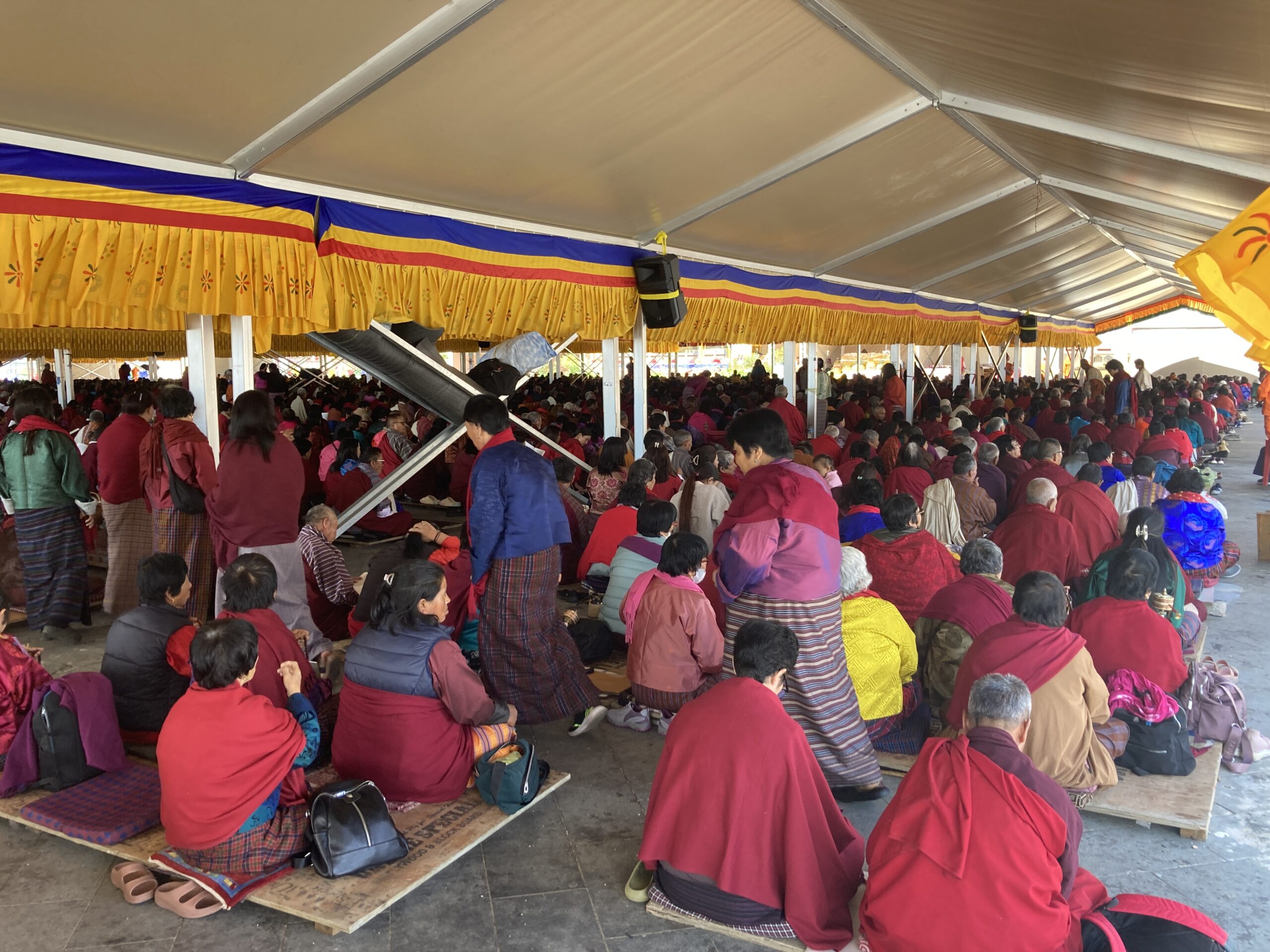
Festival at Dordenma

At the giant Buddha, it is a festival day, and we walk in minutes before a member of the royal family arrives in a cavalcade of 4x4s, to be greeted by an array of Bhutanese army officers, and a range of monks – many in the orange robes denoting they are of the highest rank.  The VIPs take up their places under a separate group of small marquees to one side of the huge marquee where literally hundreds of devotees are gathered, all sitting on cushions on the floor, under the awnings at the feet of the Buddha. 

Over huge loudspeakers, a venerable Lama is intoning mantras: it is an oral transmission, a teaching and blessing from a great master to all who are interested – including, it seems, today, members of the royal family and the military, along with the most senior clergy in the country.  I am amazed, frankly, that we are all here without having been thoroughly searched, frisked, vetted, etc, but then that sort of security is clearly not needed here in the wonderful land of Bhutan.
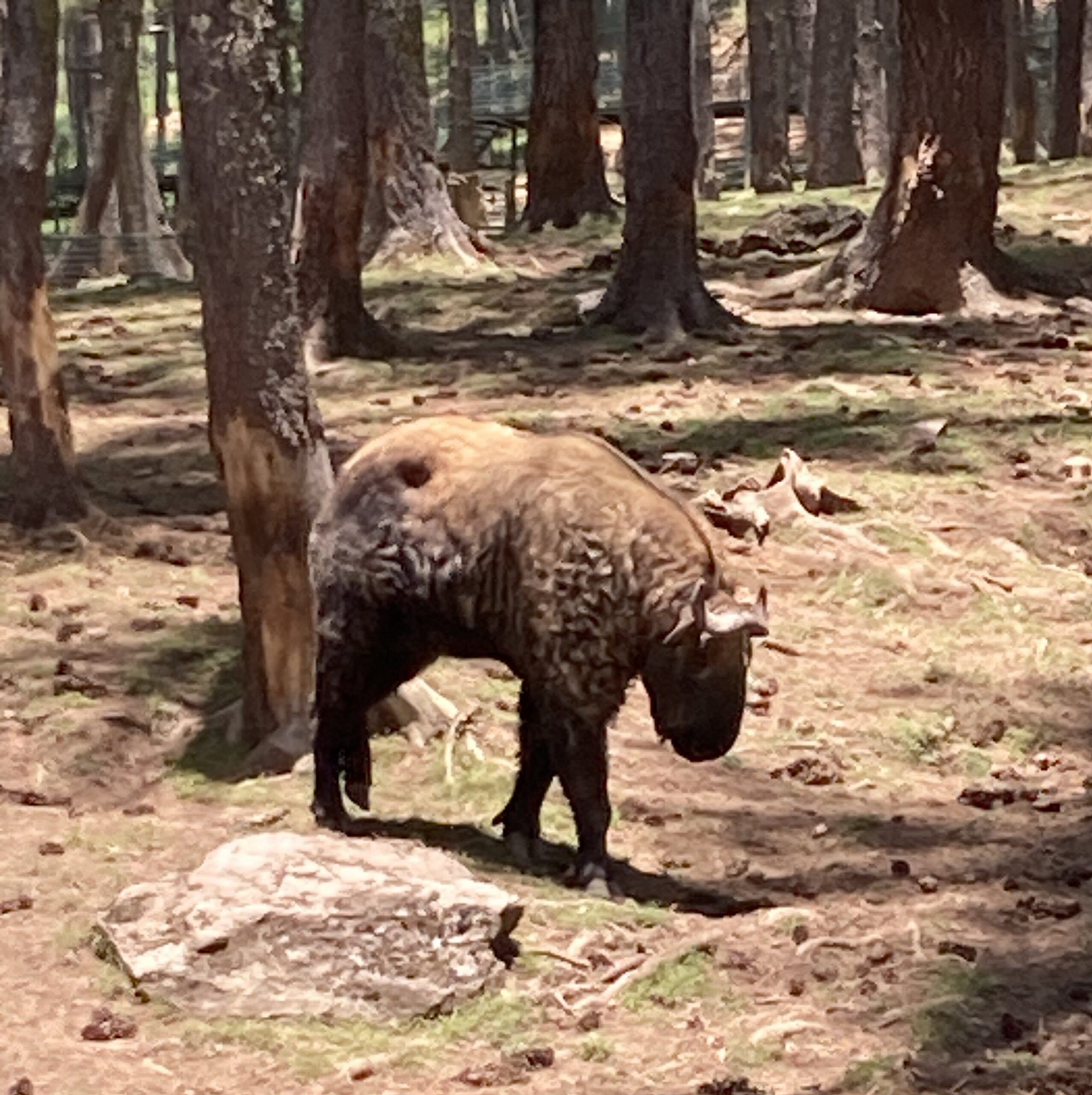
Takin
Takin

On the way to the pass we stop for a coffee and some mo-mo (delicious little dumplings) in a cafe at a preserve (you couldn’t call it a zoo) where some of the potentially endangered indigenous wildlife of the region are conserved and cared for, including the national animal of Bhutan, the Takin.  I hadn’t ever heard of one either.  It’s a kind of a cross between a cow and a goat, and has a low rumble that is neither a low nor a bleat.  There are also Yak and local deer and some very colourful birds here.

The high Dochula Pass (over 3000m) is cool – very welcome after the 23’ heat of Thimphu, and especially welcome as the temperature at Punackha, where we are headed, is likely to be around 30’.  It is 2000 metres below the pass, whereas Thimphu was only 1000 below.

3/6/26

Today – the last proper day of sightseeing – began early at a nunnery only minutes from the hotel.  I was delighted that in fact we arrived at breakfast time, and all the nuns were in the temple, intoning the mantras, banging the drums, blowing the clarinets, and being served butter tea and rice.  Invited in to sit quietly in a corner, it was such a privilege to witness this at the same time homely and devout ceremony.  The nuns ranged in age from toddlers to middle-aged.  Teenagers served the tea and food.  Older women supervised.  On the secondary throne (not the empty one reserved for the head of the religion) the Principal sat, leading the mantras.  This – apart from myself and my guide – was the only man in the room.  At the end of the breakfast, he stood and walked over to the altar side of the temple, and gave a little lecture to the assembled females.  There were titters and some laughter – obviously whatever he had to say he was doing so with humour.  My guide explained to me afterwards that he was telling the women that the ritual cakes they made as offerings should be uniform in shape, and that the tray offered up this morning included quiet a variety of shapes and sizes.  Many of the guides bringing tourists here, he told them, grew up as monks and they will be able to tell; and besides these are offerings to the Buddha and to the Boddhisatvas, and this should be done properly.  For all the criticism it was all clearly done with compassion and humour.  The intoning of the mantras, and the banging of the big drums, and the piping of sacred clarinets, made for a mesmerising and very peaceful start to the day.
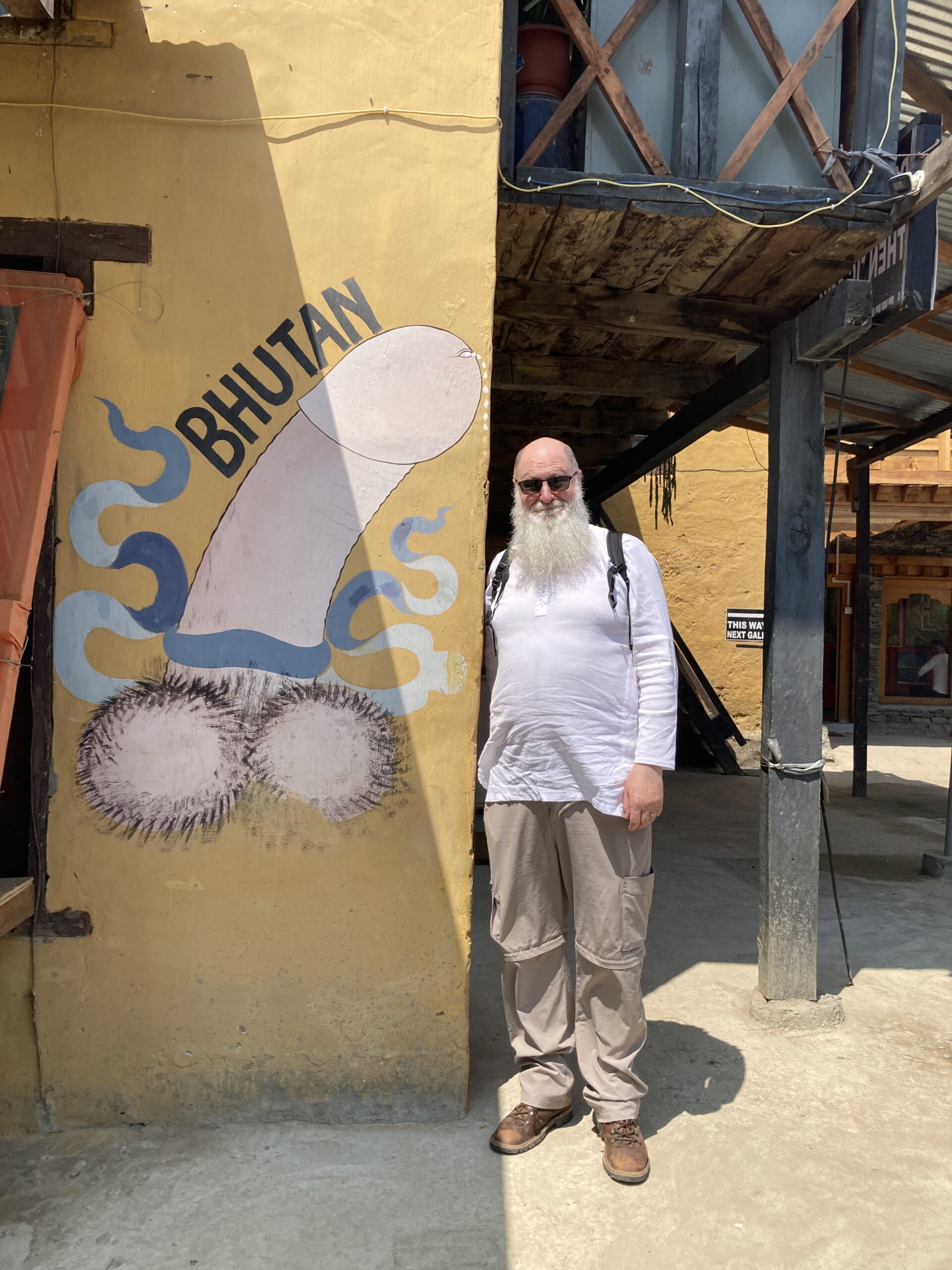
Phallus Wall-Painting

We then drove to Chimi Lakhang, and the little village of Sopsoka – the beating heart of Bhutan’s famous fascination with the erect penis: the phallus.  Readers of this blog may remember that 10 years ago I visited a Phallophoria at Tyrnavos in Greece, and witnessed their celebrations of Clean Monday, where the whole village came out sporting big phalli, the baker made phallic loaves, and there were phalluses everywhere.  I wrote a long blog-post about the Phallus around the world, through history, much of which was later published as a chapter in a book about the Phallus, including many photographs that I had taken in various parts of the world.  
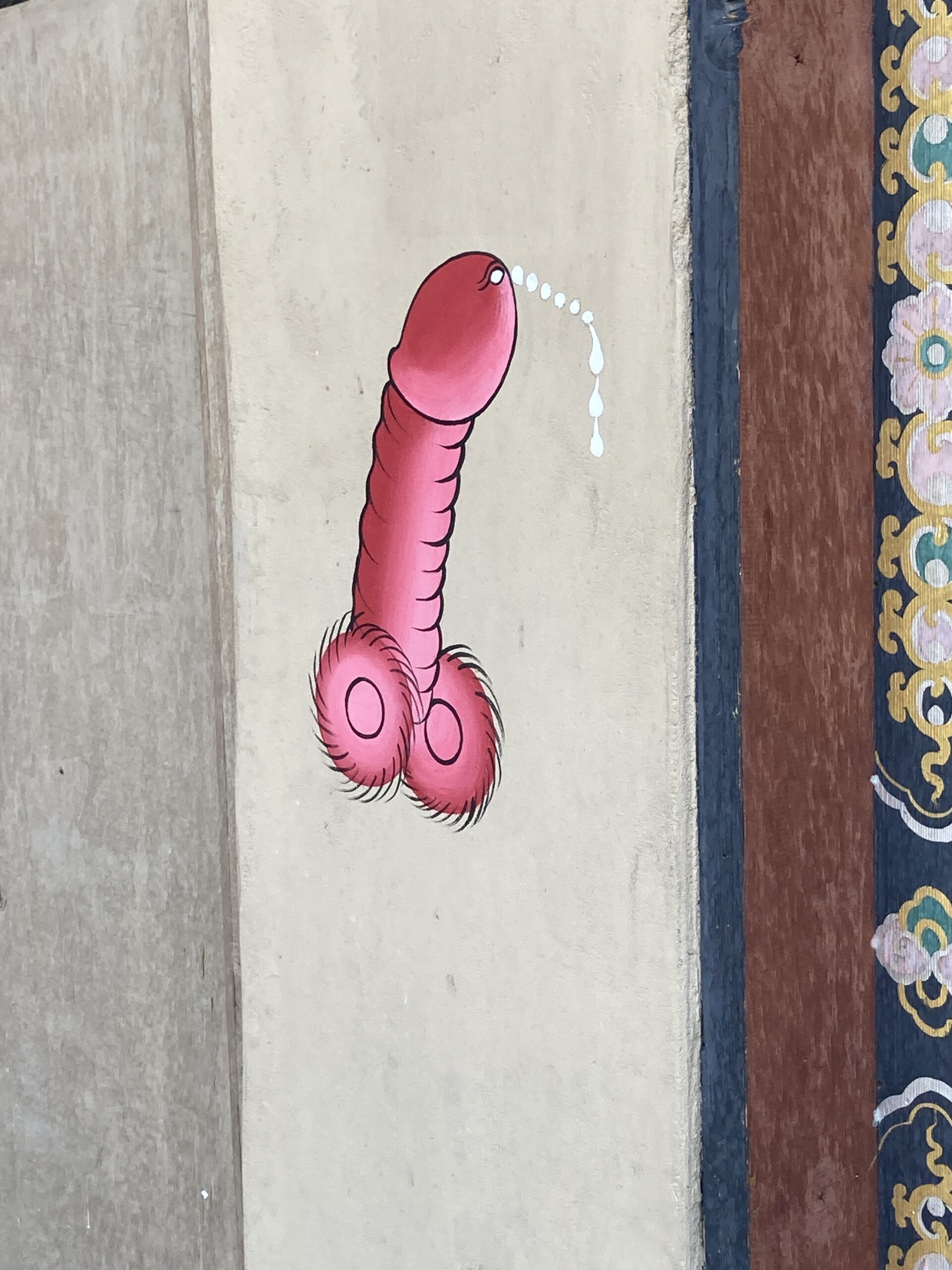
Phallus Wall-Painting

One place that was not represented, which, although dimly aware of it, I did not mention because I had not been myself, was Chimi Lakhang, here in Bhutan.  It is very wonderful to finally be here.  Almost every building here -rather than one here and there in the rest of Bhutan – has one or more large colourful phallus paintings on it.  Many have wooden phalli hanging from the top corners of the roofs.  As you walk into the village, you realise quickly that this is a big high street of Chimi Lakhang ‘tatt’ – a veritable Glastonbury High Street of sacred items, a bit like Paro outside the airport, here. 
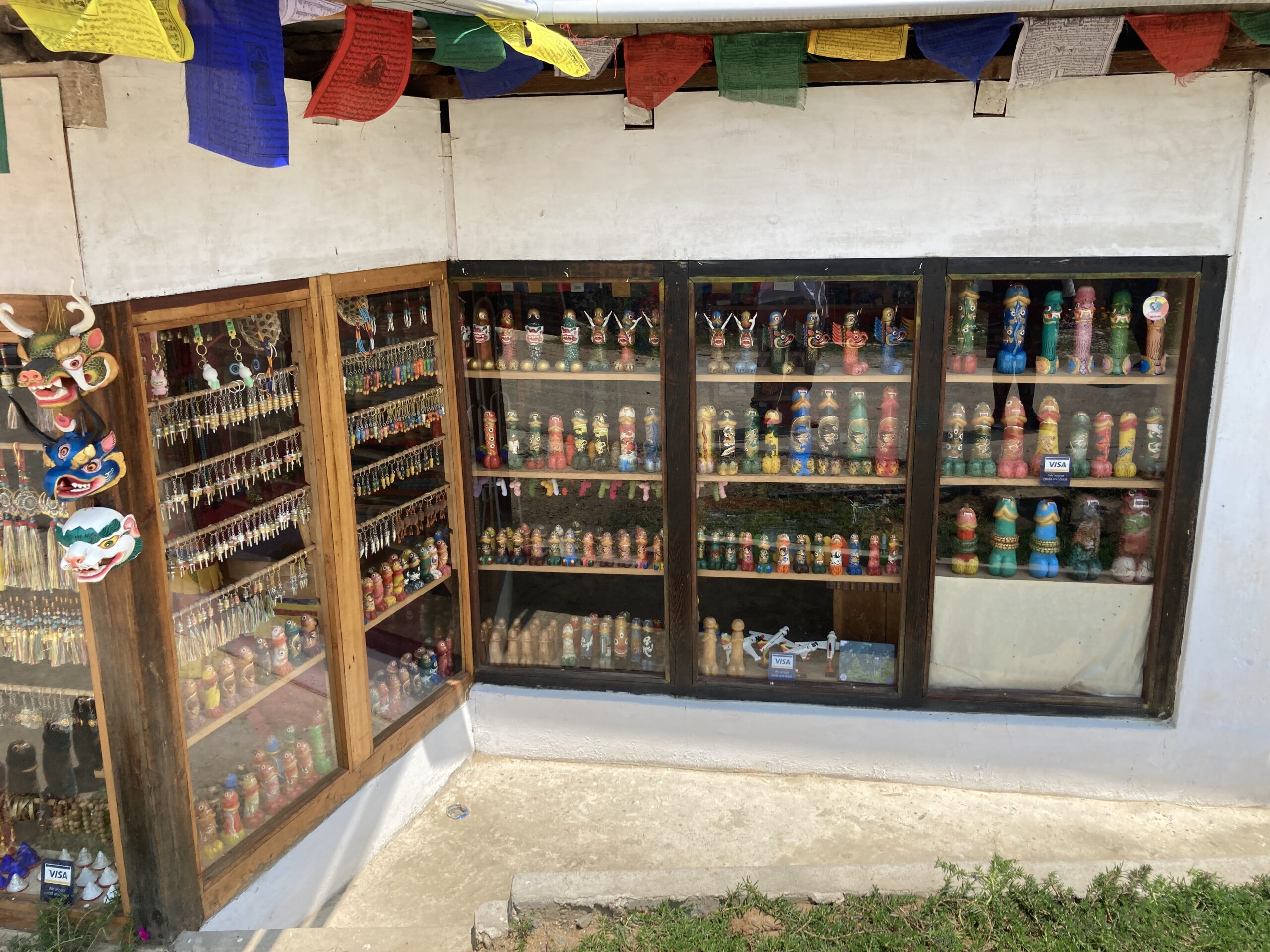
Phalluses on sale
Phalluses on sale

Except that more than half of the items on sale in this village – called Sopsoka – are erect penises. They come in all shapes and sizes, plain wooden, and brightly coloured, and painted with intricate designs.  At one shop I buy a large blue one with a white Druk painted onto it curving round the shaft, and an angry face on the glans at the top. 
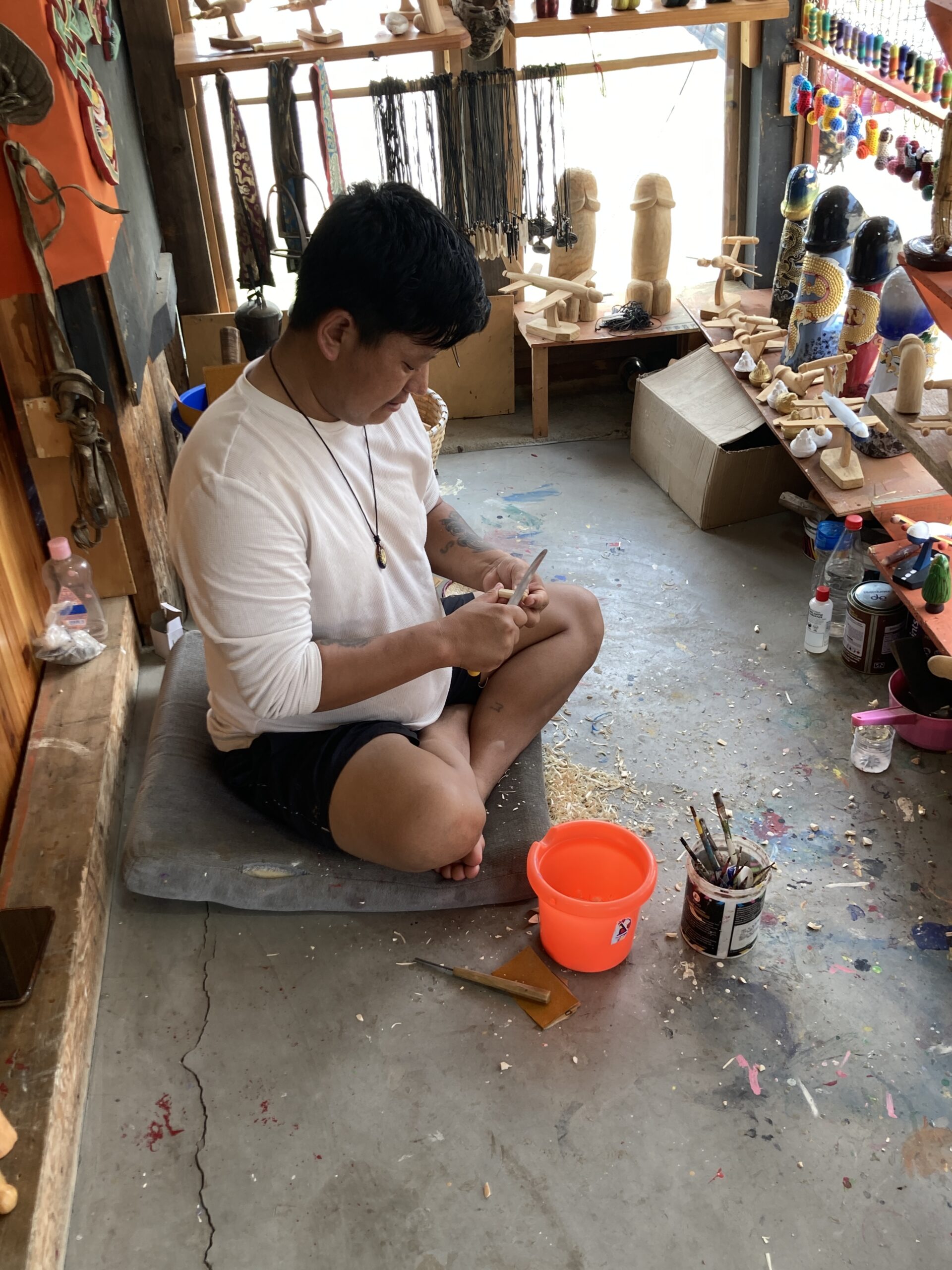
Hand-carved phalluses

At another shop I see the man hand-carving his wares, and buy a pair of plain wooden ones.  Only one is varnished, but he says he will varnish the other for me and I can collect them both on my way back down by which time it will be dry.  At the top of the village we come to the entrance to the Chimi Lakhang Temple, and take the short climb up the steps to the top.  It is hard going in the 31’ heat, up the steep steps, but I manage it, excited to be here at last.  The view from the top is wonderful. Under a tree my guide tells me the story of 15th century CE Lama Kinley Drukpa, the Divine Madman – the Tibetan Lama who came to this area and gave the most unorthodox teachings of all. 
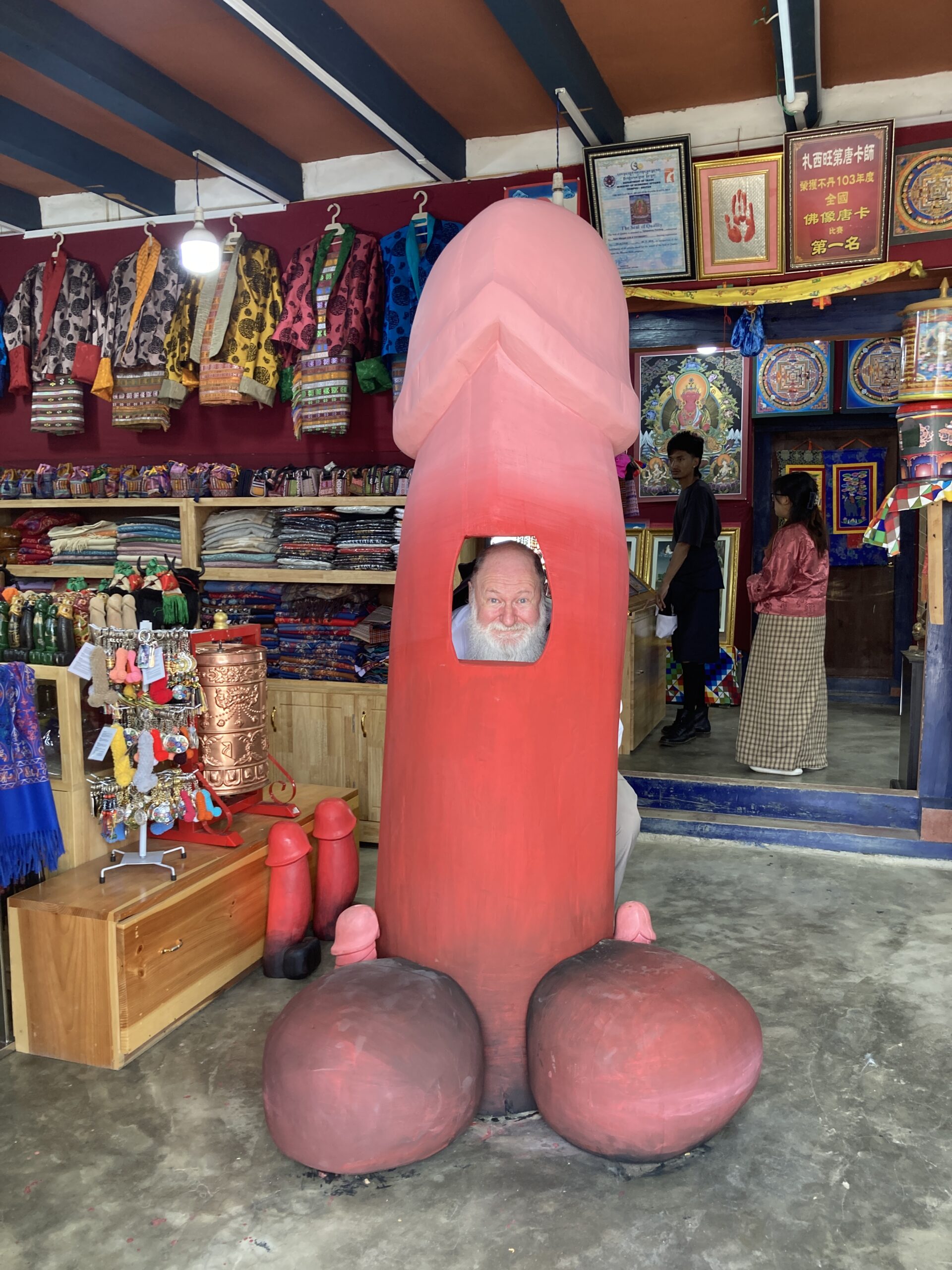
Phallus shop fun
Phallus shop fun

He used sex and alcohol and drugs and behaved in an outrageous manner to prove that the hierarchy and the establishment and all the ‘right way’ to do things were not necessary, if you had the right attitude inside. It seems clear he also found – in the pre-Buddhist Bon spirituality of this region, focussed around the phallus – a fascination with it that could not/would not/should not be dislodged, and so he  assimilated it.  Using his own phallus, shooting fire with it, he vanquished evil forces that were terrorising the traders trying to use the passes in and out of this valley: protecting the people.  He set up his Temple here, and gave teachings.  A couple having trouble getting a child to live beyond a few months brought their latest dead child to him, begging him for help.  He took the child and threw it across the river.  The parents were shocked, but then saw a demon leap out of the child’s dead body and run away, shouting over his shoulder that he would never trouble Lama Drukpa again.  
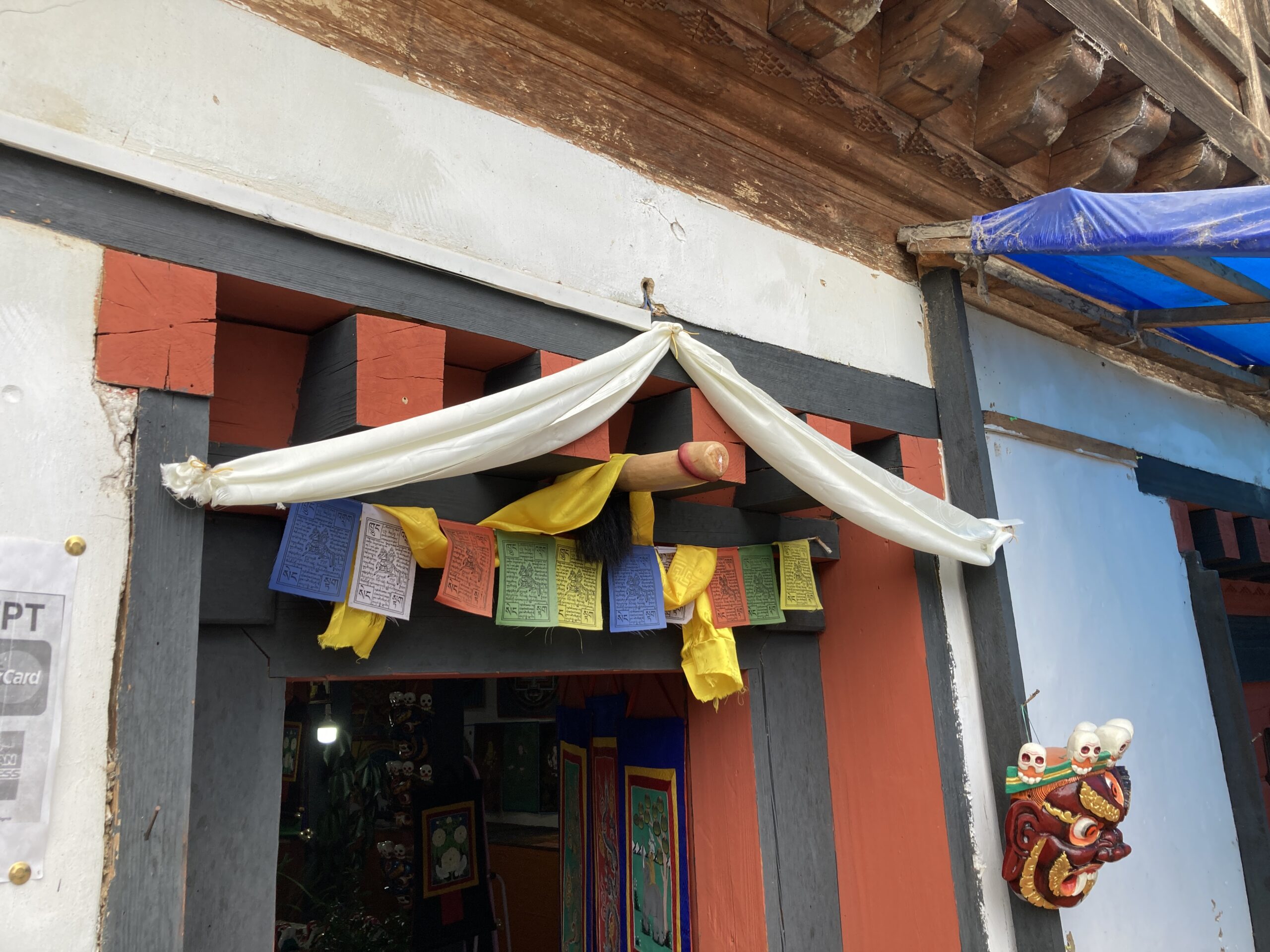
Phallus above the door

Ever since then Lama Drukpa and his Phallus have been associated with protection, and with fertility, and couples come from all over the world to circle around the giant wooden phallus in the Temple for aid with fertility.  Of course there is no photography in the temple, but I can tell you it was a big one, and very beautifully carved.   The monks inside give tourists little coloured threads to tie around wrist or neck, which you must wear for several days, to bring you fertility and good luck.  Descending once more from the Temple, back through the shops, I buy a nice ritual dagger – the three-sided blade with which the three great sins of delusion/ignorance; greed; and hate are vanquished, through wisdom, compassion, and power.  We return to the shop with the carver, and he presents me with the pair of wooden phalli, the freshly varnished one already dry in the sun.  Driving away I am very pleased to been able to visit here at last.
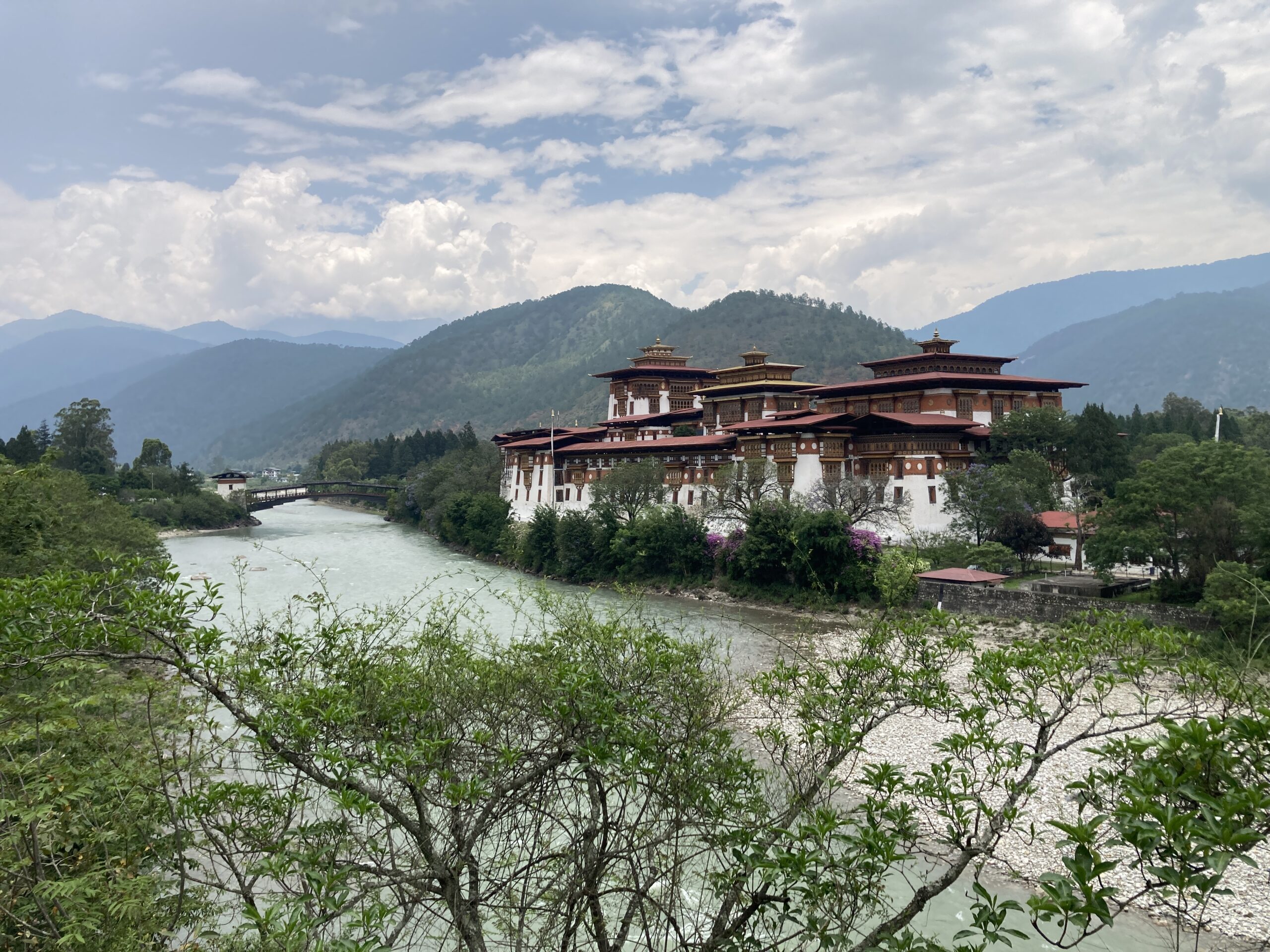
Punacka Dzong
Punakha Dzong

Our last big stop of the day is the Punakha Dzong, probably the finest and most famous Dzong in Bhutan.  It is breathtakingly beautiful.  Built – by Zhabdrung – in 1637 as a fortress (and maintained ever since) at the confluence of the Mother River and the Father River, the Mother-Father River flowing on from where they join, it is simply magnificent.  Today, as with the other Dzongs, it remains in dual use; part for the Government administration of this district, and part as a monastery.  As we are quite high up here, it is the Summer Palace of the Head of the Religion, with the Winter Palace at the much lower Thimphu Dzong.

Exhausted by now, in the heat, I am glad to return to the air-conditioned car, for the long drive (some two and half hours) up and over yet another pass, to my Hotel for this night, the Gangtey, overlooking the broad marshy valley that is the habitat of the black-necked crane, birds which I shall see in their sanctuary in the morning.  

4/6/26
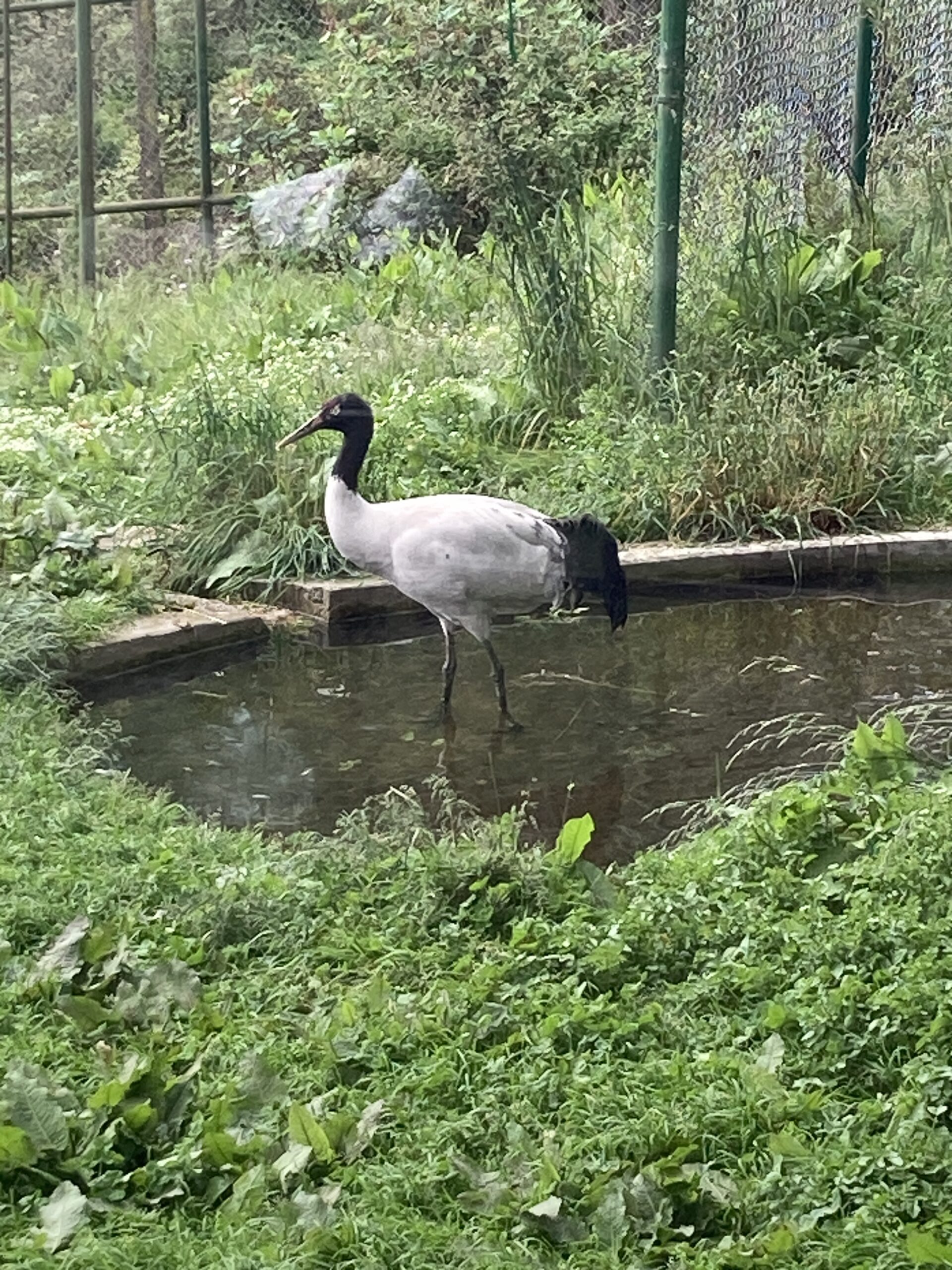
Black-necked Crane
Black-necked Crane

This centre for conservation effort takes pride in looking after two cranes wounded by predators – one a wild dog, the other a leopard – and enabling people to get up close to see them. There is a good deal of information and an excellent documentary in the centre, where I learn that one of the most important tasks of the centre is in educating the local farmers, who have become very successful in exporting their potato crops.  A balance between development and conservation is the mantra of this centre.

Lastly then, a visit to hilltop Gangtey Monastery, where the migratory cranes circle three times, each autumn, on their way down to the marshy valley bottom where they winter.  This is a peaceful and friendly farewell to this lovely country, before my 5hour drive, back over the Dochula Pass, where we have coffee, to Thimphu and at last to Paro, where I check-in for my last night before the journey back to Kathmandu in the morning.

5/6/26
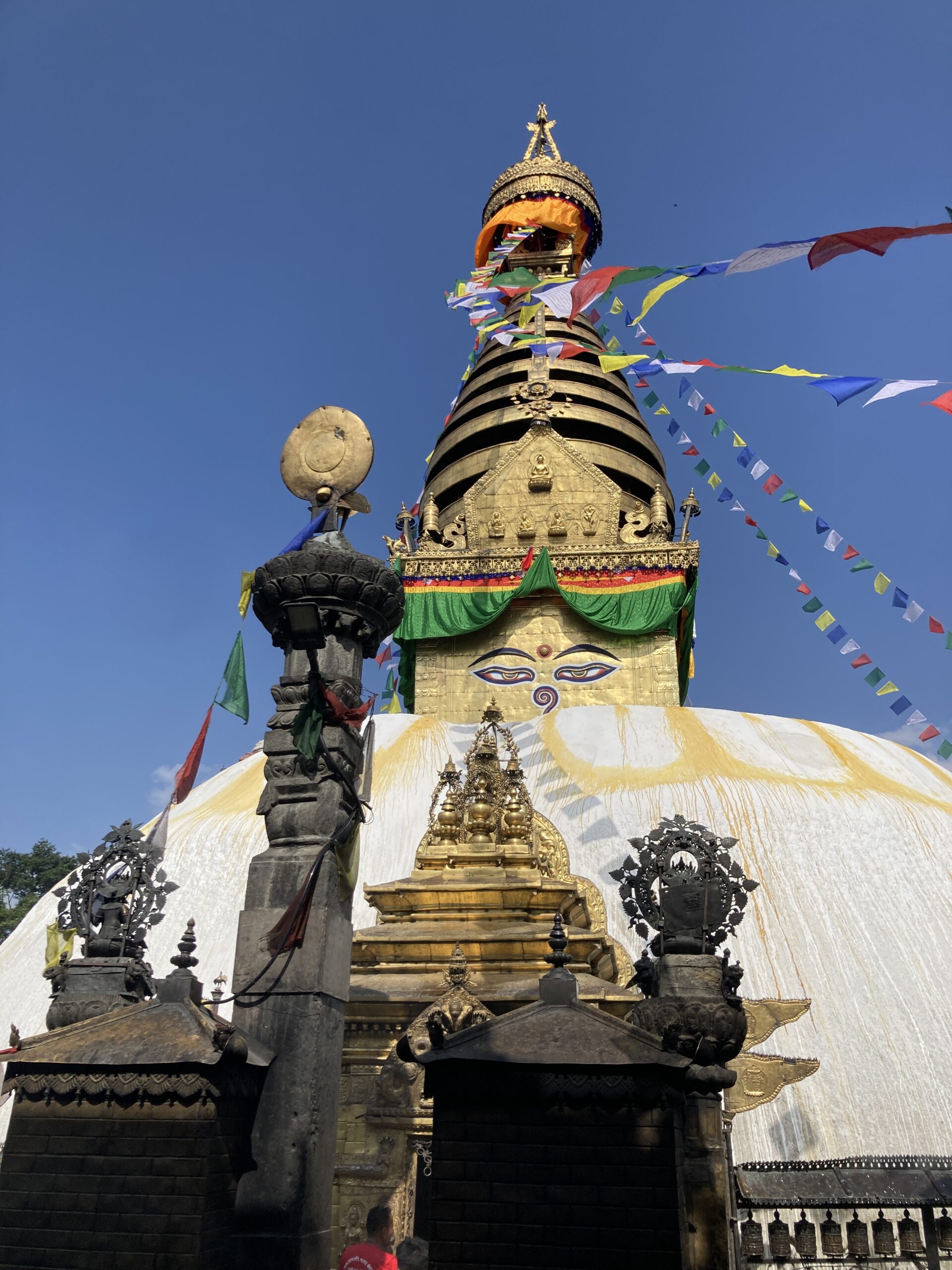
Swayambanath

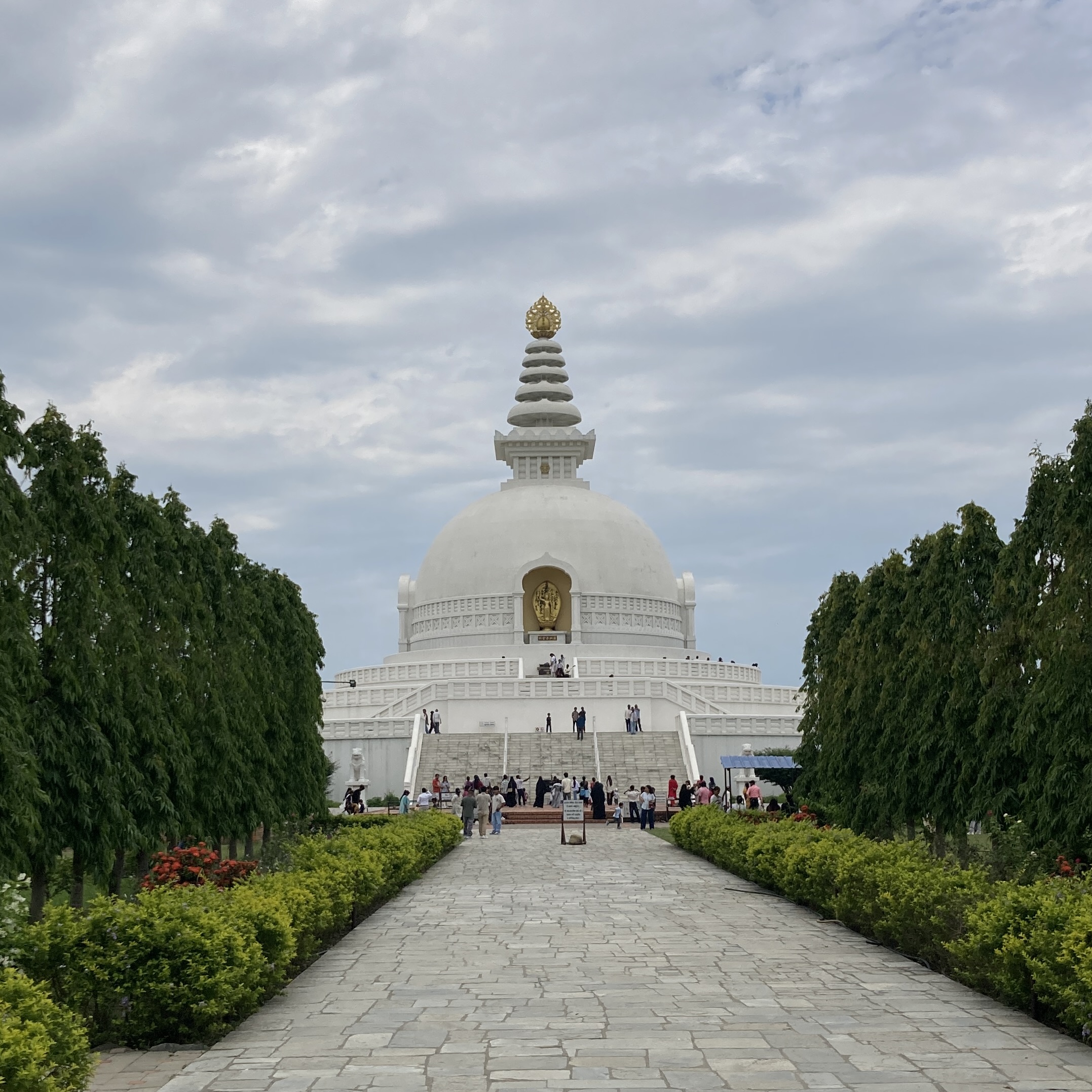
Finally, it remains for me to visit Swayambanath, on my last day in this trip – a Buddhist centre second only in importance to Boudhanath, here – and to take in the breathtaking splendour of this Stupa and Temple.
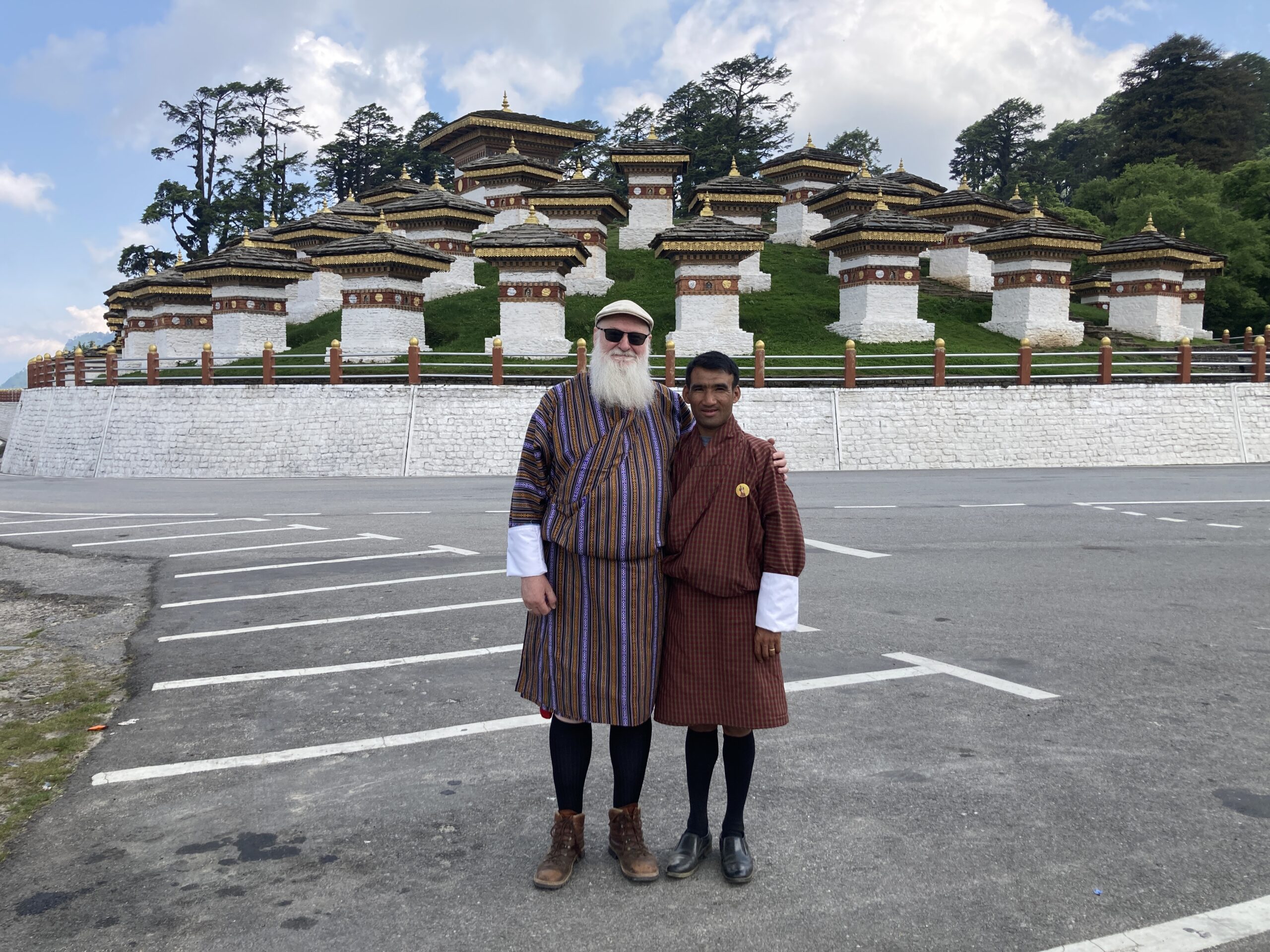
With Doji my driver, Dochula Pass

But before I finish this blog, I must put in a good word for 3rd Rock Adventures, my tour operator. Naba, with whom I have been in very regular contact, first organising the tour, and then during it, and all his guides and drivers, have been attentive, knowledgeable, friendly, helpful, on-time, informative – I could go on but really, I couldn’t have asked for better and couldn’t recommend them more highly if you are considering a trip to this part of world. I did converse with one or two others, back in February, but even then Naba stood out as someone whom I could do business with, someone I could trust. It was a great holiday, and I am grateful.

In summary, I think I have seen and experienced as much as I am able and keen to of Bhutan, but that I would come back to Nepal again. There is Pokhara (Nepal’s 2nd city) and Chitwan National Park, which I did not have time to visit on this occasion, and I would welcome the opportunity to visit Pashupatinath again – probably my favourite place of this entire trip, if I had to choose – and to stay again at the wonderful Barahi Hotel, which did much to make my stay in Kathmandu so comfortable.
Nepal-Bhutan May 2026 #4

Post #1 | Post #2 | Post #3 | Post #4 | Post #5

30-31/5/26

Mountain view from the aircraft

For the weekend I have been on an excursion out of Kathmandu, to see a little more of Nepal while I am here. Having visited Namobuddha and Kopan Monasteries, Bouddhanath Stupa and the Triten Norbutse Bonpo Monastery, it seems only fitting that I take the short flight to the south west to visit Lumbini, the birth-place of Siddharta Gautama Buddha, and the ruins of Tilurakot, the palace where he lived until his 29th year.

Domestic flights in Nepal are notorious for being delayed, and my 9.15am flight doesn’t actually take off until 11.45am, in the end.  There is little in the way of information, but everyone seems sanguine about it all, and I take their cue; I am not, after all, in any hurry, and my tour operator is very attentive, in regular contact, and arranges my tour guide for Lumbini to collect me based upon my notification that I am actually on the plane!

The guide’s driver meets me at Bairahawa’s Gautama Buddha Airport, after a wonderful short 35minute flight over the foothills of the mountains arcing over some of the many great rivers that flow down off the peaks onto the plain – with a glimpse of the Himalaya in the distance!  The heat down here is a good 3-5’ hotter than in Kathmandu, and I am grateful to get into the air-conditioned Leapmotor EV that whisks me away from the airport.  As everywhere else in Nepal, these past few days, I sit in the air-conditioned EV surrounded by mopeds, overtaking huge 1970s trucks and little tuk-tuks, everywhere we go.  Every now and then, a BYD or Tata EV swoops by on the other side of the road.  Apparently the tax on a new car is over 100% – to pay for road development no doubt – which is why so many opt for a scooter, moped or motorbike.  Many of these are also electric.  China’s presence here is palpable; Kathmandu from the air glitters with all the solar panels on the roofs.  At the end of the short drive to Lumbini Park I am met by my guide, Suroj, who will tell me about the places I am to visit here, and escort me around them.  Lumbini Park is an enormous and global project, overseen by UNESCO and the Nepalese Government.  The project began in 1972, and reached an agreed Master Plan in 1978.  The building of the park continues, with only some of the planned buildings complete, many still under construction, large areas as yet untouched.  It is far too large to see it all in one visit, but Suroj has curated a representative sample of what there is to enjoy here, and we take the car between each place.  

Japanese Peace Pagoda

Our first visit at Lumbini is to the huge Peace Pagoda built by Japan – finished in the year 2000.  All the signage is in Japanese, some also in Nepali, occasionally in English. It is a brilliant white, and very shiny in the 32’ heat.  I take my wide-brimmed sun hat from my bag and place it on my head.  I hate it as a hat, but it is very practical and quite necessary!  I also apply sun-block – frequently – while we are at the park.  My guide tells me about the four stages of the Buddha’s life – birth, meditation, enlightenment, and death – represented on the four sides of the pagoda.  He points out the great long vista from the Pagoda across the park to a small white building in the distance – where the spot where the Buddha was born can be seen.  I am glad we won’t be walking there!

Thai Royal Palace

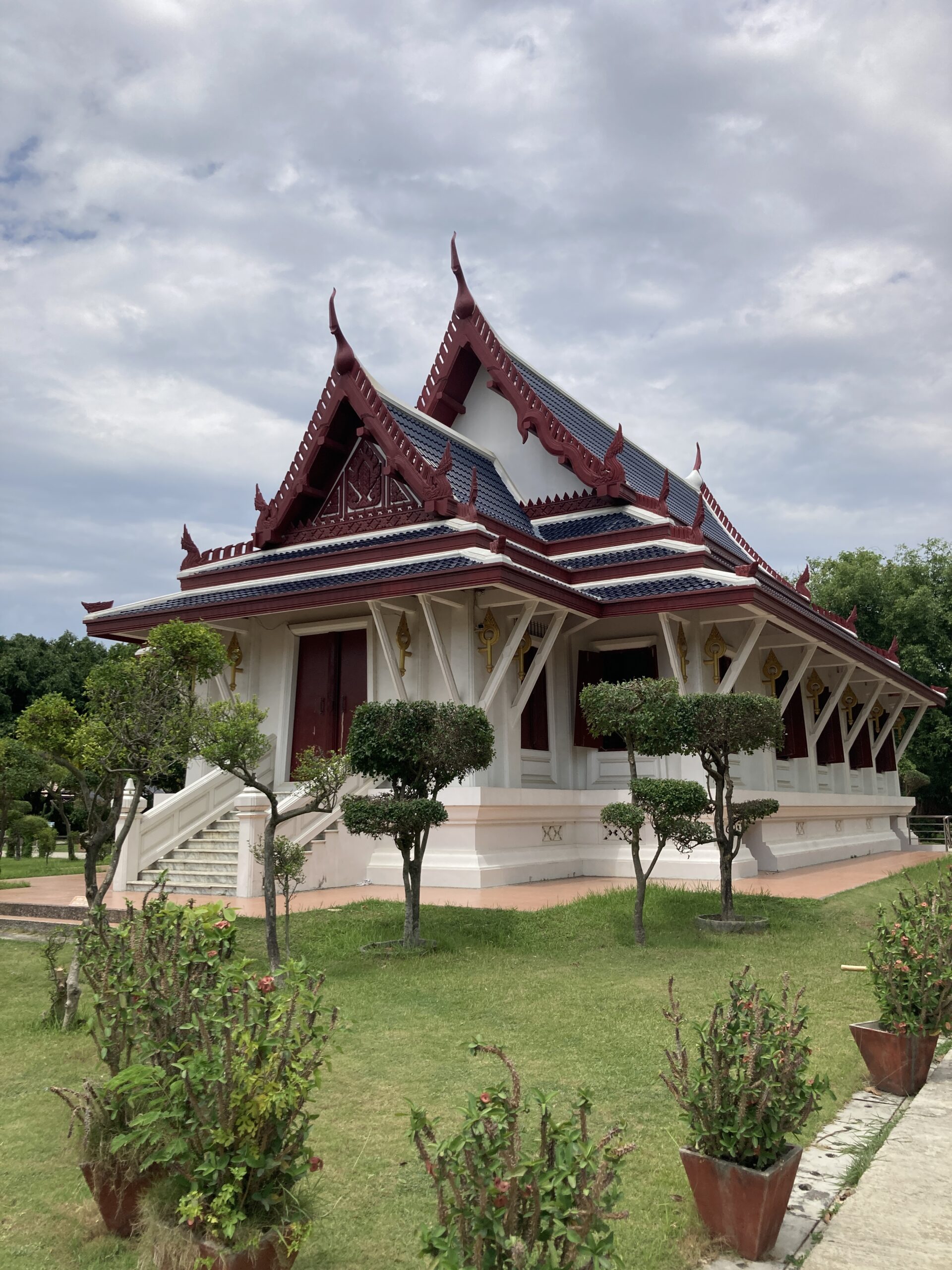
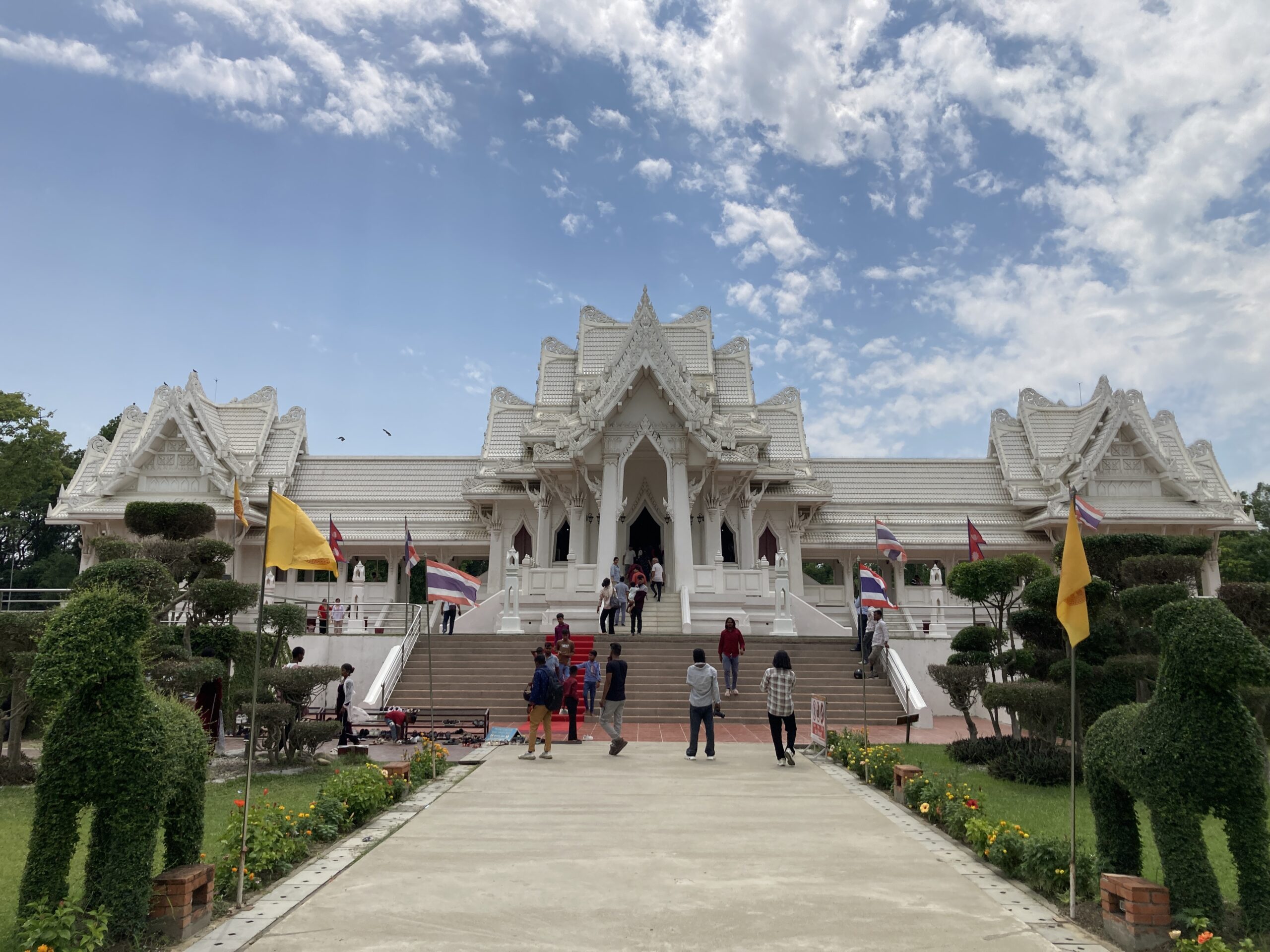
Glad to be back in the air-conditioned Leapmotor again, even if only for 5mins, we drive to our next visit in the park: the Thai Royal Temple, built by Thailand.  Suroj explains that the Thais are very active in Buddhism, graduating 1000 monks a year, and collecting and distributing large sums for the relief of the poor in many countries: Buddhist Relief.  The royal palace reminds me of some of the Temples I visited in Bangkok, and behind it, still under construction, a new building with echoes of the architecture of the ancient temples at Ayutthaya that I visited on a day-trip from Bangkok.  I tell Suroj about them and he knows of Ayutthaya and agrees that yes this new building is more like those ancient temples. 

Thai Monastery
Cambodian Naga
Cambodian Monastery

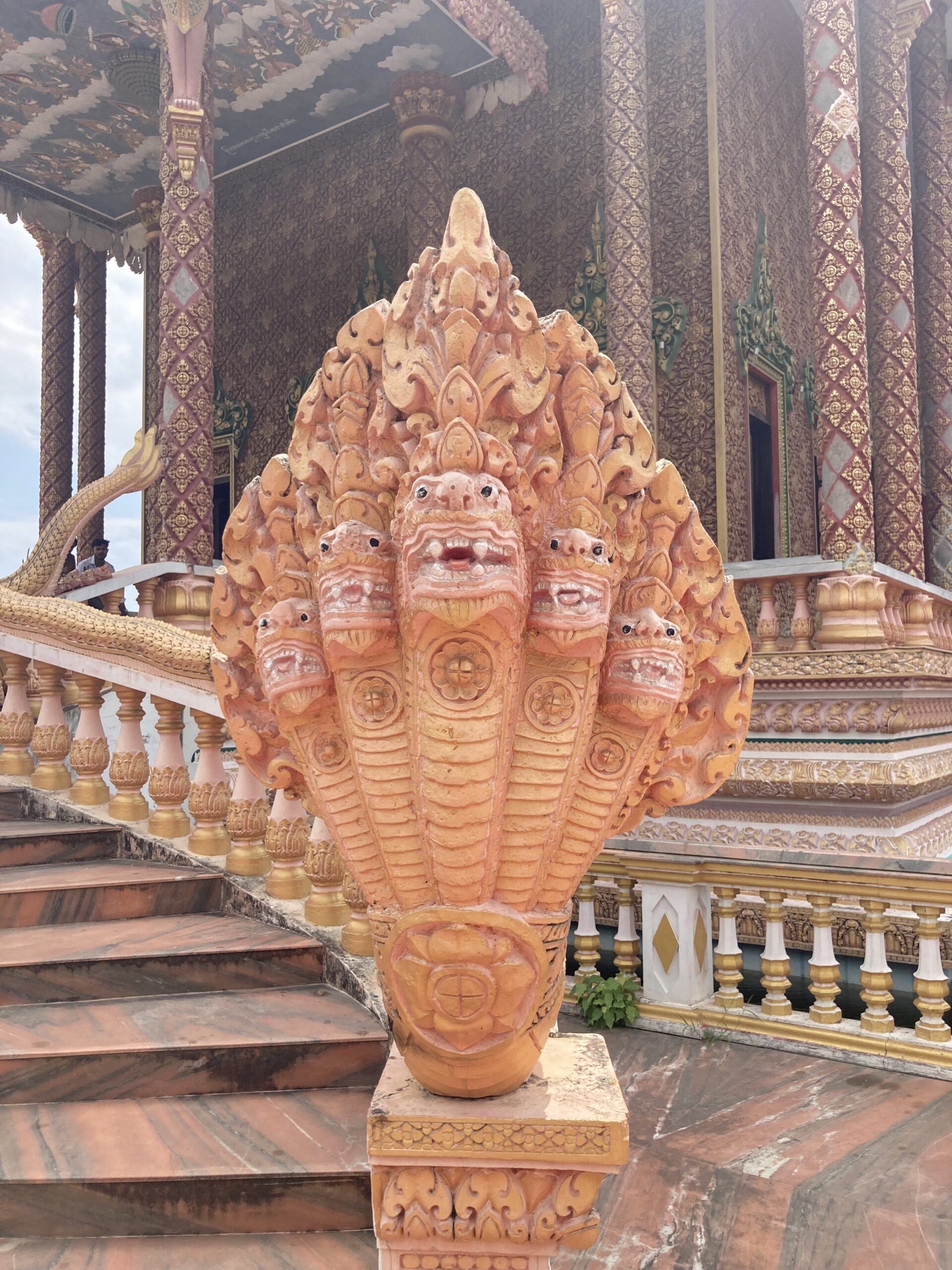
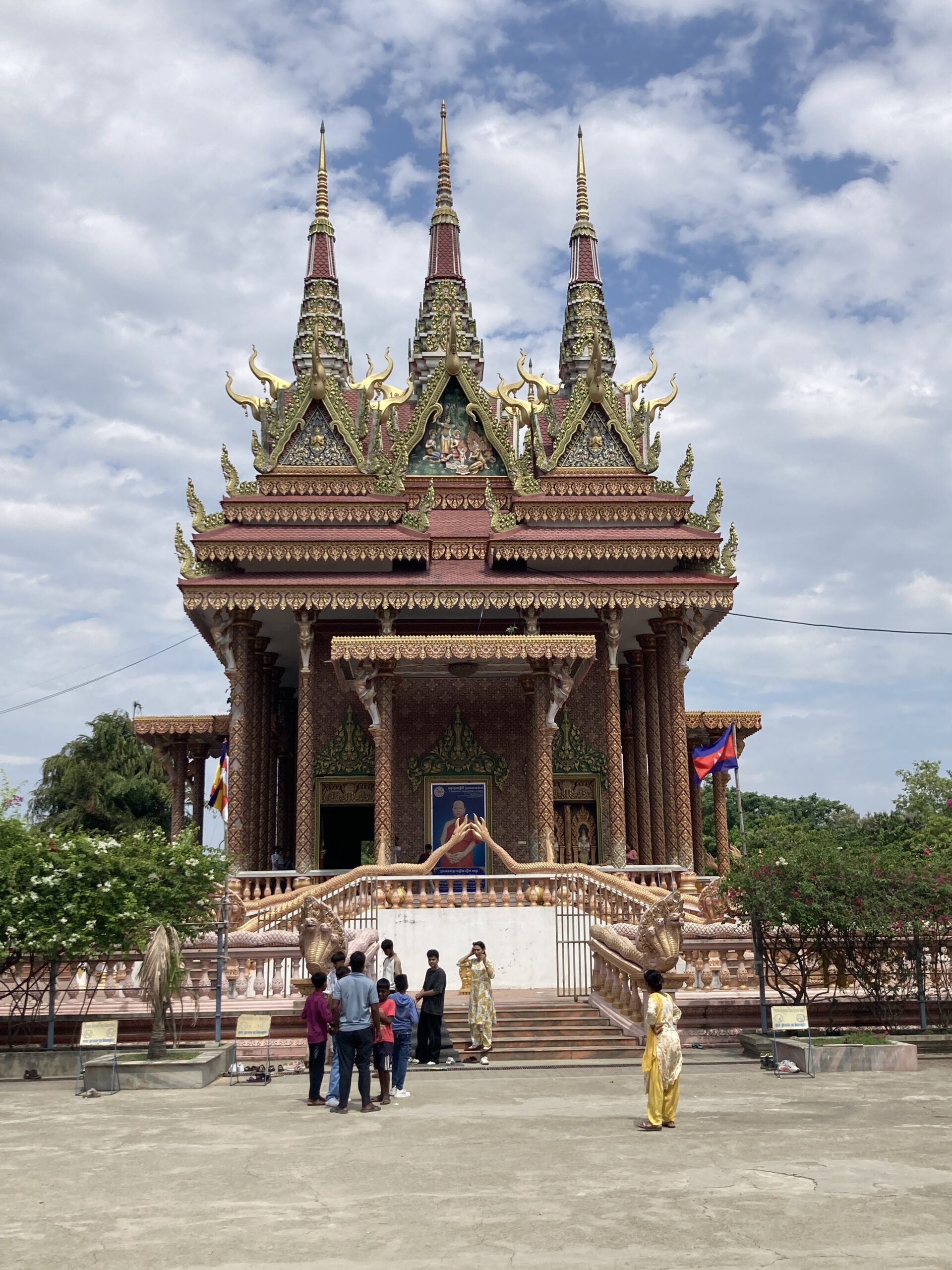
After another welcome few minutes in the air-conditioned car, our third visit is to the Cambodian Monastery.  Here the echoes are of Angkor Wat, as far as I can tell from photos I have seen.  [Note to self – Bucket list must include Angkor Wat, both for its Hindu and Buddhist temples!!].  The Cambodians have excelled themselves here with a truly amazing building, surrounded by Naga. 


Lastly – after another 5mins in the air-conditioned car – we arrive at the carpark from where we can take the walk along the great approach to the Birthplace itself.  There are many pilgrims – Japanese, Chinese, and Korean faces amongst the browner faces of India, Nepal, Cambodia, Thailand….. and I realise I stand out as one of the very, very few white faces.  Apparently Western tourists only really come to Nepal between September and February, because of the weather.  I tell my guide that I was here for work, and could not choose.  Besides, I think to myself, it is quite nice to be here when it is relatively quiet, by comparison.  I have met two other UK tourists, whilst here, this week.  

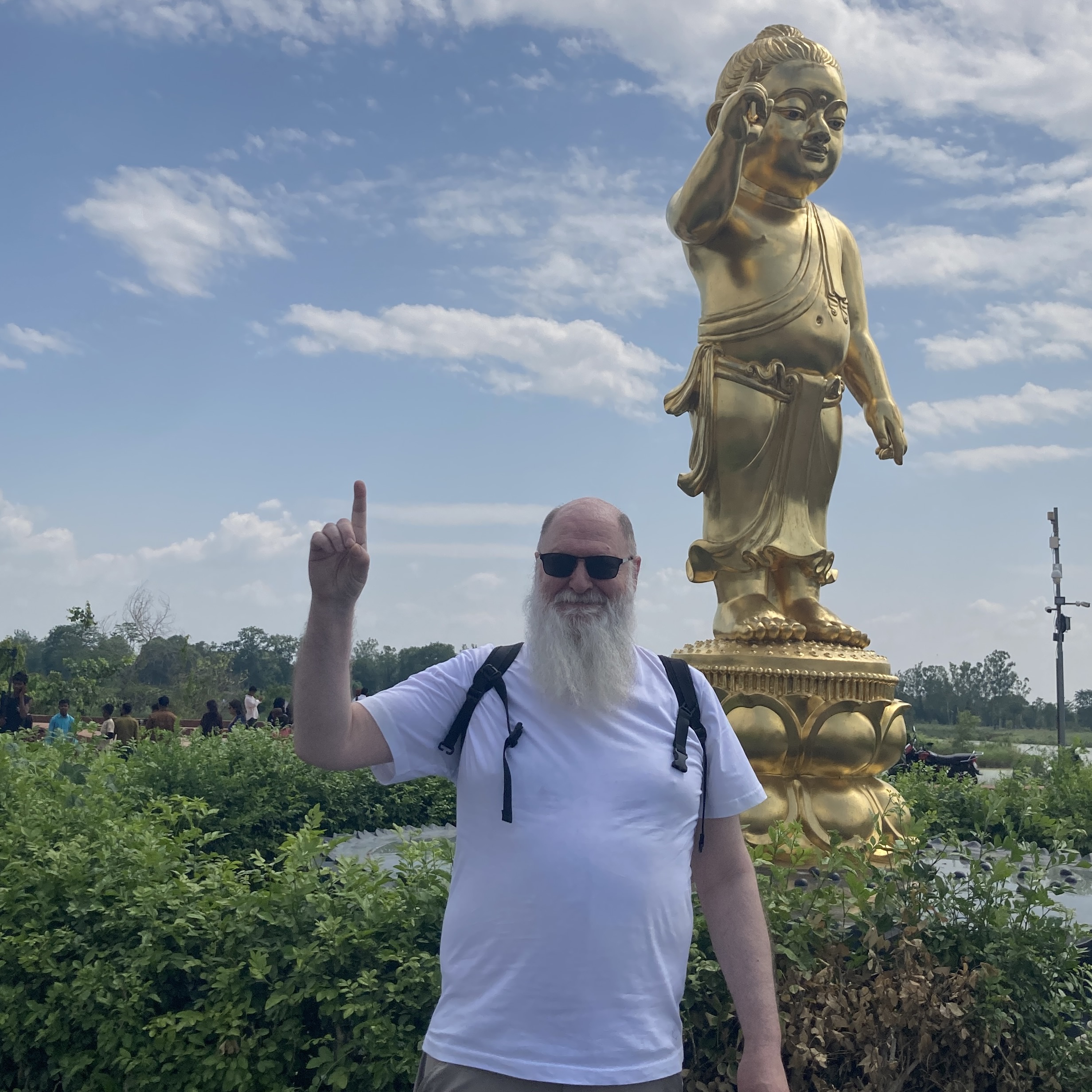
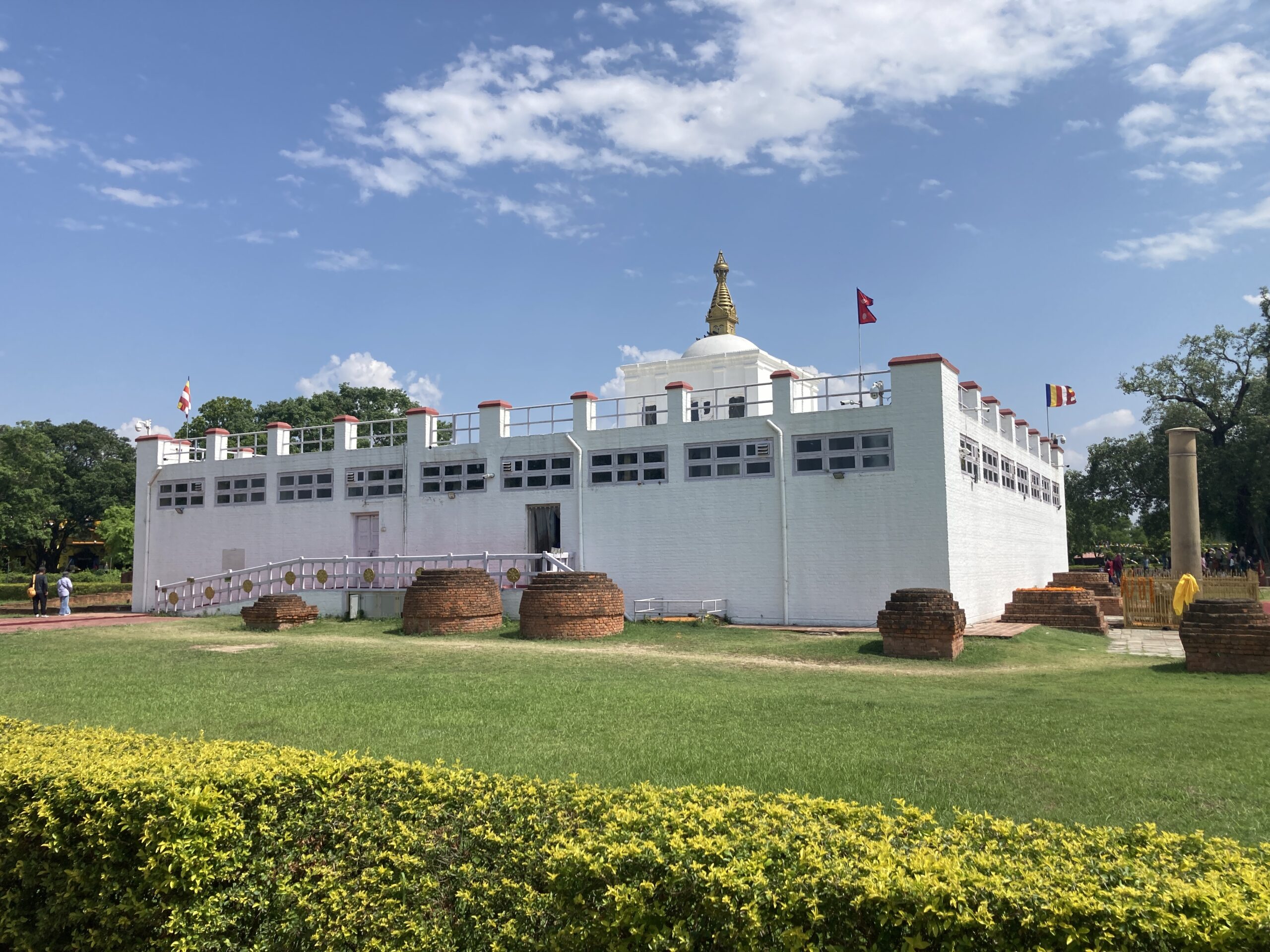
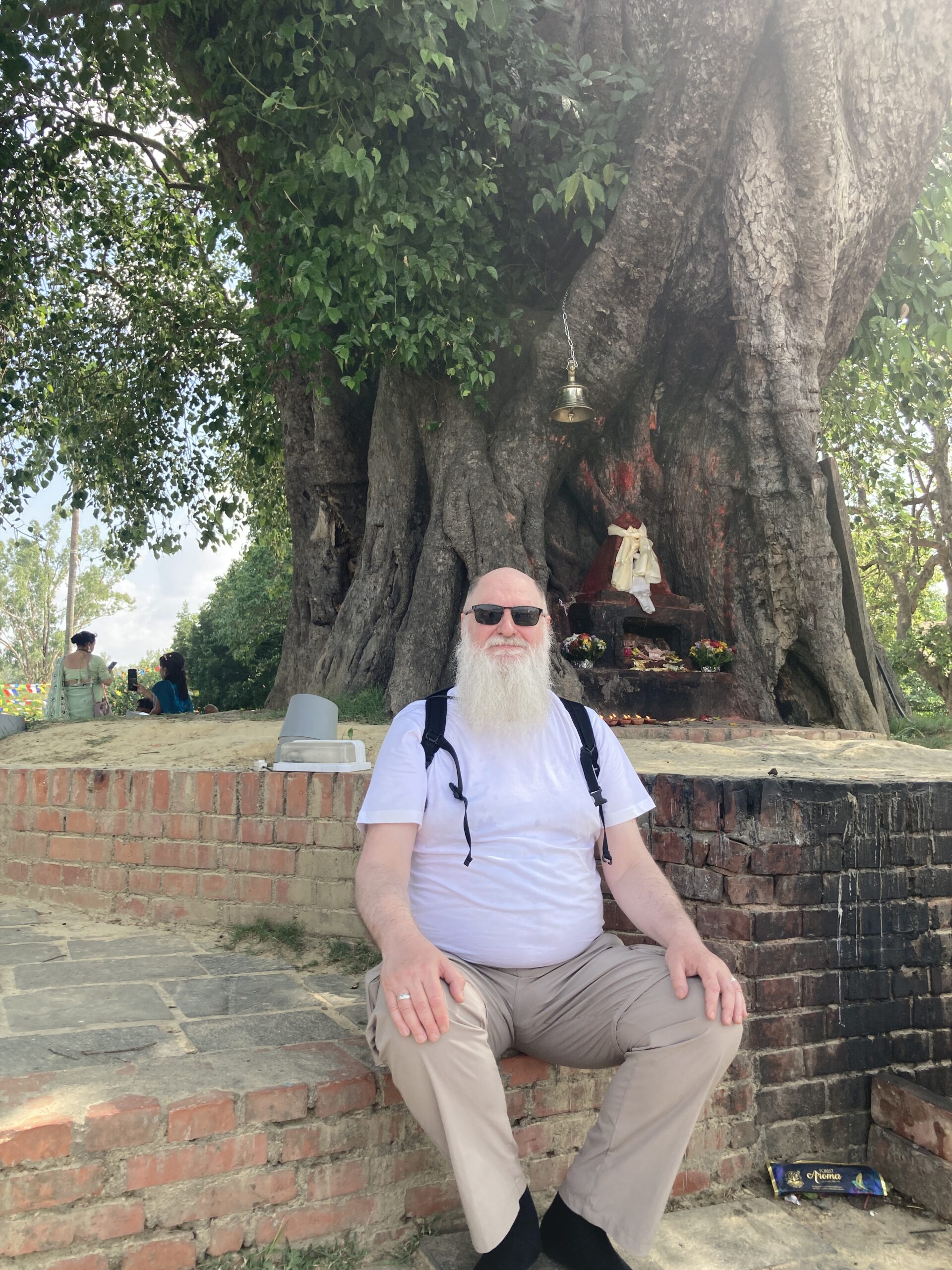
The long walk includes a lovely statue of the baby Buddha, right hand raised and finger pointing to the sky.  It is said that he took seven steps when he was born, pointing the way, announcing that this would be his last incarnation.  At last we arrive at the little white building that encloses the spot where he was born.  We sit under one of the great bodhi trees here for Suroj to tell me the story.  There were two kingdoms, here in this part of what is now Nepal, back in the 7th century BCE.  And the King of one of the Kingdoms, and the Queen of the other, decided to marry, so that they could unite their kingdoms into one.  They waited long, but at last the Queen fell pregnant.  It was the custom for a birth to take place at the home town of the mother, so the Queen set out from the King’s capital, where they lived, to her own.  But the King was afraid for his pregnant wife and would not let her travel on a donkey or an elephant, insisting in a litter. This proved to be slow going, and before she had got much more than half way home, she suddenly realised she had gone into labour and would give birth here, at the tiny village of Lumbini.  Standing under a bodhi tree, holding one of the branches, she gave birth standing up; and the buddha made 7 steps and held his hand aloft.

Birthplace of Siddharta

All around the white building are the low brick remains of temple buildings from the 2nd century CE.  In front of it stands the pillar erected by Emperor Ashoka in the 2nd century BCE.  We pass, then, through the door into the modern white building.  Inside no photography is allowed.  It is an open plan building, covering more of the 2nd century CE ruins.  In the centre, a wooden walkway surrounds a plinth.  We file slowly behind the crowds, each person taking the opportunity to briefly look over the banister of the walkway, down into the centre of the hollow plinth.  There – under glass – and surrounded by ancient brick walls, is the Marker Stone – a horizontal slab of stone marking the very spot where the Buddha was born.    I bow and touch the banister with my forehead, muttering Om Mane Padme Hom. We walk around the banister where there is a second view from the other side.  The crowds are gradually thinning, short well dressed Indian ladies bustling with their children.  Suroj speaks to a guard and we are allowed past a tape barrier to sit with our backs to the wall of the building, a few feet from where a monk is quietly meditating.

Sitting beneath the Bodhi Tree

 We sit for some 10-15minutes, silent, meditating ourselves, drinking in the calm and peace of this sacred spot, that has been venerated continuously for two and half thousand years.  Unfortunately – as at Pashupati – my back simply isn’t up to sitting cross-legged (even with the wall behind me) for very long, and we rise, leave the modern white building, and go to sit at one of the benches around the trunk of a bodhi tree for a while, to watch the local monks filing through the white building, to come and gather under another of the trees and begin to chant together.  It has been a special visit.

Suroj and my driver then take me back to Bariahawa to my hotel – the Landmark – where I am treated to a lovely Thali, (though I cannot say much for the wine, I’m afraid … never mind!). In the morning, at 9am, I am collected once more and this time the drive is somewhat longer – a good 75mins or so – out into very rural southern Nepal. 

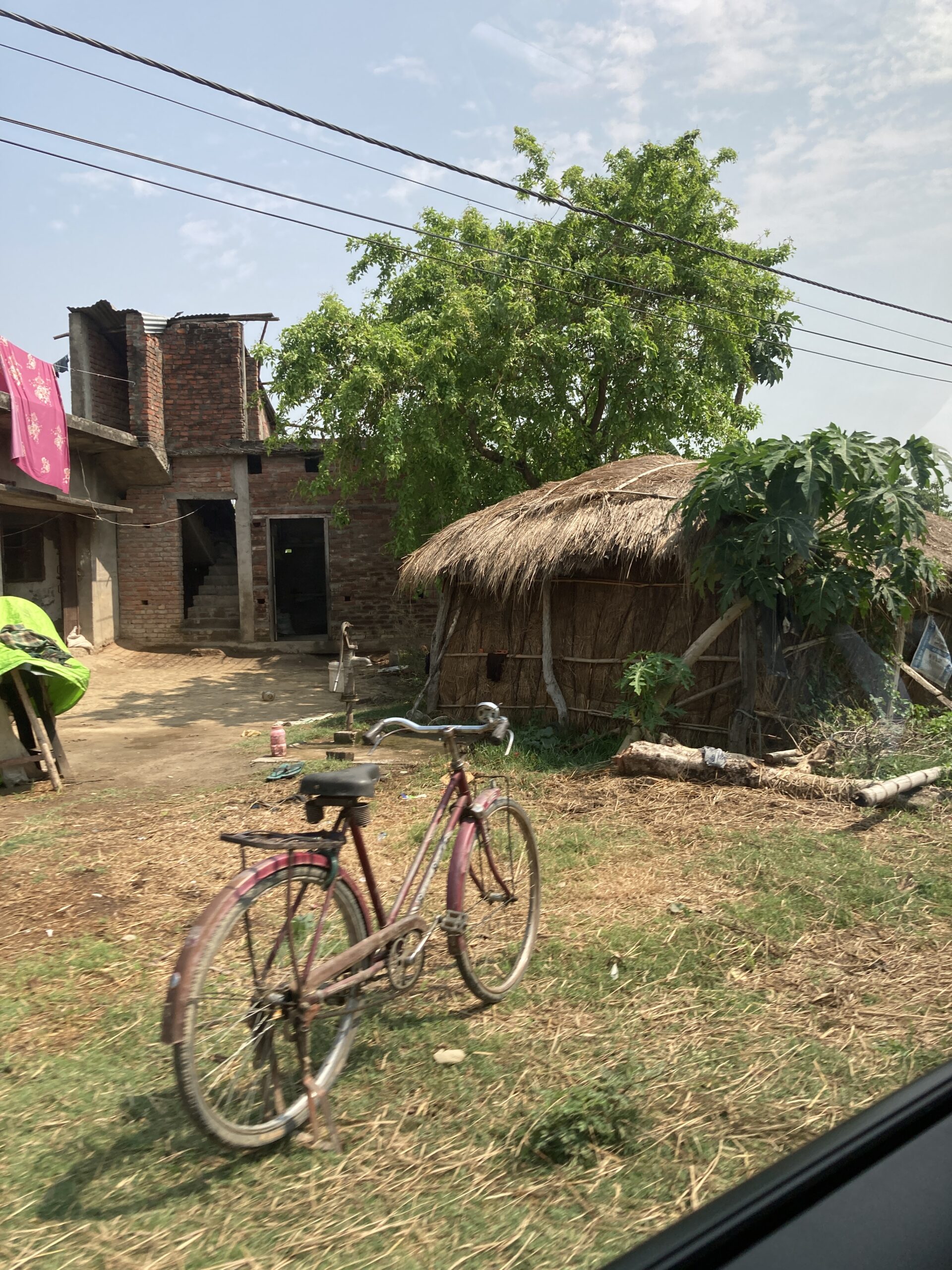
Nepali poverty

Here the poverty of this poor country is much more obvious; some of the ‘buildings’ (if they can be described as such) are not even of brick, but circular and seemingly made of straw.   Everyone I have met here has a phone – gateway to the world of today – but I guess the people living in these places may not – or perhaps a family shares one, as I have heard is not uncommon now.


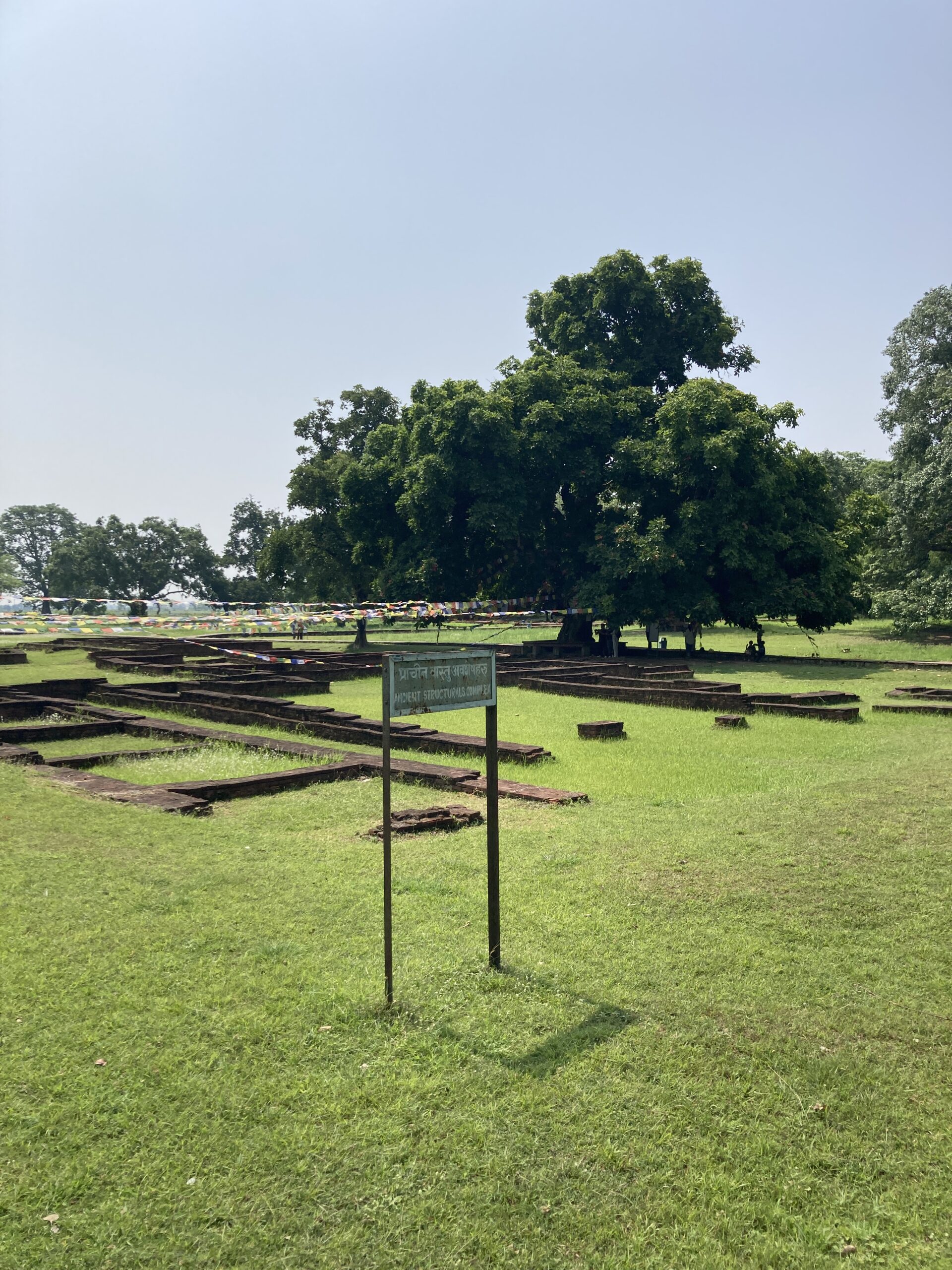
Ruins at Tilurakot

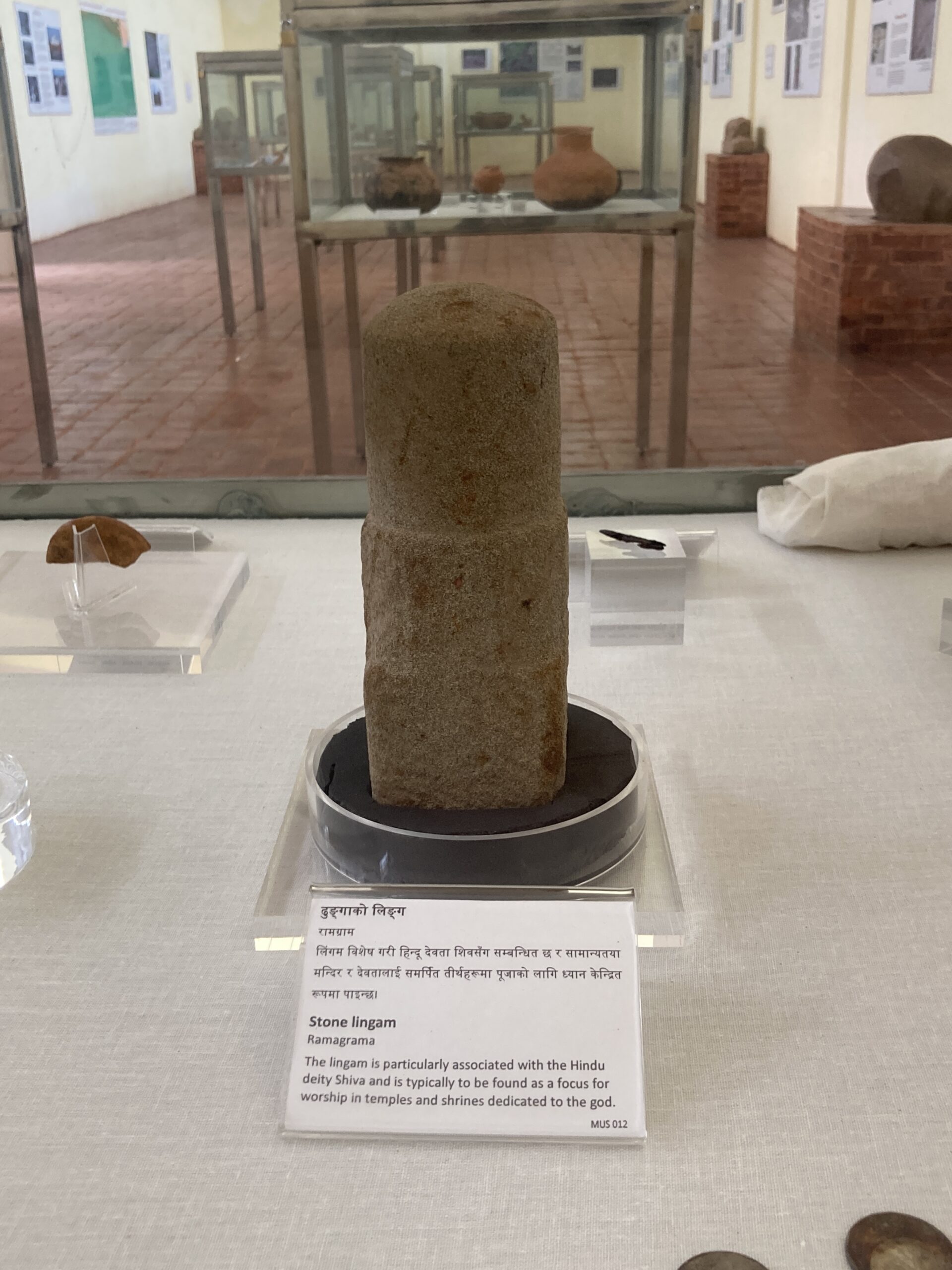
But the drive takes us, at last, to Tilurakot – the archaeological site and associated ruins of the palace where Prince Siddhartha grew up in the luxury of a royal household, got married, had a son, but – throughout this time – was somehow never satisfied.  His mother had died 7 days after his birth, Suroj tells me, and indeed his wife died 7 days after the birth of their son, Rahul.  Always Siddharta spent time in meditation, trying to find wisdom.  Then, one day, he escaped from the sheltered life in the palace grounds which was all that he had known, and discovered the poverty, suffering and sadness of the real world outside the palace.    He determined to find a solution, and began six years of searching, which would take him south, deep into India, and, at last, to Bodh Gaya, where he found Enlightenment, under a bodhi tree.After touring the ruins, we also visit the little museum here, where some of the artefacts found by archaeologists are on display, along with lots of interpretive information boards and photographs.  It is an excellent little museum with some fine pieces, including a very ancient stone lingam.

Ancient Stone Lingam in the Tilurakot Museum

Next ->

Nepal-Bhutan May 2026 #3

Post #1 | Post #2 | Post #3 | Post #4 | Post #5

29/5/26
Today is a more peaceful – and shorter – day of sightseeing, than yesterday.

Kopan Gompa
Kopan Gompa

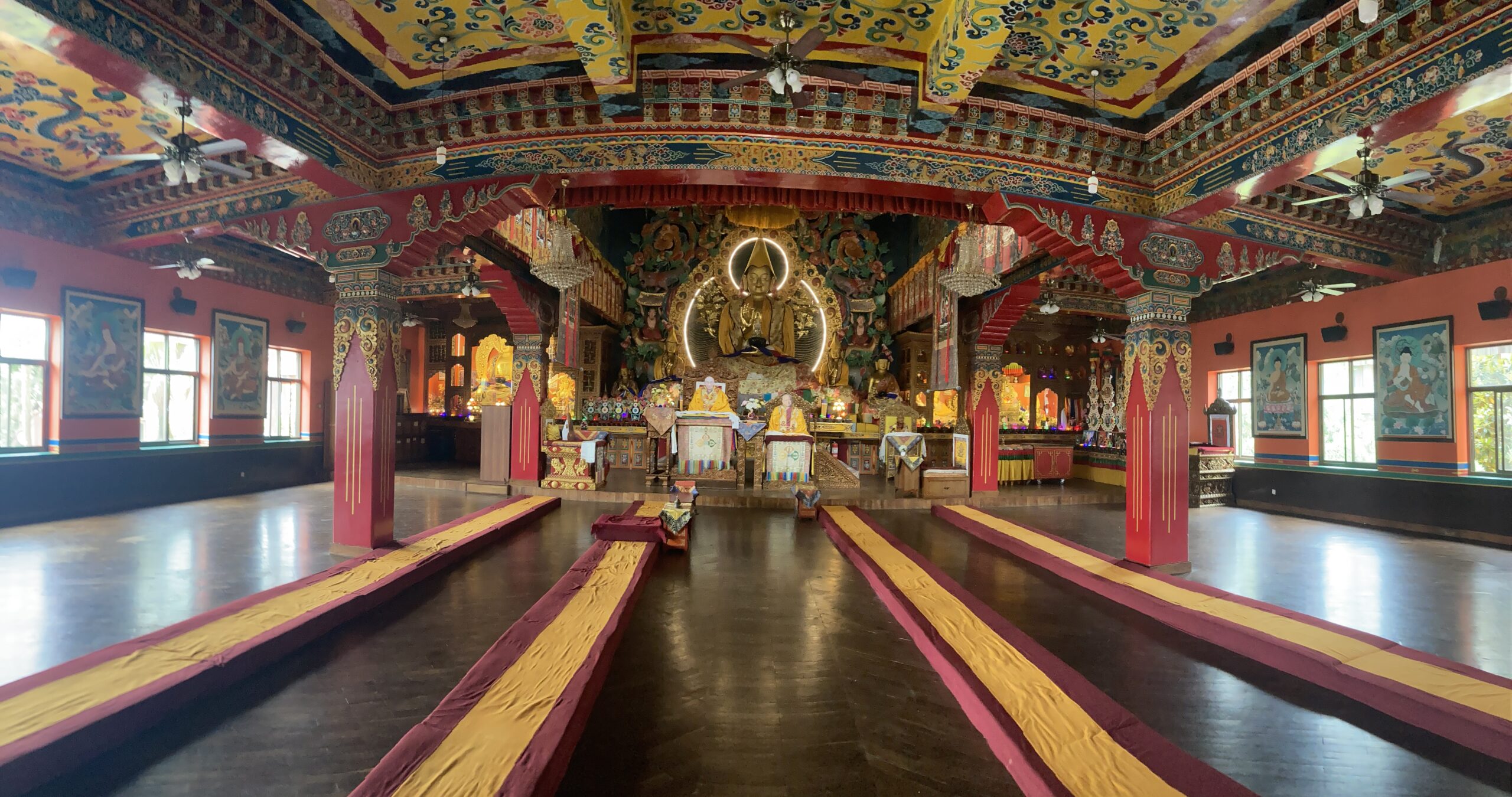
We begin at Kopan Gompa (Monastery), home of Mahayana Buddhism in Kathmandu, where I find, in the library, a little bookshop, and – amongst one or two other finds – buy a copy of Hermann Hesse’s Siddharta, a book which I read in the early 1980s, and which it would be good to read again.  In novel form it tells the story of the Buddha’s life, which is the centre of all the various forms of Buddhism.  The main shrine is beautiful- like that at Namobuddha – but somehow the Dalai Lama seems more prominent here. Tibetan Buddhism is a form of Mahayana and very strong here.   Mahayana Buddhism includes many boddhisatvas along with the teachings of the Buddhas, and their own many and varied guides to the Way. Very strong here at Kopan is the Boddhisatva Avalokiteshvara, whose specialisation is compassion.

At the Sleeping Vishnu

We then go to the Sleeping Vishnu – the Buddhanilthankah Temple.  This 7th century carving from a single slab of basalt rock is sacred to the Buddhists, too, as an emanation of Avolkiteshvara.  Completing a trinity of sanctity, this statue is also regarded by the Shaivites as the emanation of Shiva known as Nilakanta Shiva.  Young boys trained at the Temple monastery preside here, chanting, and placing tika on foreheads and garlands of flowers around necks.  I am very touched by the whole experience, despite the long queue!  The chanting here is quite mesmerising, and learning it from my guide, I repeat the mantra as I pay homage to the shrine.

Lama at Triten Norbutse Bonpo Monastery

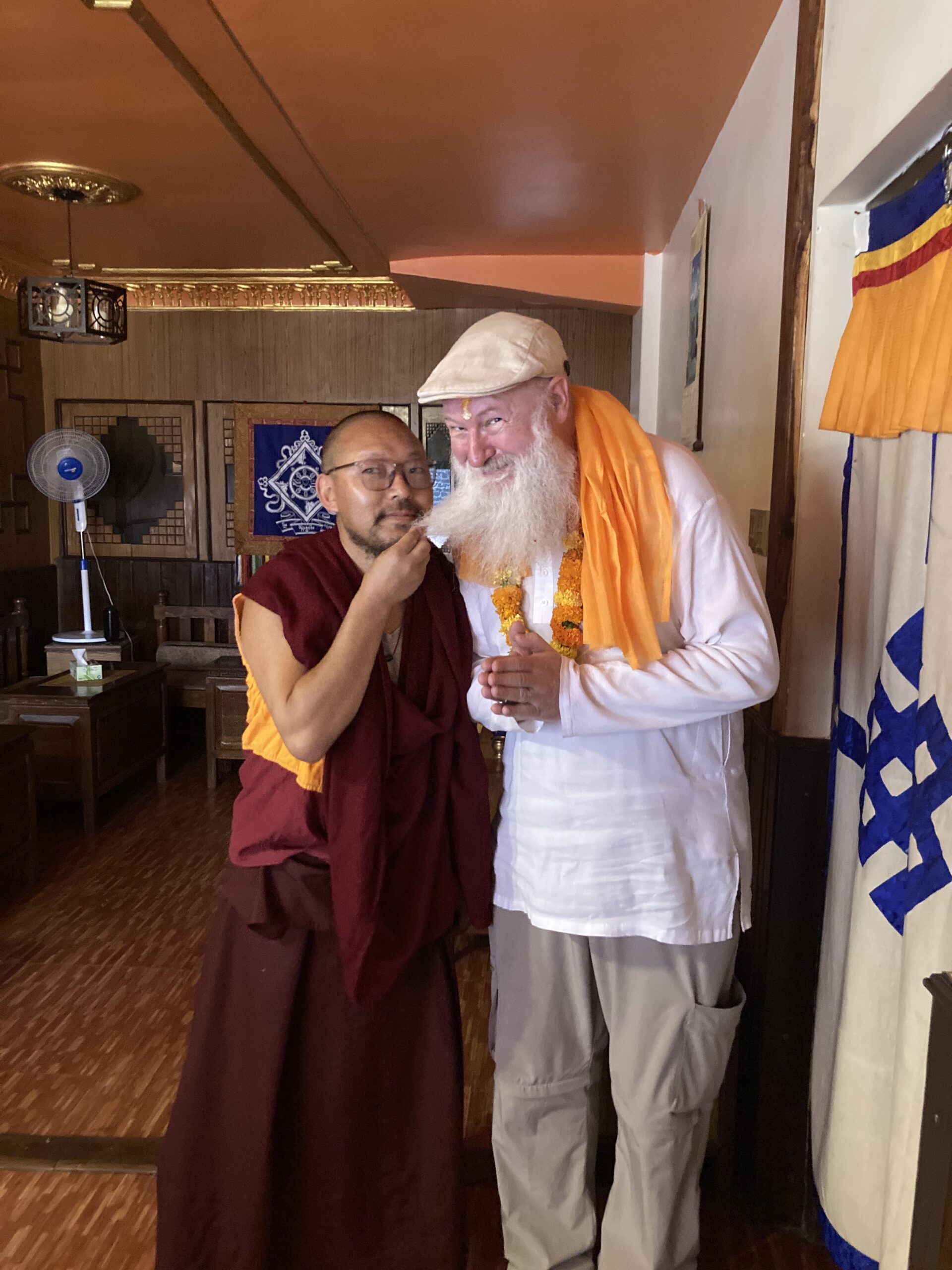
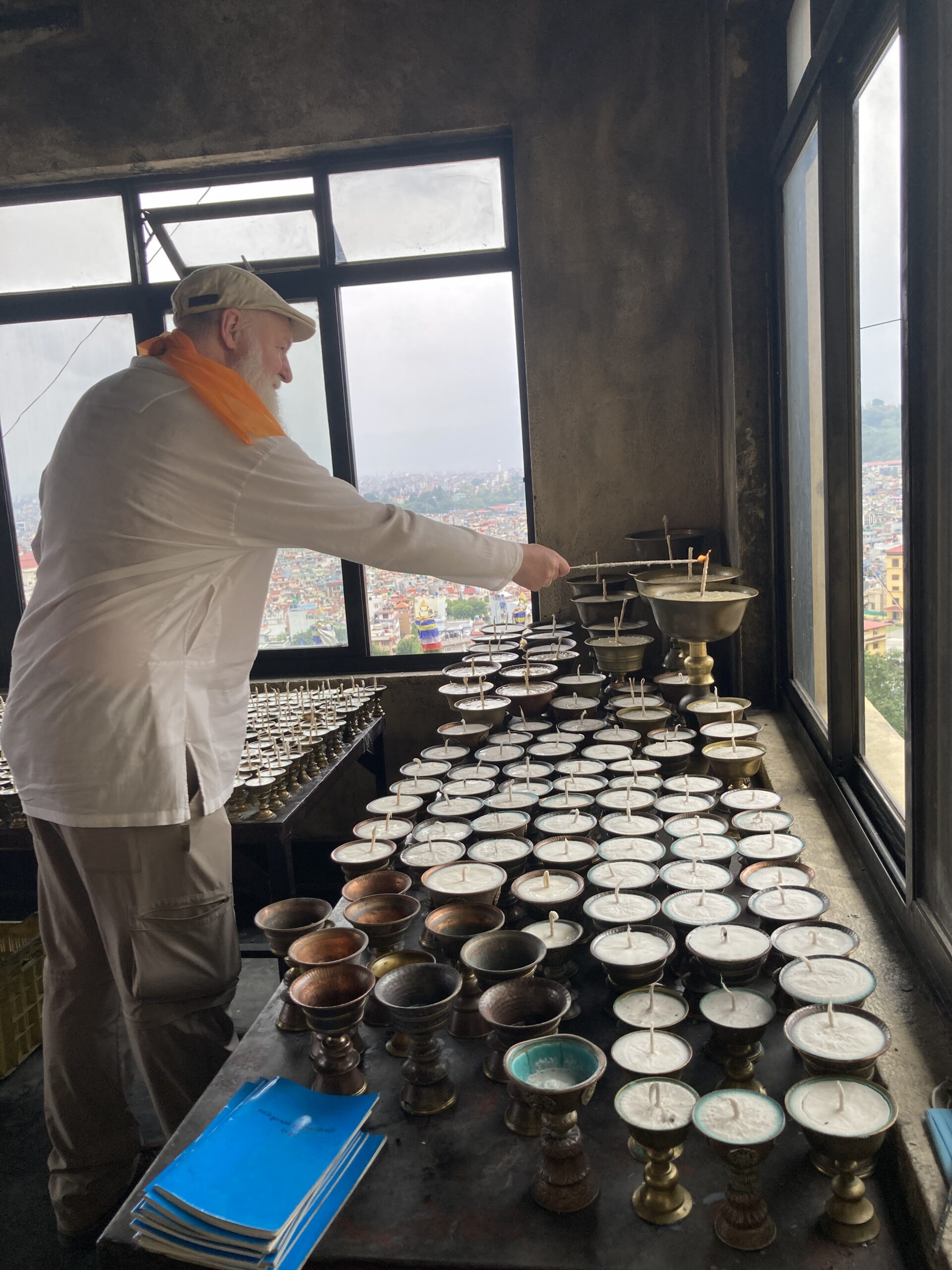
Thirdly we climb up into the hills again for our second Buddhist Temple of the day, this time the Triten Norbutse Bonpo Monastery.  Bonpo is one of the lesser known schools of Buddhism, with its stronghold in the West of Nepal, rather than in Kathmandu, but there are 280 monks here, and I met a lama – who liked my beard – and invited me to light a large butter candle, saying a prayer for my loved ones, before going in to see the main the temple.

Lighting a butter candle
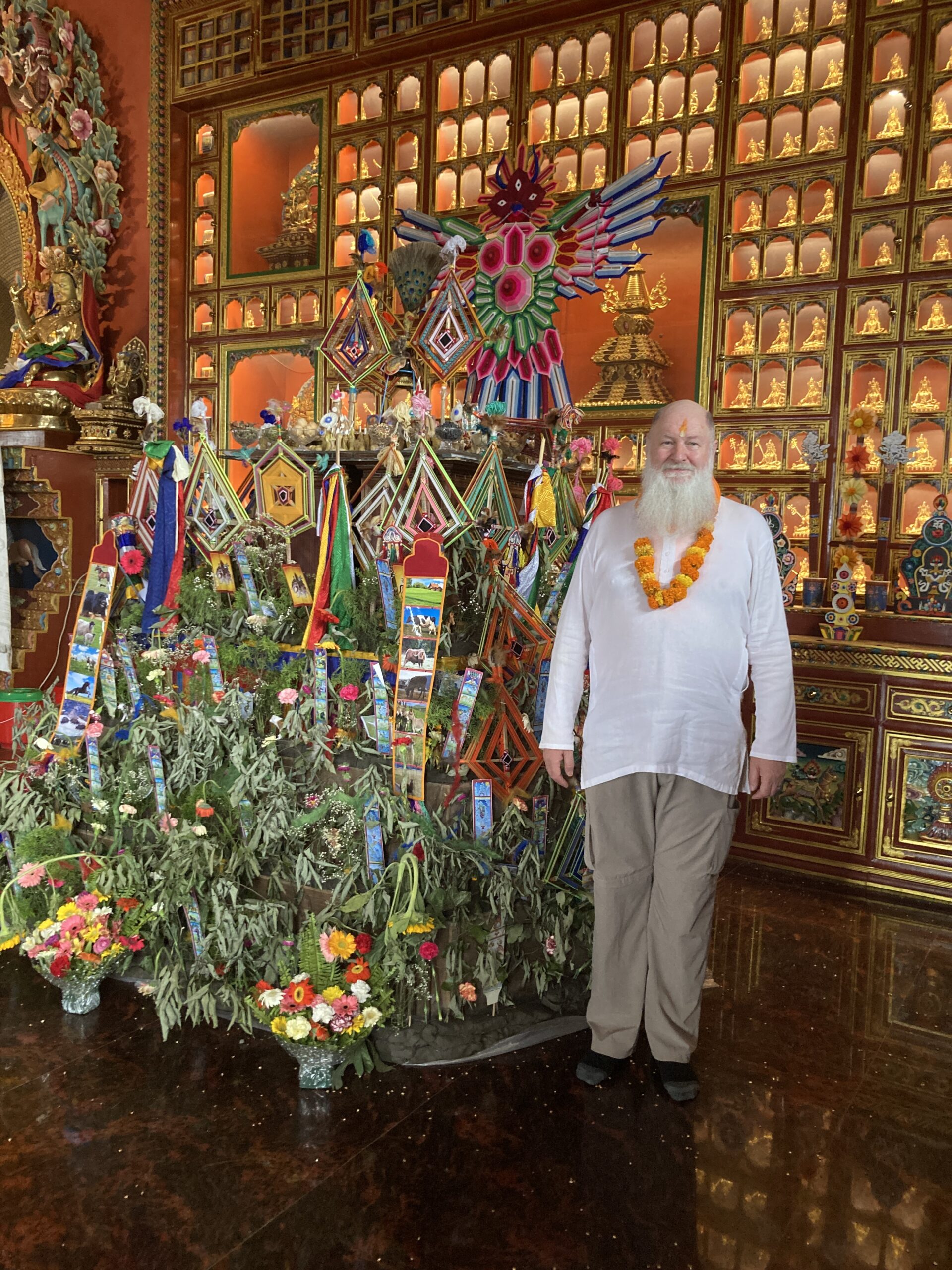
Cotton Mandalas in the Main Gompa

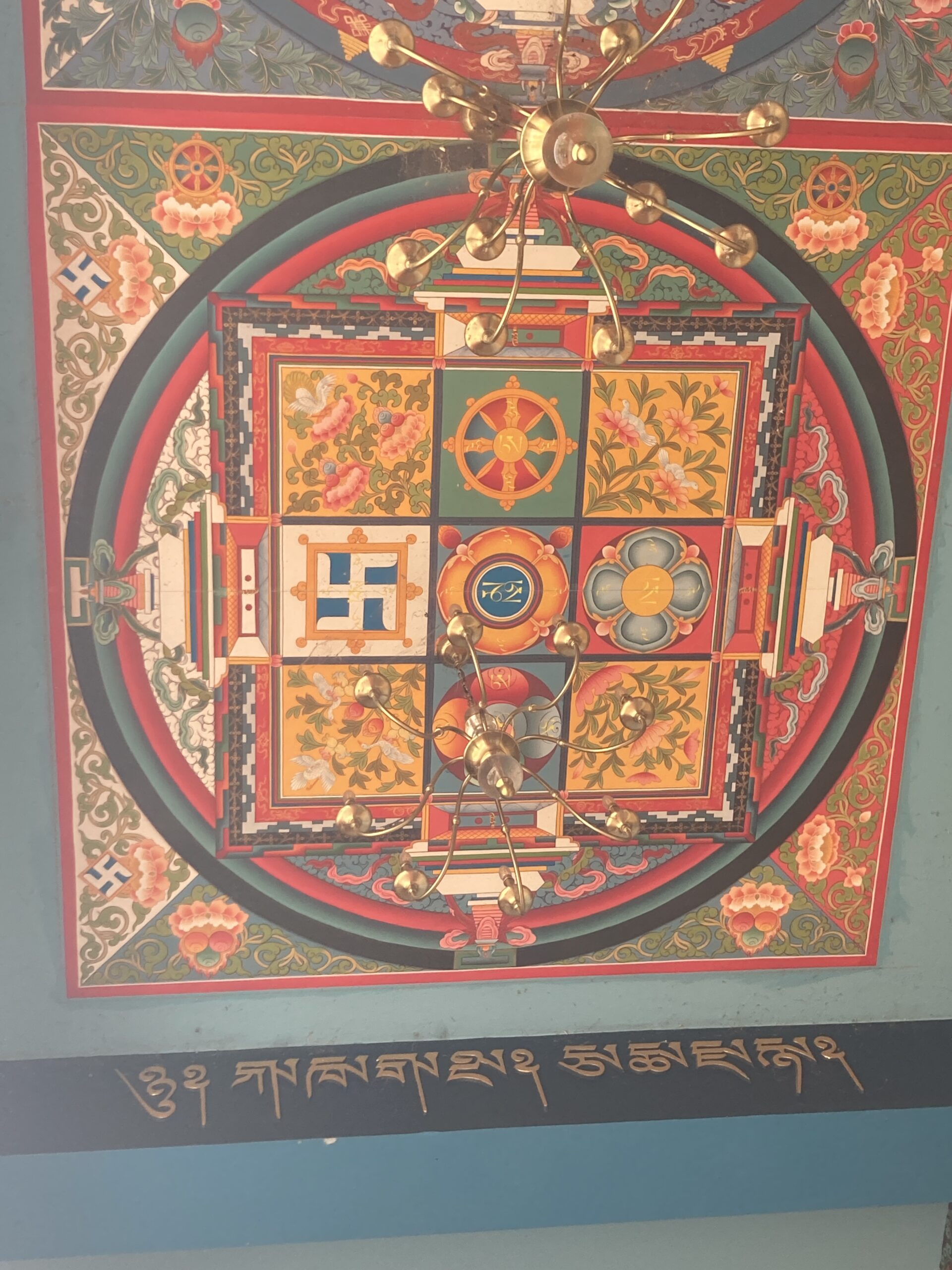
Here the very ancient (pre-Buddhist) roots of Bonpo are visible in the unique cotton mandalas, and the intensity of their relationship with the Buddha in the – equally unique – and huge mandalas painted directly onto the ceiling.

Huge painted mandalas on the ceiling

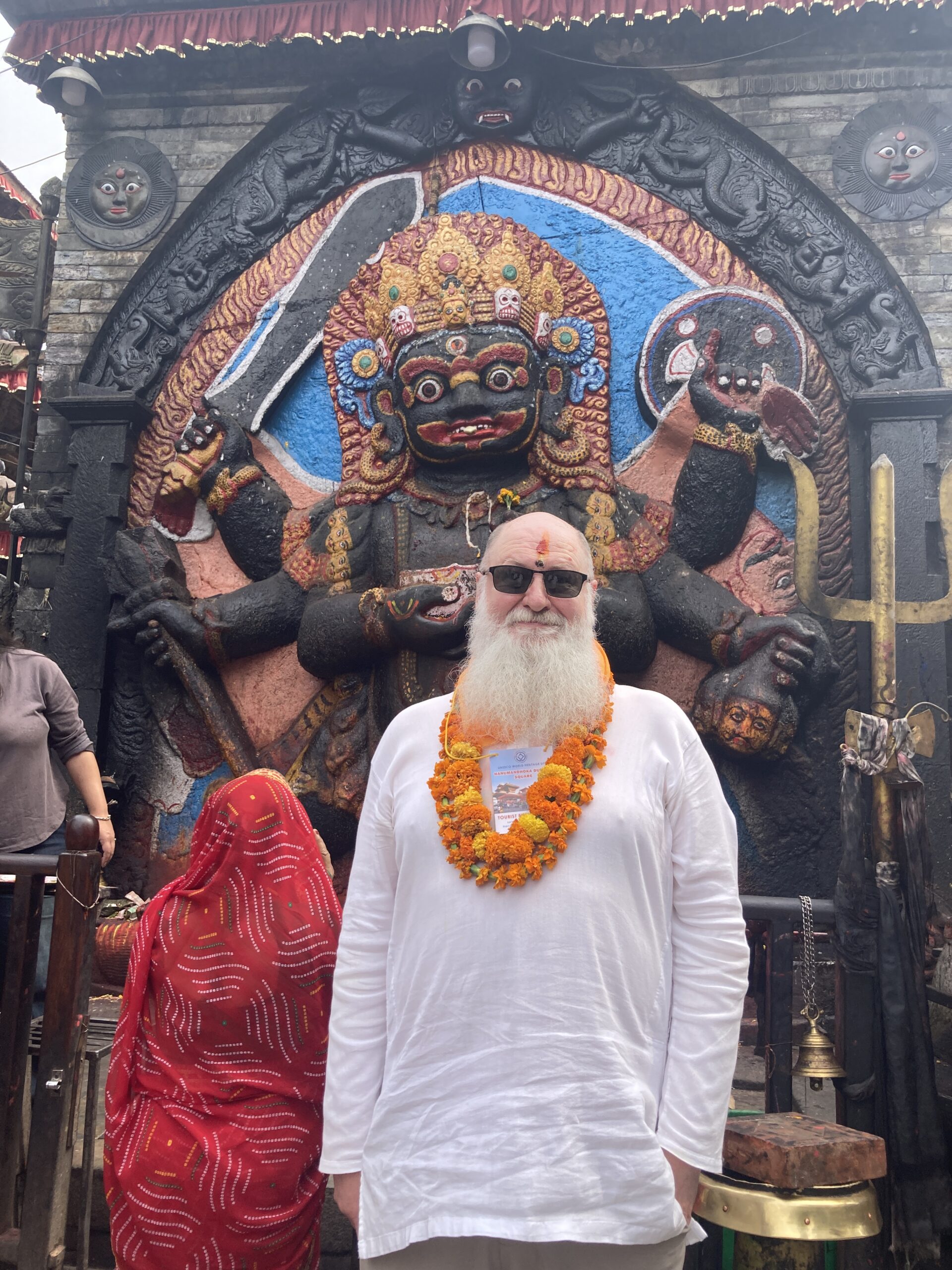
Lastly, we pass through Kathmandu Durbar Square, the medieval royal heart of the city, with its 15th and 16th century pagodas, and its early 20th century neo-classical dictatorship palace.  Most interesting, for me, is the Kaal Bhairav – the great Shiva in his aspect of destroyer and protector.  The presiding priest places the unique black tika of this emanation of Shiva on my forehead.  In one of the many shops, I acquire a brass Kaal Bhairav to take home.

Kaal Bhairav


Next ->

Nepal-Bhutan May 2026 #2

Post #1 | Post #2 | Post #3 | Post #4 | Post #5

28/5/26
This was a huge day.  Conference done – my paper on the Buddhist concept of anatman presented on Tuesday – I awoke this morning excited to begin a true holiday.  I didn’t count on it being such a deeply moving day.

Collected by Jaya, my guide, and my driver, Ram, in our little Hyundai (they let me sit in front, thankfully, to stretch my long legs) I discover they are friendly and knowledgeable, and clearly pleased to have a tourist who seems not just genuinely interested in their religion and culture but both vaguely knowledgeable about it and keen to learn more.

Shiva
Shiva

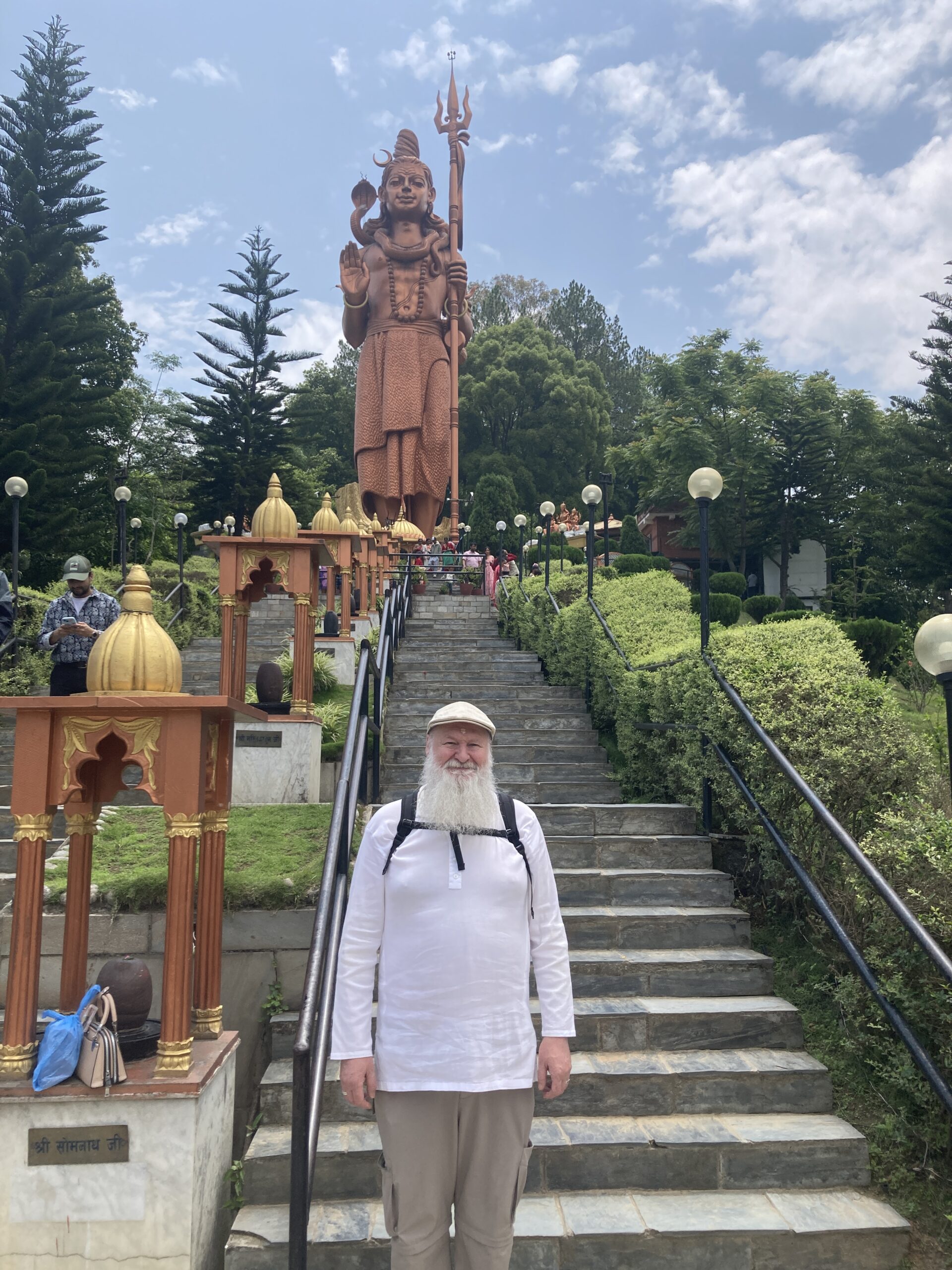
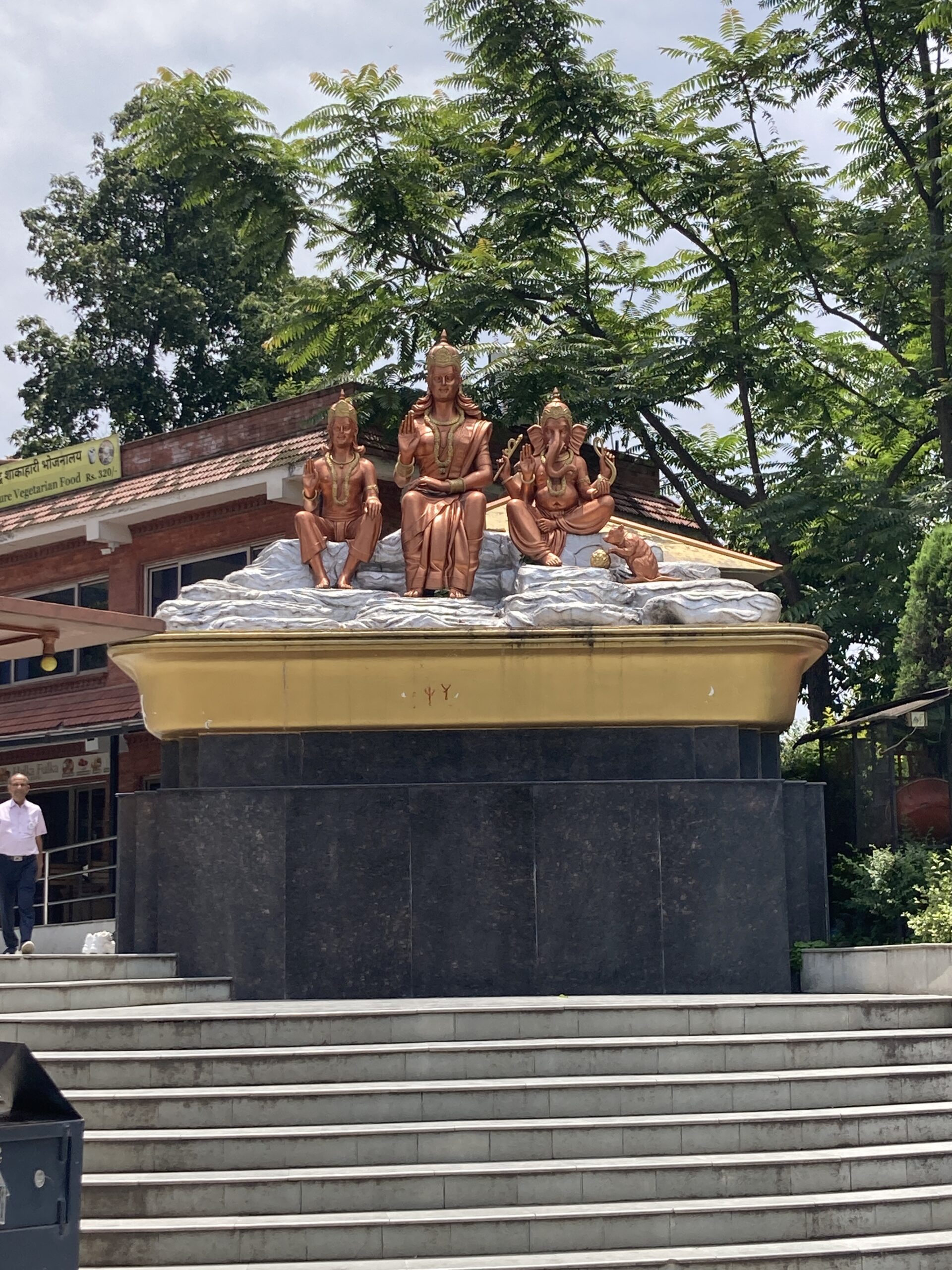
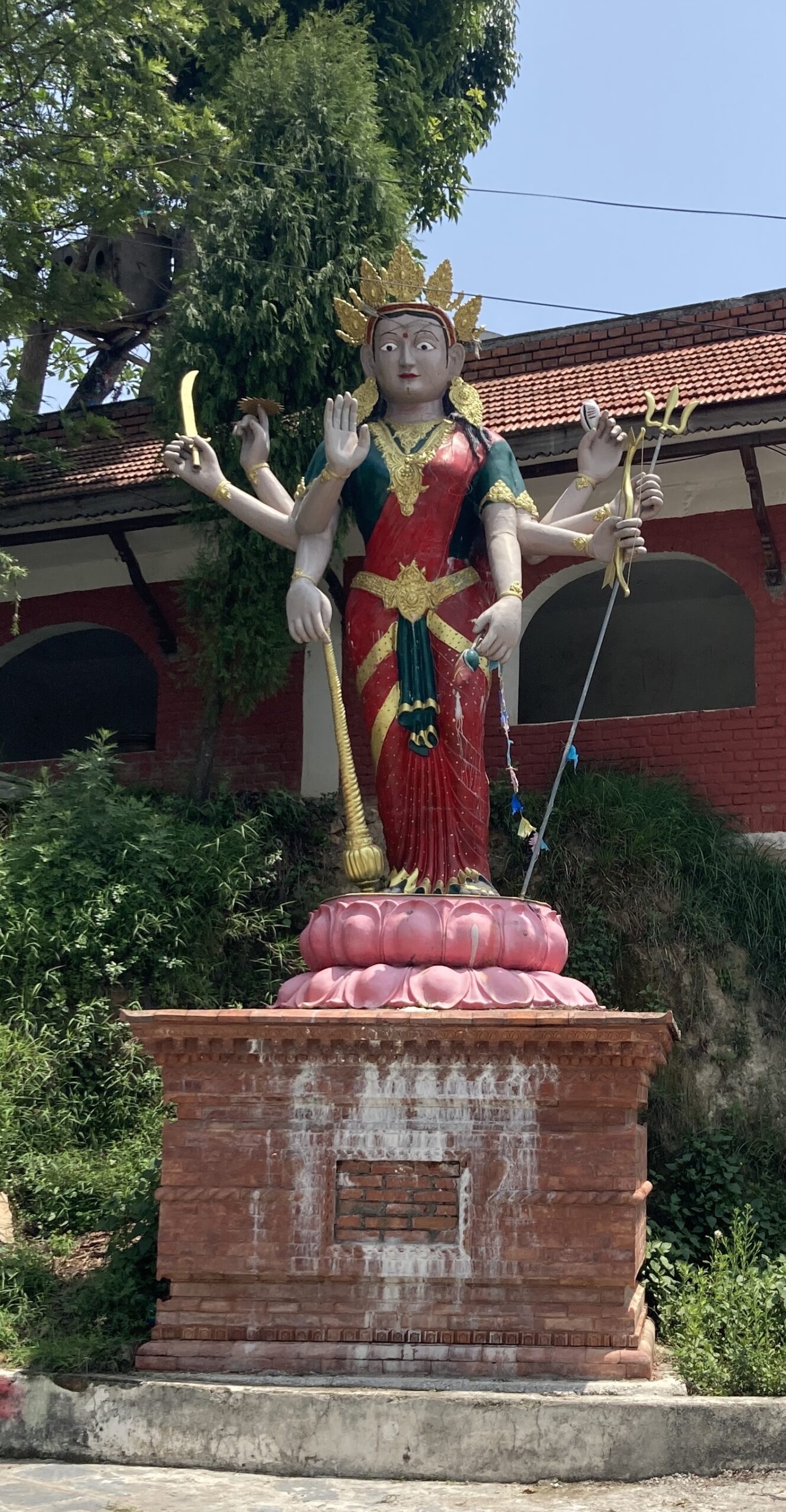
Our first visit was to the largest Shiva statue in the world.  Very impressive. 144feet tall, with Parvati, Ganesh and Skanda on a little plinth at his feet, Mahadev is here in his purple splendour with trident and cobra.

Ganesh, Parvati and Skanda

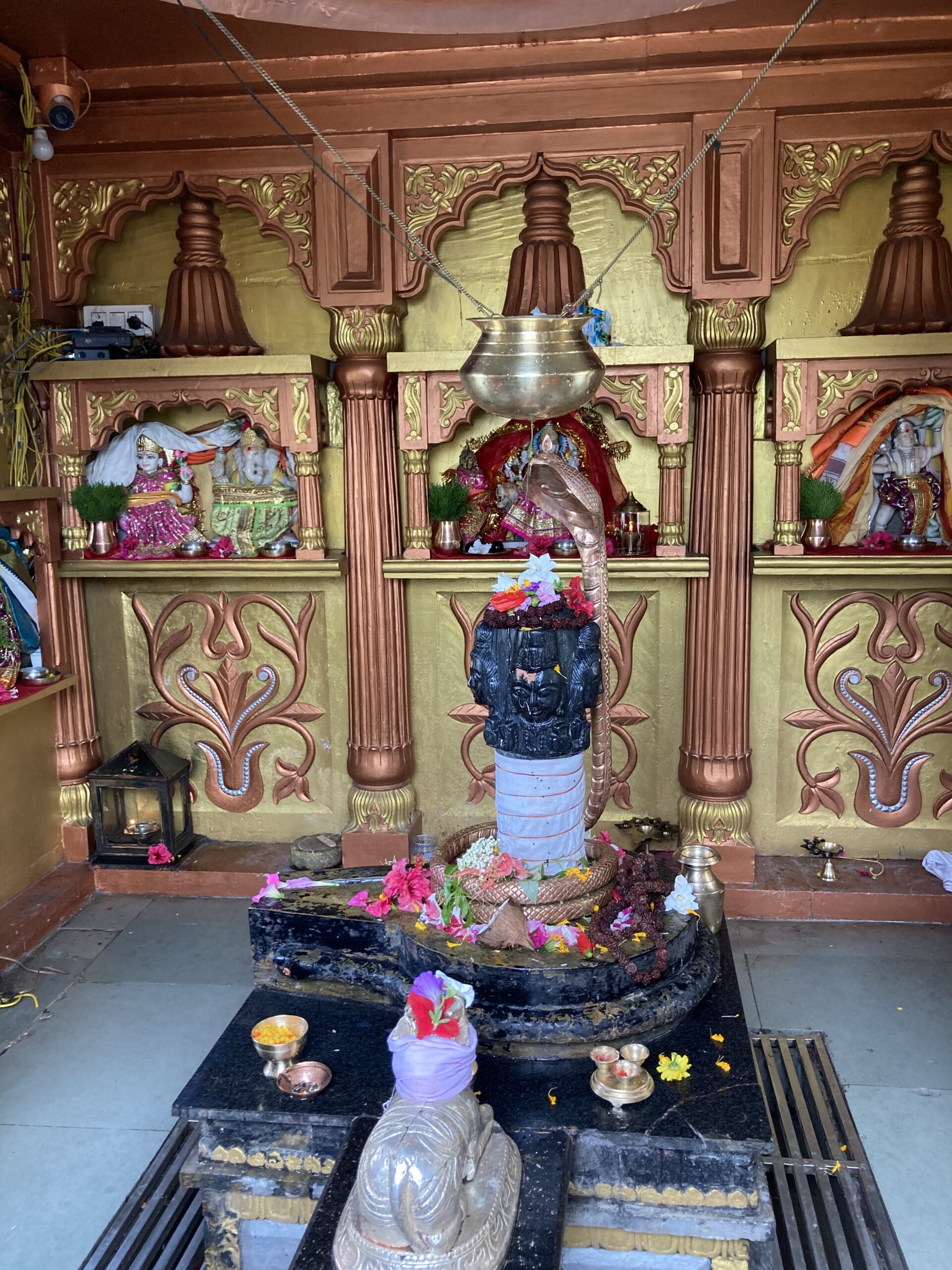
At the little shrine at his feet, the priest put a tika on my forehead, blessed me with the rudraksha beads, gave me a few little yellow flower petals from the flowers draped across the shivalingam in the shrine, which I placed upon the crown of my head, and handed me a few of the sugared sweetcorn, which I duly ate.  It was very special to embrace and engage with the ritual of this Shiva puja.  My guide taught me how to sing the mantra, “Om namaha shiva—-ya”


Shrine at the feet of Shiva

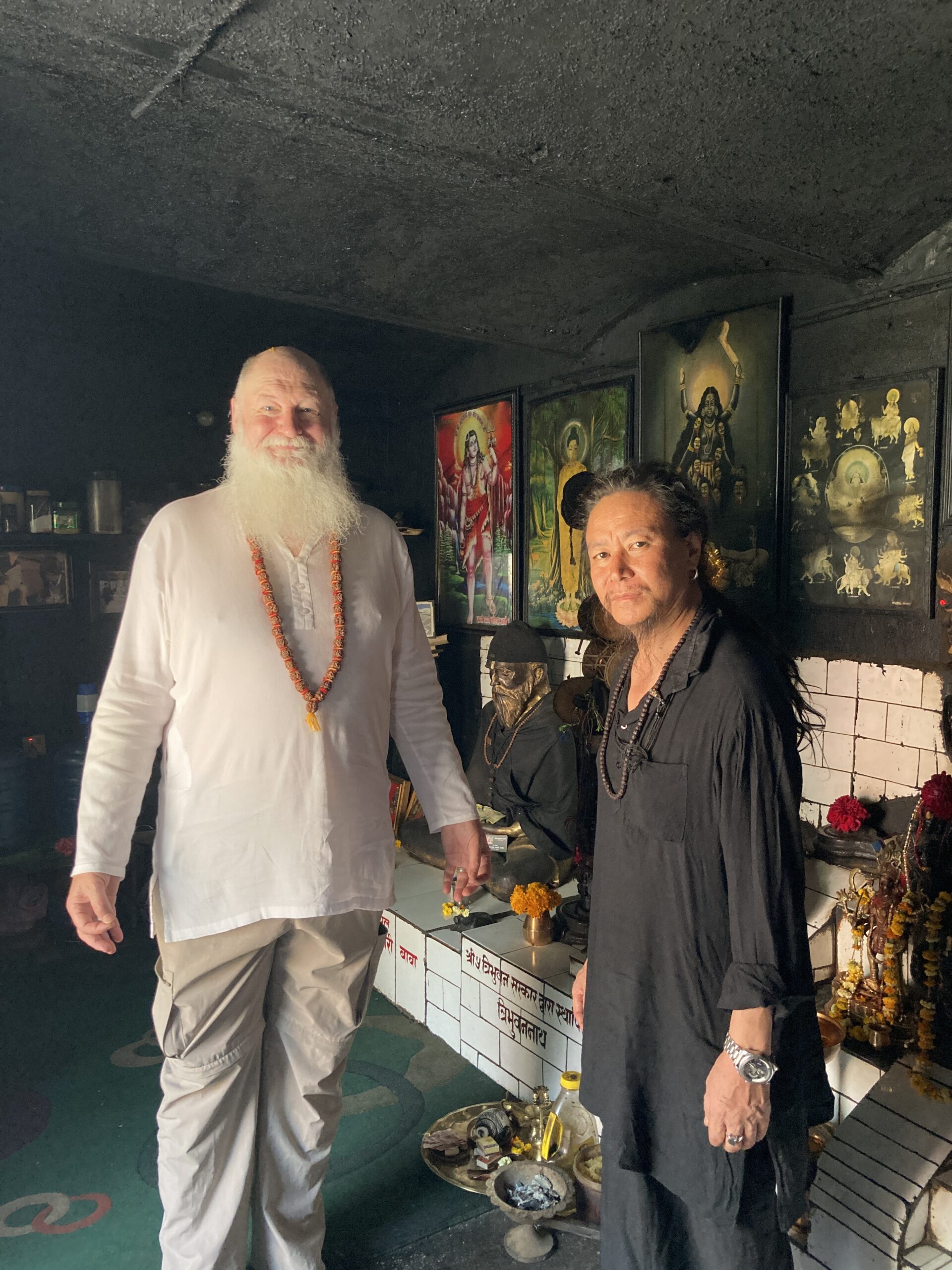
But this was just the introduction. Because we then drove to Pashupatinath.  This huge complex of over 500 shrines to Shiva in his ‘Lord of the Animals’ guise was simply breathtaking, and we began it by going straight to the cave-like shrine of an Aghori Baba Sadhu.  These black-linen clothed holy men follow a very special path, different to the better known white-linen clad ascetic sadhus, and their specialisation is conquering fear.  This is why the aghori sadhu (who has been practicing for 32 years, I am told) has his shrine in the wall overlooking where the bodies of Kathmandu people are prepared for, and then cremated, at the shore of the sacred Bagmati river that runs through this city – Nepal’s Ganges.  I am led into the shrine, and greeted by the sadhu, invited to take off my shoes, and sit facing the seated statue of the Guru Dresh.  A small woman with a friendly smile shows me how and where to sit, with my fingers in the proper rudra (thumb and first finger touching, the other fingers outstretched, both hands resting palm upwards on my knees, and invited to meditate for 15 minutes.  My guide goes to sit at the other end of the shrine, and he and the two women and the sadhu chat quietly.   Occasionally a phone makes a sound.  There is chatter just outside the shrine too.  But somehow none of this matters.  I am soon lost to the world, deep in meditation in this sacred space.  But my back is really not up to sitting in this position for very long, and I begin to shift and feel uncomfortable. Opening my eyes, I turn to look across and my guide calls over saying just to be comfortable and take it easy.  So I lie down, with my knees up, and my elbows on the ground but hands in the air, fingers in the rudra.  This is much better.  But inside, now, it is the mantra om namaha shivaaaaya that runs over and over in my mind.  This is somehow easier than silent meditation.  It is simple.  I lie in this position, with the mantra in my mind, hoping to last for 15 minutes.  At last, feeling a little numb in my elbows, and then realising my hands are tingling with pins and needles, I shift again, and begin to sit up.  I am done.  Looking at the clock on the wall, I realise I have been meditating for 25 minutes.  It is quite something. The sadhu is smiling at me.  He seems quite young to me, perhaps in his late 40s.  His dreadlocks hanging down his back are the same colour as the black cloth draped around him.  His welcoming smile is reassuring.  I am invited to stand so my guide can take pictures, with my phone, of me standing with the sadhu, in particular with the statue of Guru Dresh in the background.
Aghori Sadhu
Aghori Sadhu

Then, suddenly, I am invited to look into the holy of holies – the sacred place at the back of the shrine I did not expect to see.  My guide tells me there is a skull there.  Would I like to see?  I nod, and follow the sadhu into the inner sanctum.  There, on a small desk, deep red all over with glistening Chandan, is a human skull.  I believe it may be the head of the Guru Dresh, who taught the sadhu.  I am deeply moved, my hands together in prayer of thanks, my head bowing, my lips muttering Namaste, and Thankyou.  The sadhu smiles.  Stepping back out into the main shrine, the sadhu puts his thumb on my third eye, presses for a while, and mutters a prayer, and I am blessed.  He does the same for my guide.  We both turn and place NPR500 notes in the little offering dish, and step back out into the sun.  I am completely blown away.  My guide tells me this was a rare experience.  Usually tourists come in for 2 minutes and are gone.  Being invited in to see the skull is almost unheard of – even for locals.  The sadhu, apparently, told him that I had a deep connection with Shiva (for a tourist!), and he was pleased and glad to help me to honour it.  It has been a deeply moving experience.

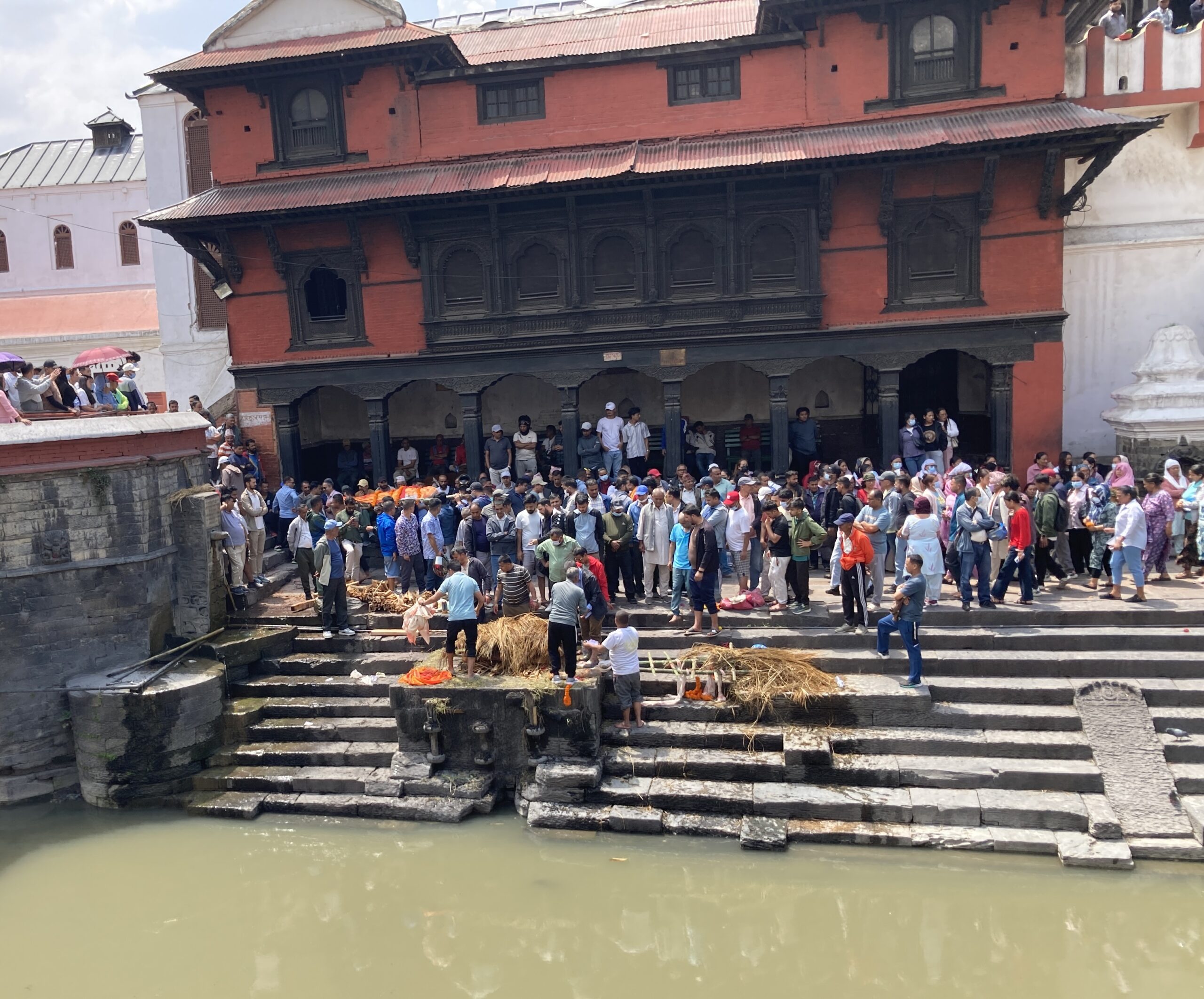
Funeral pyre
Funeral pyre

Out in the sun, we walk across a little footbridge, over the Bagmati River, and stand to watch as families tend to their dead. (The other four of Kathmandu’s rivers flow into the Bagmati, which itself later joins the Ganges.) There are four dead bodies on the paving on the other side of the river, and their families are purifying them with milk, honey, water, and tears, dressing them ready to be carried to the pyre where they are covered with straw, and set alight, in the typical open-air cremation that all the people of Kathmandu may enjoy. It is free – one only pays for milk, honey, incense, etc – and the favoured manner of seeing off the dead.  It takes about 3-4 hours to burn each body, I am told.

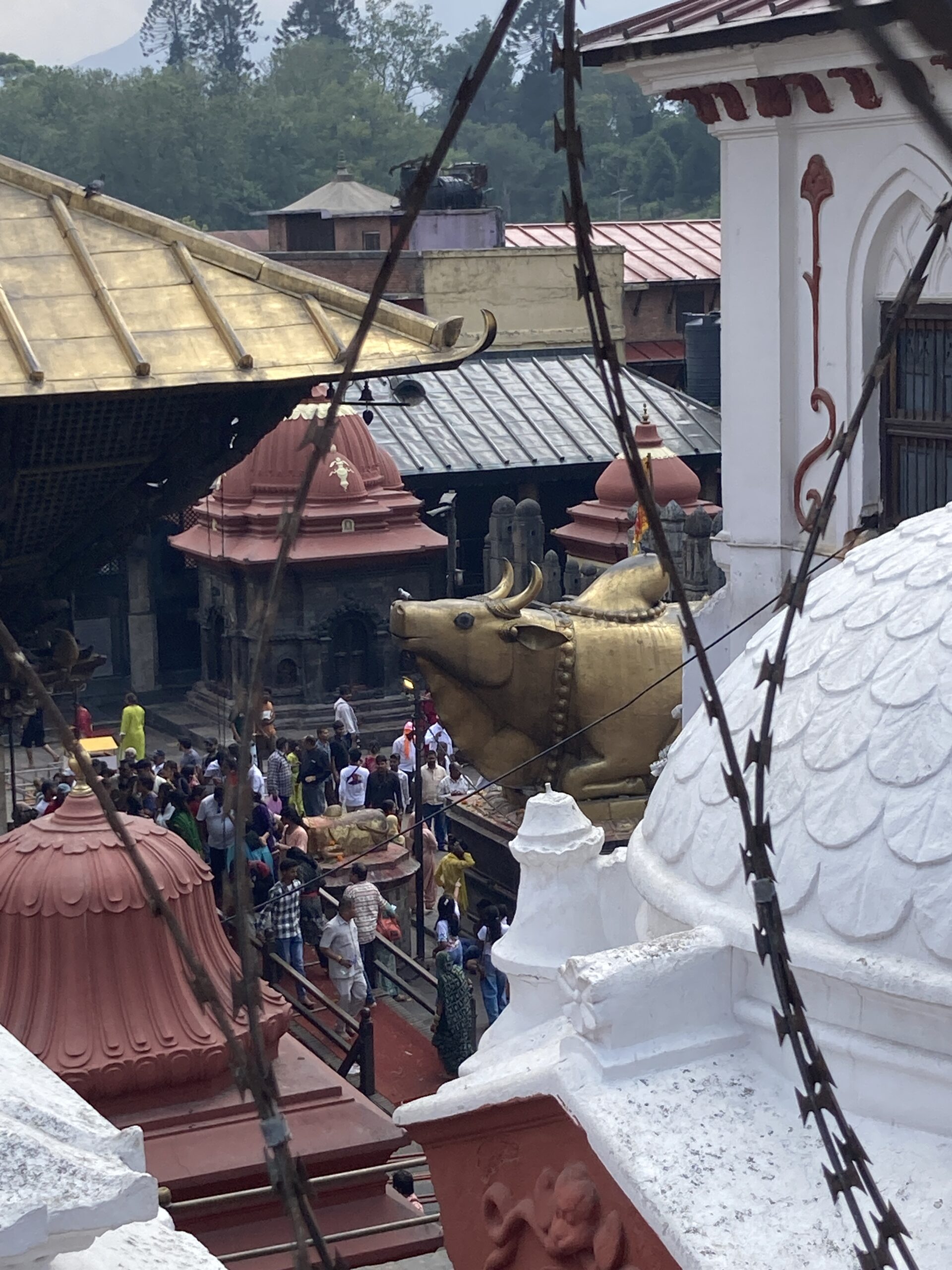
After my experience with the sadhu, somehow all this just seems quite natural, and I am not phased.  It is a serious business, but not I am not discomforted.  We move back across the footbridge, and round to the side of the main Pashupatinath Shrine.  Only genetic Hindus are allowed within the main temple.  Only five sadhus from the south of India, who have been chosen and come to Kathmandu for the last 1400 years, are allowed to touch the self-existing ShivaLingam in the centre of the main shrine.  All I am allowed is a glimpse of the great Bull – shiva’s ‘ride’ – outside the main temple, where people gather on their way in and out of the shrine.

Shiva's Bull Ride
Shiva’s Bull Ride

It has been an incredible morning, and I am glad of the rest and opportunity to have some lunch, before the visit to Boudhanath – the Buddhist Stupa some five minutes away from Pashupatinath.

After lunch, we strolled around the enormous Boudhanath Stupa.  Built in the 7th century CE, by a woman who made bricks with dew water she collected each morning, it is sometimes known as the Dew Stupa. Jaya tells me the prayer flags represent the five elements: Yellow earth; White wind; Green water; Red fire; Blue sky. The Enormous Eyes represent compassion and wisdom to the four directions, and the Third Eye is the eye without illusion.

The stupa is surrounded by shops, making a huge circle of friendly but vibrant capitalism around the solid representation of liberation from all that stuff….  I am – like most – enraptured with all the things, nonetheless – the Buddhist Tat, as one might call it (as opposed to Hindu Tat, Christian Tat, etc) and fork out on a magnificent  Thangka painting of the Kalashakra – the wheel of time mandala – representing the four truths and the journey towards enlightenment: an ‘asset’ for one who meditates.

Finally, then, we arrive at my hotel, and western comforts.

Next ->

Nepal-Bhutan May 2026 #1

Post #1 | Post #2 | Post #3 | Post #4 | Post #5

27/5/26

Travel Writer has been rather quiet on this blog, of late. The blog itself has been pretty quiet! After the profound trip deep into my ancestral past in Ukraine, in October 2019, I have made, in comparison to previous years, almost no ventures out into the wider world; certainly none worthy of blogging.

There was a trip, almost immediately afterwards, to the Hawaiian island of Maui – for a January 2020 conference – involving four flights each way (!) at the end of which I had the opportunity for a day’s drive around the northern tip of the island – the area some years later destroyed by extreme weather! Then COVID struck and all international travel stopped. Or rather, as I did indeed record in this blog, there was one international trip during the pandemic: emigration to Ireland, in January 2021. Since then, apart from frequent hops back and forth between Ireland and the UK for one reason or another (some just for a restful break, most for family and friend visits, once back to the Orkneys again(!) in 2024), there have been a few brief work trips: to Nantes, to Lille, to Sydney (a long way to go for three days!), to Bratislava, to Lisbon, to Nyon near Geneva. All rather civilisationally familiar, european (with a small e) places.

So although travel picked up again, work-wise, from 2023, there has been little in the way of personal, exploratory international travel, and none really worthy of blogging. Four days celebrating my 60th birthday (and Colin’s 50th) in Turkey in March 2023 consisted mainly of a visit to Ephesus, about which there is little more to say, on a personal note, than that I was struck by how my own academic discipline of ‘information systems’, once known as Library and Information Management before it was all digitalised, could be said to have begun at Ephesus, where indexing alphabetically by the first letter of an author’s surname is said to have been invented, by its famous Library’s Roman director, Celsus. And then in December 2024, a conference in Bangkok, which included two days sightseeing, taking in some fantastic Buddhist temples. Perhaps I might have written about what I saw and experienced there. But I have long held the view that, in general, one should write a review of something in terms that are at least appreciative, and rather than writing a bad review (of a hotel, a restaurant, a travel agent, a country) simply decline to go again, or even mention it. On this occasion I wrote a bad review, not worthy of this blog.

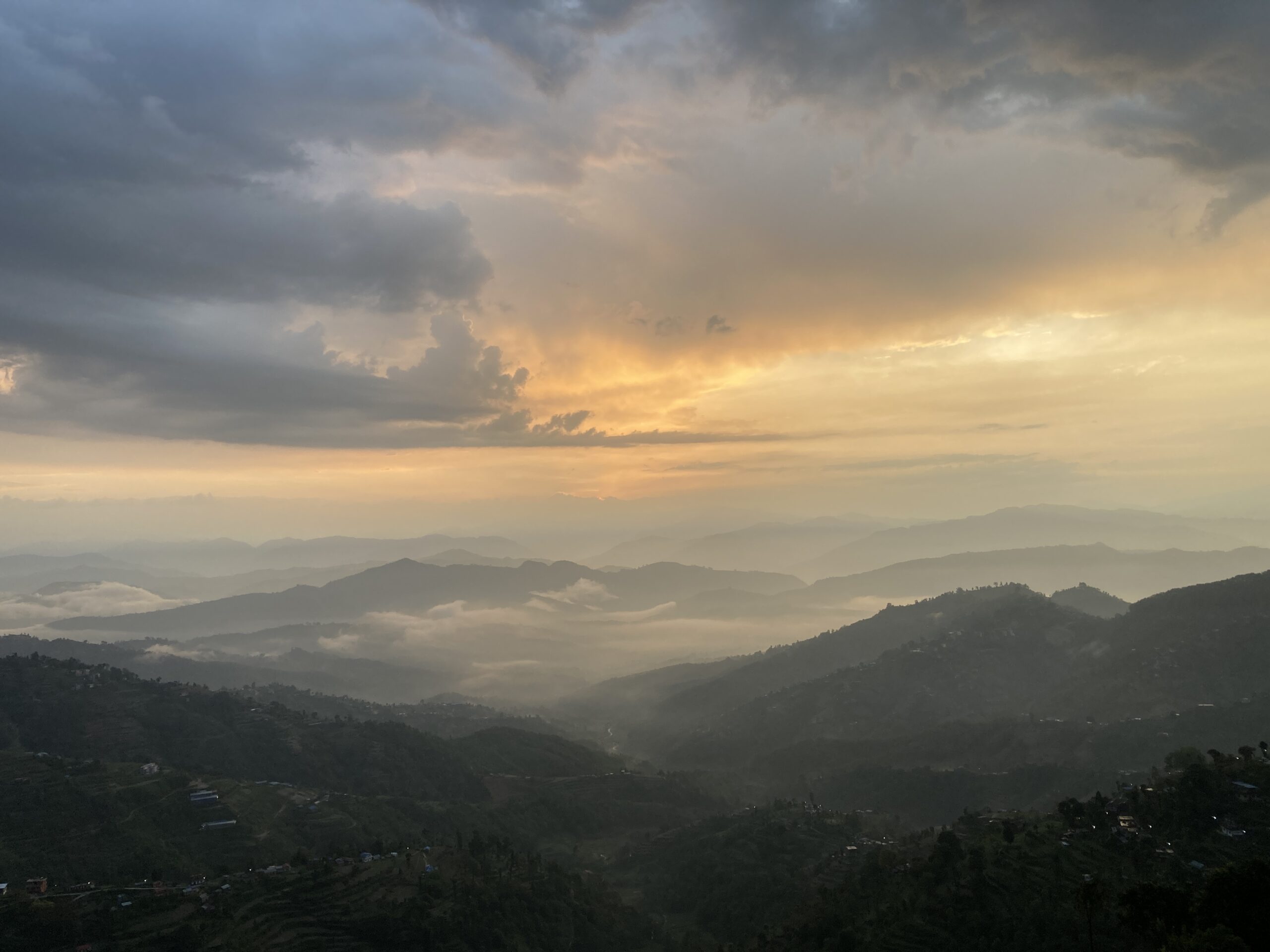
Dawn from Himamlaya Drishya Resort

All this changes now. Similar to my trips to Ukraine (2019), Sri Lanka (2017), Japan (2016), and Peru (2010), work has sent me somewhere really quite exotic, for a change, this May, (to a conference where I have given a talk on the Buddhist concept of anatman) and I have taken the opportunity, once again, to properly go on vacation, whilst here, before returning home. So, I am in Nepal -a multi-ethnic, multicultural, multi-religious republic, as it proudly describes itself. Conference is done, and I am now on holiday – for four days here, and then for another four days in Bhutan! Travel Writer’s blog, then, for this trip, begins with my arrival on the 23rd, and my one day of sightseeing on Sunday 24th May, the day before the conference, and continues on 28th when my vacation proper begins.

23/5/26
Collected at the airport by the hotel transit in a nice cosy BYD, I was relieved and impressed. The drive from the airport to the hotel, however, was very instructive. My driver took a ‘secondary route’, perhaps because the main highway is very full.  The state of these roads is appalling. We were frequently reduced to a crawl across rough ground, frequently circumventing half-made gravel tracks. Occasional stretches of concrete road were rarely long. The hills and valleys of the sprawling city make for perilous climbs and sharp bends. My first views the city made it seem to be a vast collection of half-finished buildings, rarely joined up. Shops are everywhere but most sell vegetables and fruit. Dotted in between are global brands like Pizza Hut. A wide range of development, seen from my air conditioned BYD SUV.

Finally reaching the hotel, after unpacking and a shower, I drifted off to sleep at around 10am. It was strange to wake, pick up my ipad, and see it was 10am. That was, of course, in Ireland. Here in Nepal it was now 2.45pm.  The heat in the morning was oppressive. In the afternoon, sitting on the balcony of my room, watching the warm rain, I delighted in the cooler temperatures that come with it, and the thunder!

24/5/26
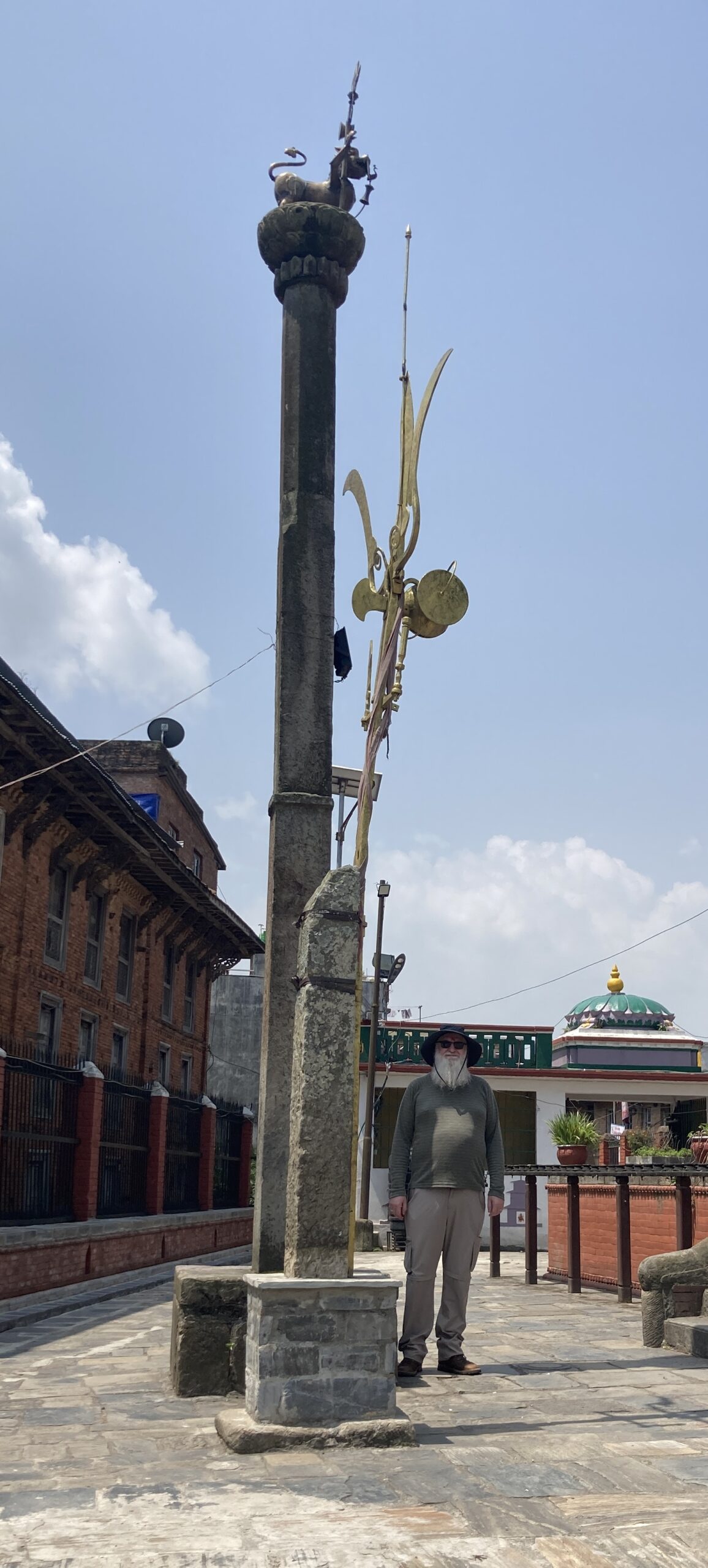
Here at Dhuilikhel, to the east of Kathmandu proper, where the University is located, I find I am a good 90 minutes (at least) away from both Durbar Square and Swayambanath, the two places I thought I might visit on my first full day in Nepal. This is not just distance, but the fact that the roads are in such a shocking state. This is in part due to the generally low level of development, here; Nepal is one of the 30 poorest countries in the world, in GDP per capita, (and Ireland is currently at No.3). It is also in part due to the massive earthquake 11 years ago, from which the country is still recovering, and in part due to renewed landslides from time to time due to bad weather. In conversation with hotel reception here, I decided on a more local tour, taking in (1) the nearby market and its local Hindu shrine to Gita Mandir, which boasts one of the tallest stone pillars in Nepal, then (2) Devisthan Kali Temple, famous for its 1000 steps, which – fortunately – my car will be able to avoid on a winding lane to the top of the hill where the shrine is built. (3) Thirdly the Namobuddha Buddhist Monastery, and lastly (4) Panauti Indreshwar Mahadev Hindu Temple and Museum. All this will only take up five hours of driving and walking around.

We agree for me to set off at 10am – with the same driver in the same BYD that collected me from the airport. Orun (29) is friendly, helpful, knowledgeable, very local, and although his English is poor the translation apps on our phones ensure we understand each other well enough.

Tall stone pillar
Tall stone pillar at Gita Mandir

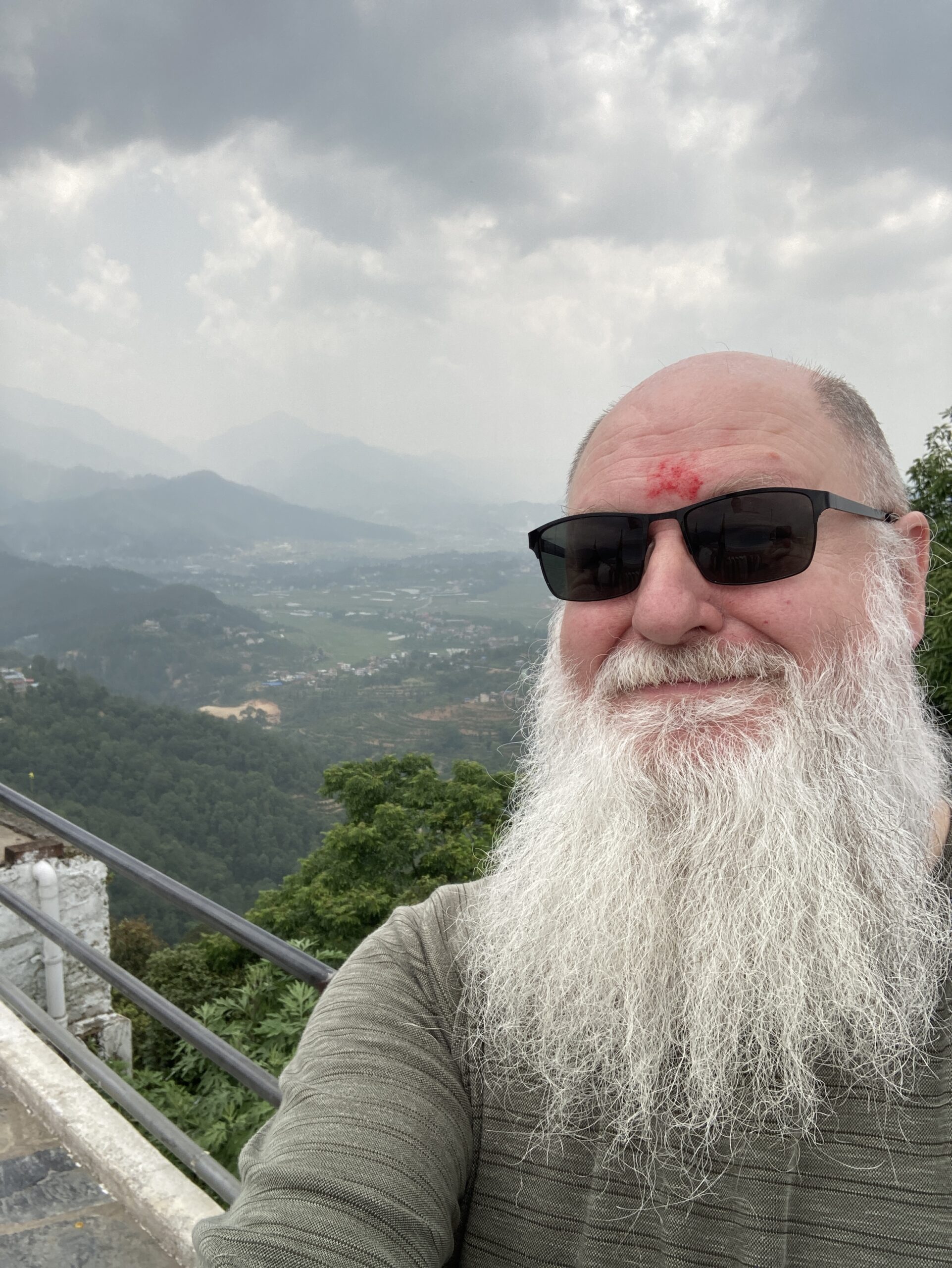
The little market in Dhulikhel is tiny, but boasts a life size statue of a Tiger, a little shrine, and a pool. Nowhere has a Nepali cotton shirt I would like: only typical Western shirts. But on the hill above the shops we visit an equally tiny local shrine: Gita Mandir Temple. There are little shrines to Shiva and to Ganesh on the way in, and a lovely small Temple to Gita Mandir overlooked by the tall stone pillar. The place is deserted. We ascend to the outer court of the Temple: the inner court with the idol is fenced off. Orun touches the stone threshold slab at the entrance with the fingertips of his right hand, then touches his chest with them, and lastly his forehead, in a seamless 1-2-3 gesture honouring the sanctity of the space, as we enter. I follow and do the same, delighted and intrigued by this simple expression of religious feeling. At the entrance to the inner courtyard, by the fence, there is a bowl of red paste. He invites me to add, with the tips of the fingers of my right hand, a bright red Tika on my forehead, “a gift from the Gods” he says, from the bowl of Chandan (brightly coloured sandalwood paste). I’m not very good at it. He does it for me, and I thank him for doing it properly.

Tika
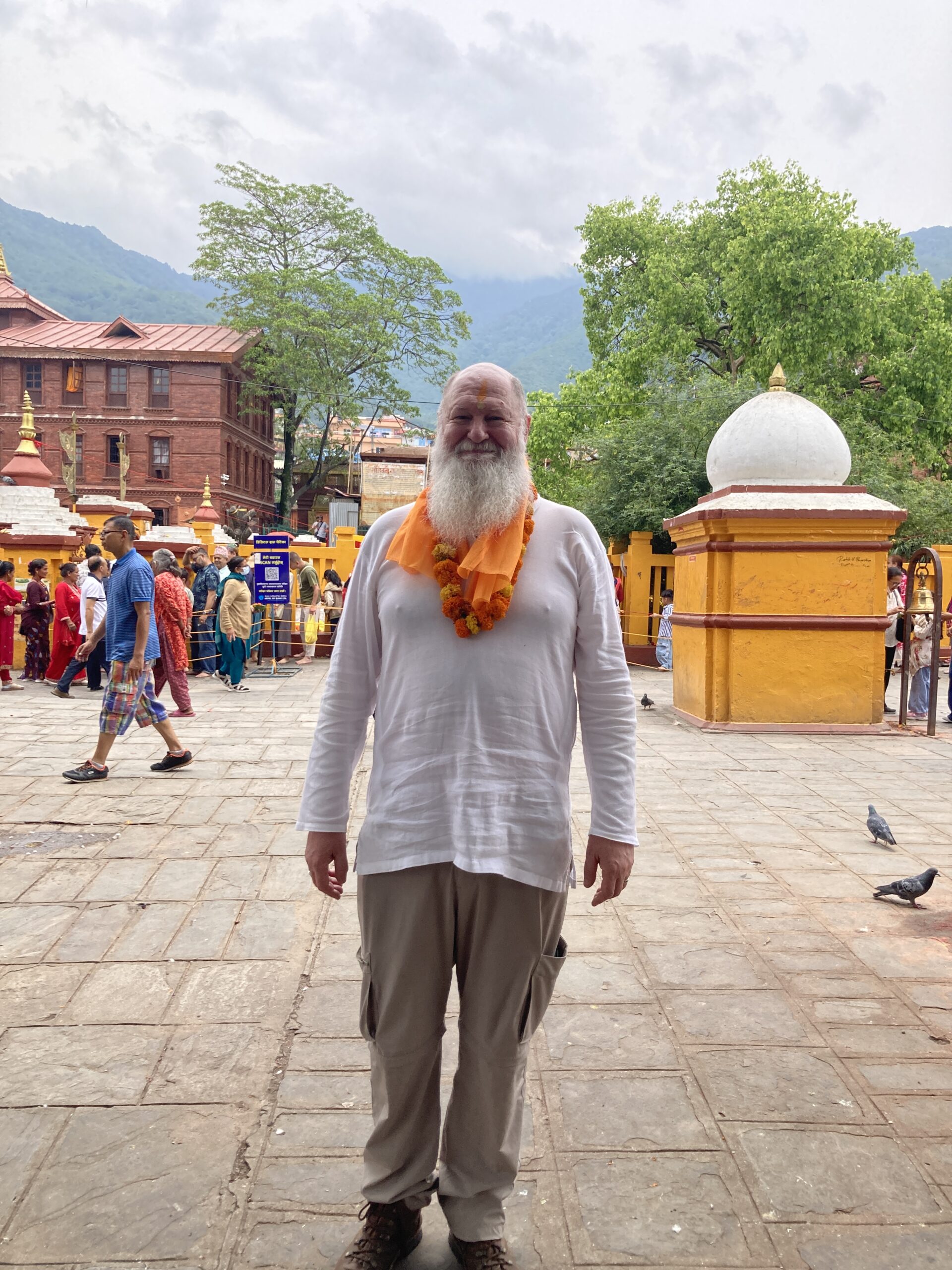
Sporting a Tika

So, for the rest of the day, I proudly sport the daub of bright red Chandan paste on my forehead, between my eyes at the top of the bridge of my nose – known as a Tika – as symbol of my experience of the holy places of this area. I am touched, and already enriched by this small local shrine. I put a NPR20 note into the slot where monetary offerings are made. I am reminded of Japan, here, and the Shinto habit of making an offering of a few coins.

Kali
Kali

Next, we head to the Devisthan Kali Temple. The 1000 steps are indeed a very long and quite steep set of steps up the side of one of the many hills that are scattered across this region. Winding up across it, back and forth like a snake, the concrete lane we drive along cuts left and right through the steps, leading us up to an area where we can park near the top, and get out to complete the last short flight of steps to the Temple. The flat crest of the hill here, at the top of the steps, boasts a statue of the first King of modern Nepal, who united the country. Then intricately carved wooden doors in the distinctive local style, in a small break in an outer wall, grant entrance into the outer courtyard of the Temple, beneath a carved Nag – the cobra. A small open Shiva shrine in the outer courtyard is all we have access to. The inner courtyard, with the Idol of the ancient Crone Mother Goddess Devi – known best in the West as Kali – is locked away in an inner walled shrine to which we neither have access nor any ability to see inside. It is a truly imposing place and I am deeply touched by the Shiva shrine, at any rate, and impressed by the amazing views. Despite not being able to see her idol, it feels as though the ancient Goddess seems very much a living presence here, where she is worshipped by living devotees. We are fortunate to be here when there is nothing going on, and almost no-one here but ourselves, save a trio of small boys.

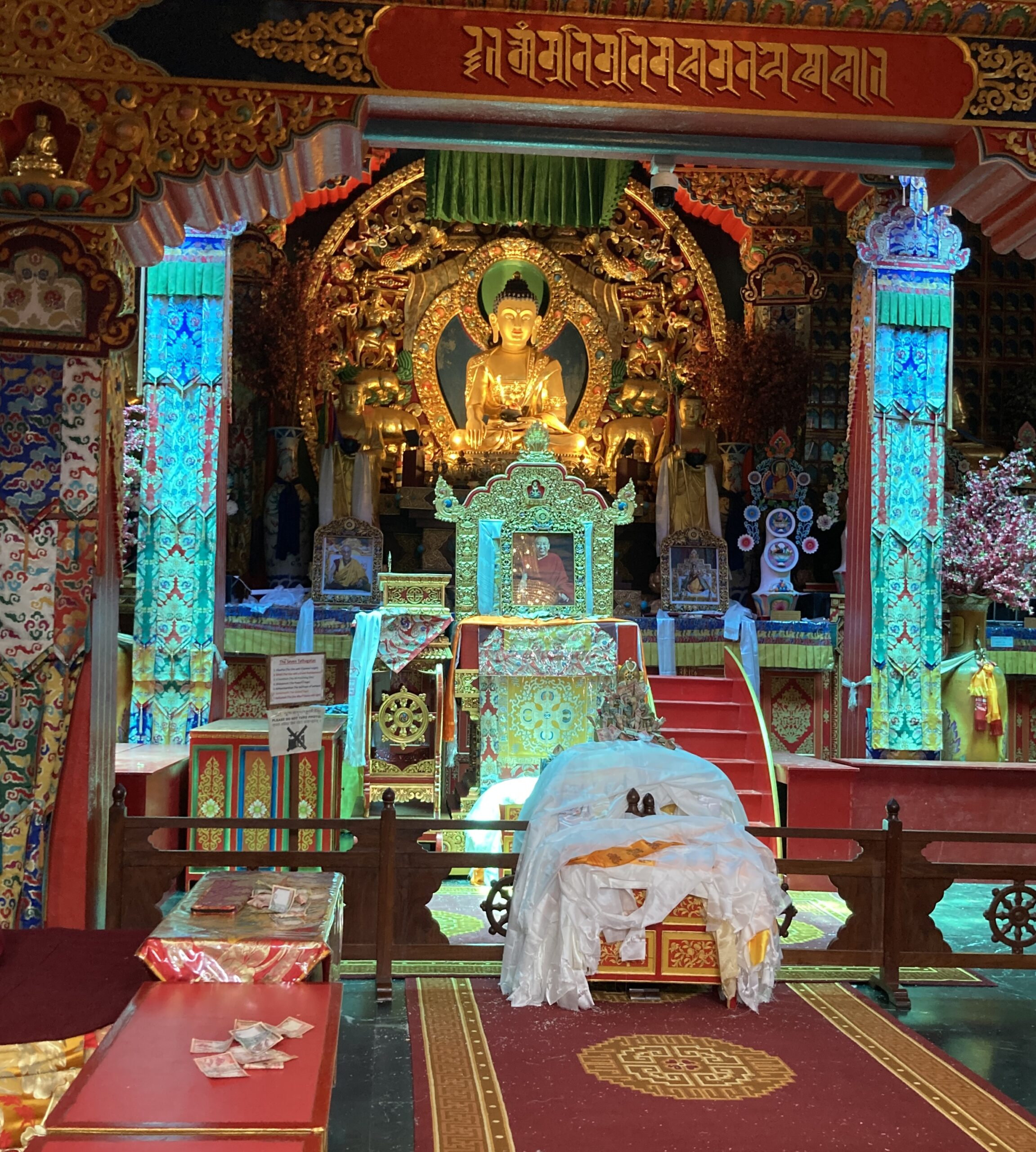
Then the drive, back down the winding lane and across a little valley – the roads a little better around here I’m glad to say – to another hill, where another winding lane takes us up the side of a wooded hill, up, up, up to Namobuddha Stupa & Monastery – home to large complex of brightly painted buildings and hundreds of monks & peaceful chants. After the quiet of the Devi shrine the crowds of monks, visitors, and tourists here makes for quite a different experience, but we are nonetheless not overwhelmed, and able to experience some parts of the Temple almost alone, from time to time. Taking off my boots each time, we visit the Main Shrine, the Shrine of 1000 Buddhas, and the Shrine to Green Tara.

Noma Buddha
Namobuddha main shrine

The main shrine is really amazing. My guide and I take off our shoes and walk up the stone steps, in through the great wooden doors to the main shrine, and walk up the aisle, and stand in front of the central Buddha at the shrine for a good while, silent. There is a line of small shrines in front of one great wide shrine that supports a series of huge Buddha statues. My heart is full. My face is a beaming smile. I am filled with peace. But the only thoughts that pass through my mind are of anatman – the topic of my presentation at the conference here on Tuesday: the Buddhist concept of not-self. I am not, and not being, I am filled with both joy and love, and compassion for both myself and all others. I am enriched, and the boundaries of who I am are wide open; there is no difference between me, and Orun, and the other devotees who now begin to file into the shrine. Noticing them, I am drawn away, at last, and follow my guide off to left of the shrine. A monk leads a group of devotees up the aisle to where we have been standing, explaining things to them in Nepali. As they turn to the left, we see they are filing past the little ‘no entry’ sign to make a tour behind the front pillars, nearer to the big Buddha statues. Following Orun’s lead, we join them in making a (clockwise) tour of the inner part of the shrine. Following my guide, I bow my head and touch my forehead to the white shawls draped across special parts of the shrine. I put a NPR20 note in amongst all the other little monetary offerings that gather like flowers atop the pillars. I follow the devotees ensuring that I touch my forehead to the correct places, as we walk in file around the shrine. I join them in making another small donation of a low denomination note of NPR in one of the little clusters of notes. At the last we return from our tour to stand again in the aisle, for a while, before turning at last to leave the main shrine. It has been very special. Just before we leave, many of the devotees are standing taking photos of the shrine – seemingly with the permission of the monk. Orun whispers to me to join them quickly. I take one picture. It is very precious. We step out through the main doors of the shrine, back to the top of the stone steps. As I return to myself, my Western self, the man in his early 60s on a tourist visit, I am blessed with such an experience. We walk back down the stone steps, put our shoes back on, and out again into the crowds. Next we visit the Shrine of 1000 Buddhas – another very peaceful place – where we make a tour of the lower courtyard, amongst many, many little statues. No thoughts really, just a peaceful emptiness, inside feeling close to, almost merging with what is outside of me. Lastly, the Shrine to Green Tara. Om Tare Tuttare Ture Swaha. My experience from 1989 playing the role of Lepchani in a big community theatre production in Glastonbury returns to my thoughts. The producer/director had a dream about me – this was the way she had created all her shows – and then wrote a script with me as the main character, experiencing the final journey through the six Bardos. She said she had dreamt I was once a monk in a Tibetan monastery. As a Goddess worshipper in Glastonbury, she made the show more about Green Tara than any of the other Buddhist figures. Tara has – since then – on more than one occasion, led me “across the sea of my unknown fears”, and brought me succour when I was afraid, deeply upset, or suffered an emotional blow or loss. At her shrine here, I put a higher denomination Nepali Rupee note at the cluster of offerings. I know what to do now and followed other devotees less slavishly and more for myself and in my own right, worshipping the Buddhist divinity with whom – at least at this moment – I had most affinity. Beaming and serenely at peace, I followed Orun back out to the edges of the temple complex, where we stopped at the Monastery’s tourist shop. Unable to resist, I bought a proper Buddhist Singing Bowl, and some Green Tara Incense. In the car, afterwards, I reflected on the fact that even now, so many years later, a familiar history is still playing out. The academic discipline I fell into, in the decade after that Glastonbury experience, once known as Library and Information Management, before computing changed it completely into information systems, means in some strange way I guess I am still the librarian, that I am here at all because of that continued engagement in the library….

Mahadev
Mahadev shrine
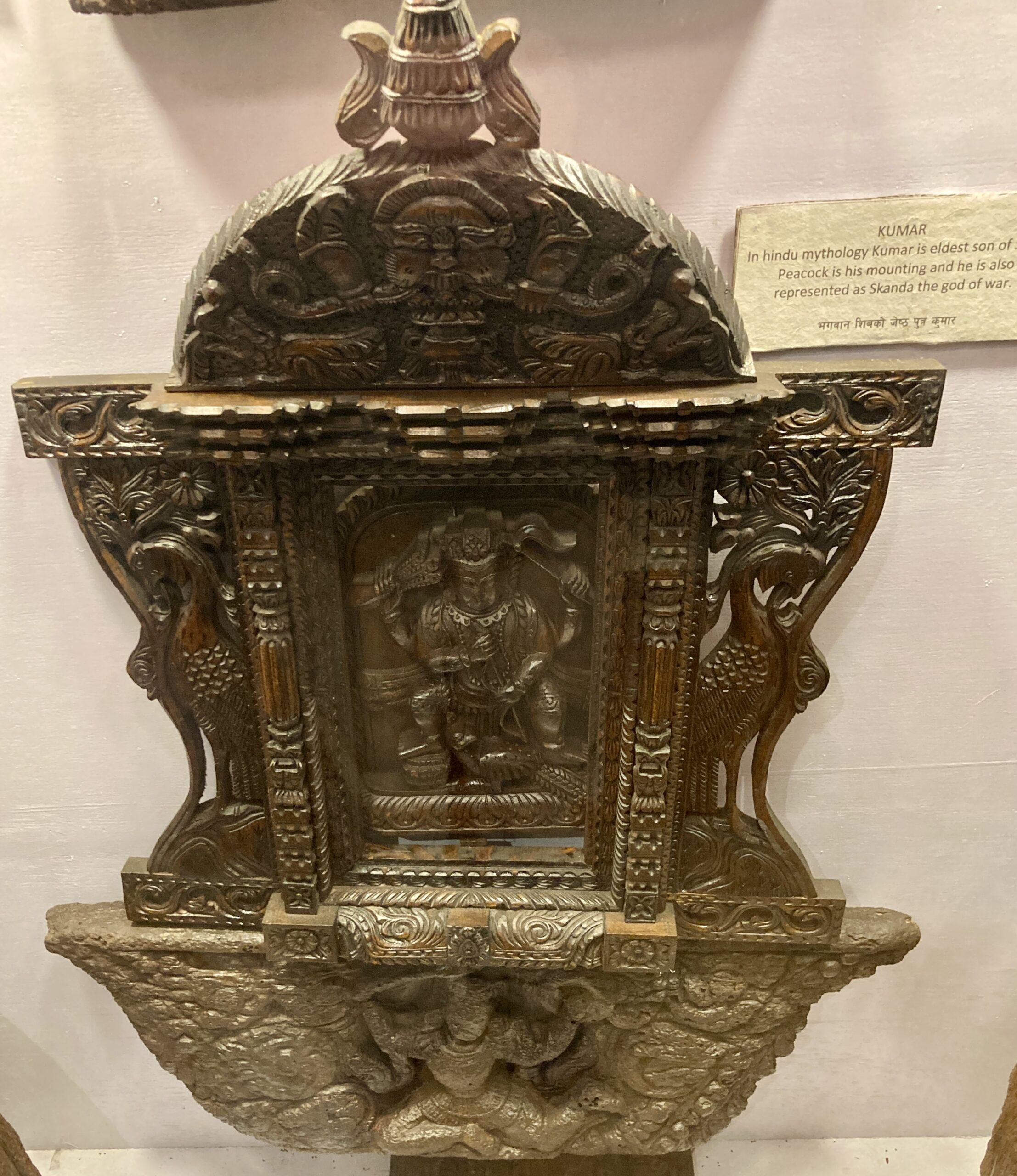
Kumar
Kumar wooden plaque

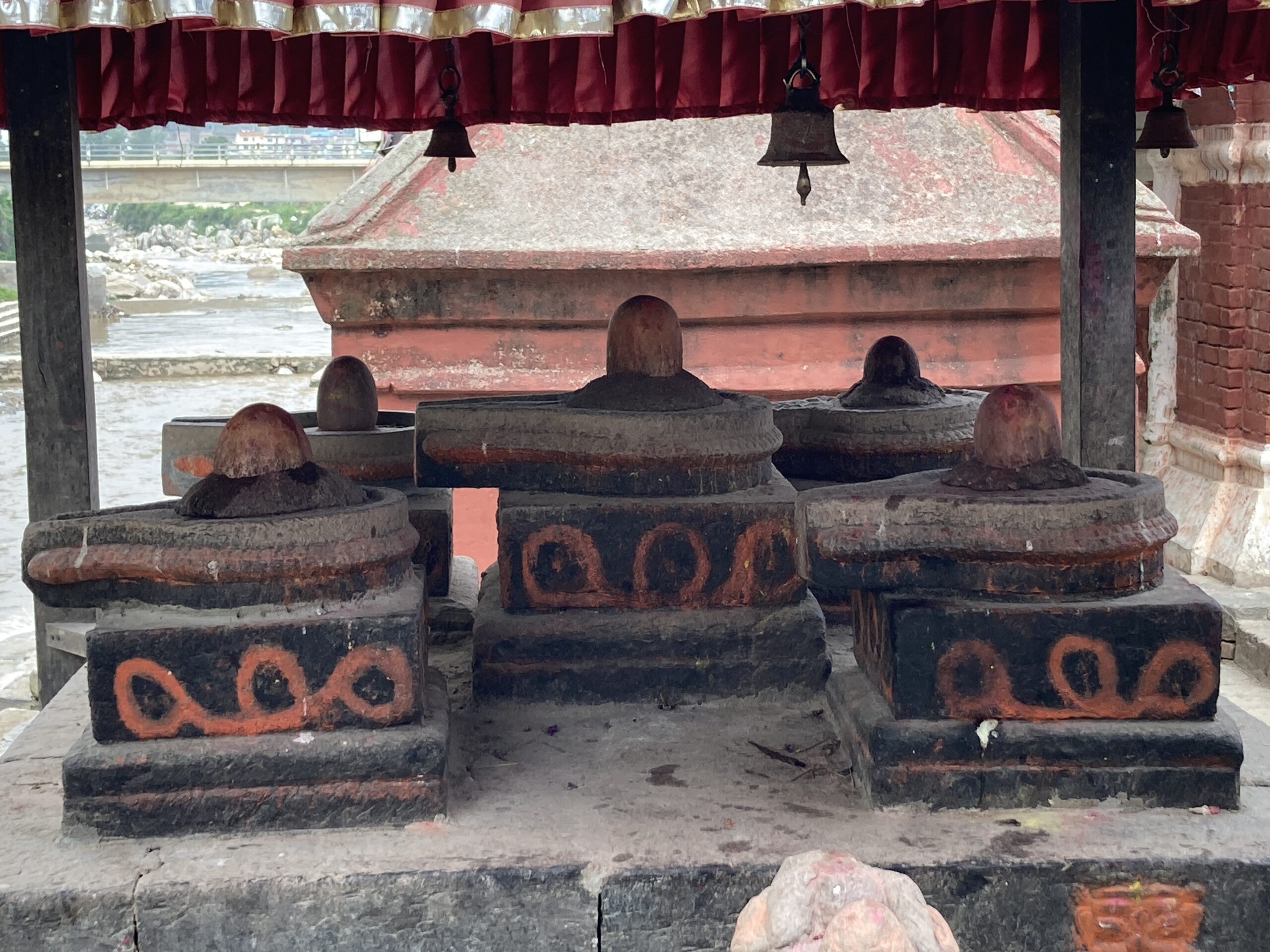
On the way back to the hotel, then, after this, we stopped for a while at a very, very old Hindu Temple at the confluence of two rivers. Panauti, in Kavre, a historical Newari town known for its ancient temples, culture, and traditions, includes this temple – the Indreshwor Mahadev Temple, one of Nepal’s oldest and largest pagoda-style temples. Mahadev is one of the names of the god I know as Shiva. There is even a museum here, where I spend some time in the cool and relative dark and quiet looking at old items from the Temple. I am also drawn to the Mahadev shrines where Shiva Linga are gathered, and the Bull and Trident make it very clear that Shiva – here known as Mahadev – is the principal god here; god of gods. I have learnt something else new too: in the Museum I discover that Shiva’s eldest son, whom I have known as Skanda (or Murugan in South India) is here known as Kumar. So Mahadev (Shiva) and his son Kumar (Skanda) are worshipped here, at the confluence of two rivers, and – as if to underline this – where the waters meet, there is a pile of logs burning, with a trail of smoke rising from it, and Orun tells me there is a body. I don’t see it. I am not phased by it. But it is my first witness of the Nepali practice of open-air cremation. I tell my guide that in Europe we cremate our dead too, often, but in furnaces, hidden away. I think of my mother, cremated only a few months ago; of my father, cremated 23 years ago now. We drive away, slowly, back up the side of the valley to wind our way over yet another hill, back towards the hotel.

As in Sri Lanka, Hinduism and Buddhism sit side by side here in Nepal.   Yet there seems no contradiction.  It seems to me that, as a European, I might understand it in the following way: the pantheon of Greek Gods – Zeus, Hera, Apollo, Athena, etc, and all their rivalries and strange relationships, were honoured and sacrificed to by the great philosophers of Athens. So too, the pantheon of Hindu Gods – Shiva, his wife Parvati, their sons Skanda and Ganesh – are honoured and worshipped alongside a devotion to the philosophy of the Buddha.  In Japan it is Shinto instead of Hinduism, but the relationship seems similar.  None of these traditions seems as jealous of the strict adherence of its devotees as Christianity.

Next ->

A home in the country

After many years of yearning, and 18 months of searching, we have finally found – and bought – a forever home, on the shores of Lough Corrib, on the eastern slopes of the Connemara, to the North West of Galway City.

Now the work of retrofitting it – to bring it up to a modern energy rating – and moulding its rooms, fixtures, fittings and decorations to our tastes, begins: a project that will take many years!  Bring it on!

On the death of Queen Elizabeth II

I confess, reading all the news this morning, that I have had a quiet little cry.

She has been there all my life. My own mother was only 19 when Elizabeth ascended the throne, 11 years before I was born….

It feels quite strange that I am sat in a hotel room in Limerick, chairing a conference in Tokyo, in the small hours of the morning, reading The Guardian and the royal.uk websites, shedding a few tears…

I shall not mourn having left the UK. Life in Ireland has proven to be wonderful – and moving probably the best thing I ever did. But something that had somehow continued to make the UK home has now gone, and leaves with the country in turmoil and seemingly irrevocable decline …

Greener pastures in the Emerald Isle

NUIG From 1st December 2020 I take up a new post as a Lecturer (‘B’ Above the Bar) in the Business Information Systems group in J.E. Cairnes School of Business and Economics, National University of Ireland, Galway.  It will be almost 17 years since I was appointed as a Lecturer in the Information Systems Institute (ISI), University of Salford, in January 2004.  Salford was at around No. 50 in the UK rankings at that time, and the IS Group I joined likely No.2 in the country.  As an Early Career Researcher with a new PhD, I was awarded a 30% research allowance, which grew over the succeeding years, hitting 60% at one point.

During those 17 years, however, the ISI was absorbed into the newly created Salford Business School, which experienced many years of poor leadership and low morale.  The institution as a whole has struggled over the past decade, falling in the UK rankings, and times have frequently been quite hard for an IS researcher. Nonetheless, I was promoted to Senior Lecturer, then Reader, during this time, and, briefly, in the past couple of years, to (Interim) Associate Dean Research and Innovation, in the School, and these have been in some ways the most rewarding years of all, with better leadership and better morale.

Yet, due to the decade of austerity in the UK since 2010, having seen my salary fall, in real terms, year in and year out, I will now receive a decent pay rise when emigrating to Ireland, despite my title falling from Associate Dean back down to Lecturer.   Also, the pressures of UK policy for Higher Education seem set to shrink the sector down to a top group of research-intensive universities, in the coming years, with the rest forced either to partner with, or become Further Education Institutions – with little if any research going on in them at all.  Salford – at No.103 in the UK rankings this year – seems more likely to be in the last category, than the first, and my research allowance for this academic year at Salford was set at 20% – the maximum allowed in the School. It will 40% – the standard for a Lecturer (B Above the Bar) – at Galway, in a thriving IS group with a strong research culture.

So, there is push, as well as pull, in my career, to leave an Institution that is struggling against severe headwinds, and to join one – at whatever level – that is already an established and leading research-led University (ranked 238 in the world!).  Equally, I must add, as the UK continues its march off the cliff of Brexit, with the potential for the break-up of the union to follow, and much economic pain with it, the prospect of returning to the EU is extremely welcome.  Finally, I must say, it’s a no brainer, however, when the beautiful Atlantic coast of Ireland is compared to the grim and often depressed urban sprawl of Greater Manchester.  And I’m already used to the rain.

Even when the gain is clear the pain required to get it is often dear and emigrating in the midst of a global pandemic is a challenge in itself.  I’ve got warm feelings of gratitude and comradeship for many of the colleagues I have worked with over the past 17 years, who I now leave behind in Salford, and working relationships I will miss. There are some great people there, and it is a shame for them that things in the UK are as they are.  But the pushes have become too strong for me to bear, and the pulls too enticing to resist, and the time has come for me do what many others have been doing during the years I have given to Salford – to leave for pastures greener.


Hope seeks a thread to cling to

Coda to Hope at Last

Sad to say, not just in the US, but, personified by the likes of Jair Bolsonaro, in Brazil, and Scott Morrison in Australia, climate change denial continues to defy the obvious.  Boris Johnson won a thumping majority to continue his  disregard for traditional British pragmatism and stability – and now takes charge of COP26. And today, the GOP displayed their utter corruption by acquitting Donald Trump, who will become the first impeached President to seek re-election.

The forces of reaction continue to be in the ascendant.

Ukraine October 2019

1911 Census
1911 Census
Kamenets in south west Ukraine

Born in 1874, in Kamianets-Podolskiy, in the Russian Empire (as it was then, now in south west Ukraine), Samuel Kreps left his home town sometime in the early 1890s, in his late teens, to come to London – then capital of the largest Empire the world had ever known.  There, on London Bridge, he met Miriam Marco, from Ukrainian Black Sea port, Odesa, and they married in London in 1898, and had three children, including my grandfather Sydney (nicknamed Solly). His youngest son, Peter, was my father, and I, in 2019, some 120 years later, am the first descendant of Samuel to have returned to Kamianets-Podolskiy since.

Hotel Ukraine, Kiev

The journey of course begins in Kyiv, the capital of what is today the independent state of Ukraine.  ‘Maidan’ – or Independence Square – is where the Orange Revolution of 2004 and the Euromaidan protests of 2014 have helped to carve out a fiercely proud democratic nation from centuries of being occupied by the Lithuanian Empire, the Polish Empire, the Russian Empire, the Soviet Union, and the Nazis.  We stayed, on arrival, in the Soviet era Hotel Ukraine overlooking the square, and enjoyed wonderful views from our balcony.

Alley of the Hundred Heavenly Heroes who died in the Euromaidan revolution
Dytynets

Kyiv is an old place, with a history of pagan peoples with strange stone idols dating back many thousands of years.  On the ancient ‘Kyiv Hill’ – one of several in the heart of the city – a few of these survive, as relics, alongside a modern pagan circle where white-robed worshippers honour the ancient gods to this day.  But the history that is most remembered is of the three brothers who in the 9th century founded the first kingdom – on Dytynets – Kyiv Hill – and then in the late 10th century turned to Byzantine Christianity, and developed their own form of it to which the various Eastern Orthodox churches and many Slavic nations all trace their origins. The City was famously divided between the royals on one hill, the churches on another, and the artisans on a third, with deep canyons in between, and it was only in the 17th-18th centuries that these were brought more coherently together.

Stone Babas on Dytynets
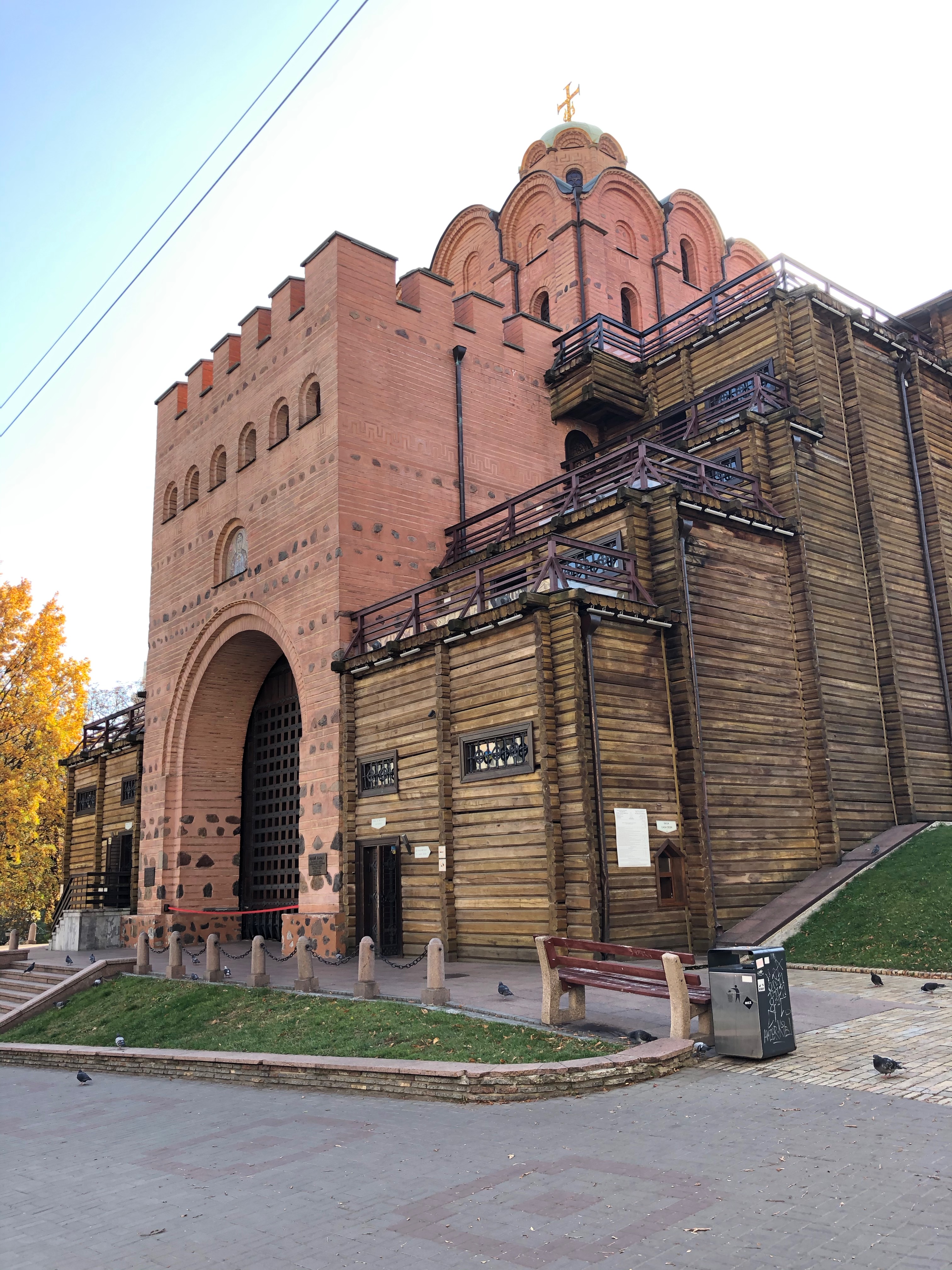
Golden Gate – or ‘The Great Gate of Kiev’

The Great Gate of Kiev, (as Mussorgsky called it,) or the Golden Gate of Kyiv, (as the Ukrainians call it,) was one of three main gates to this city, another being the Jewish Gate, because there were so many Jews living here, and a third being a small gate opening out onto marshes.  The ‘Kievska Rus’ era included great churches in the city bedecked with fabulous mosaics and frescoes.  In the 10th-11th centuries it was the largest and most powerful state in Europe.

St Sophia Cathedral, Kyiv, 1037AD
St Sophia Cathedral, Kiev

But the small gate onto the marshes was the weak spot of the city, and when the Turks and Tartars came to attack, in the 13th century, they waited for winter and walked across the frozen marsh into the city and conquered it.  This was, for the Ukrainians, the first of many such occupations.  For the Lithuanians were soon to take control, and then the Polish, and then the Russian Empire, and then the Soviet Union.

Babi Yar, Kiev 1941

It was during the Soviet era that Kyiv saw probably its darkest days, first with the millions who were starved or simply ‘disappeared’ by Stalin, and then, when the Nazis occupied the city in 1941.  Although probably some 100,000 people were killed during the Nazi occupation, in Kyiv, the worst of all these mass killings took place over two days, when 33,771 Jews were slaughtered, with machine guns, and with the assistance, as our guide told us, of the Ukrainian Auxiliary Police, at Babi Yar.

Babi Yar Memorial

From Kyiv, then, we took the road across country to Kamianets-Podolskiy.  The roads in the Ukraine are in a terrible state, once you get out of Kyiv, and it is slow and heavy going.  But the Autumn colours, mixed with the unprecedented October heatwave (some 10degrees above normal) made for a very interesting journey, both across this broad and fascinating country, and back in time, both to one of the most historic cities of the region, and to my own, family history.

Kamianets-Podolskiy is an incredible city built in and around a stunning ‘island’ of rock.  An earthquake millions of years ago tore apart this land and created a deep ravine in an almost circular shape, making for a perfect space to defend from enemies.  The resulting city, and the castle defending the bridge across to it, became one of the most multi-cultural, multi-ethnic cities of the region, and was, at times, capital of various kingdoms and principalities.

The town has its own ancient pagan origins, of course, with the archaeological museum including both items from an ancient pagan altar -the time of the Trypil culture – and several Stone Babas, too.

Stone Baba, 7th-3rd century BCE

During the Mongol occupation, when Islam was the overarching religion, minarets were built, but not all these were destroyed when the Eastern Orthodox Christian tribes regained control.  Here, uniquely perhaps in all Europe, there is a minaret with a statue of the Virgin Mary on the top, as part of the Roman Catholic Church.  This was the one church that survived the Soviet era, kept as a museum against religion, when all the other churches, mosques, and all but one of the synagogues were destroyed by the Marxist Fundamentalists under Stalin.

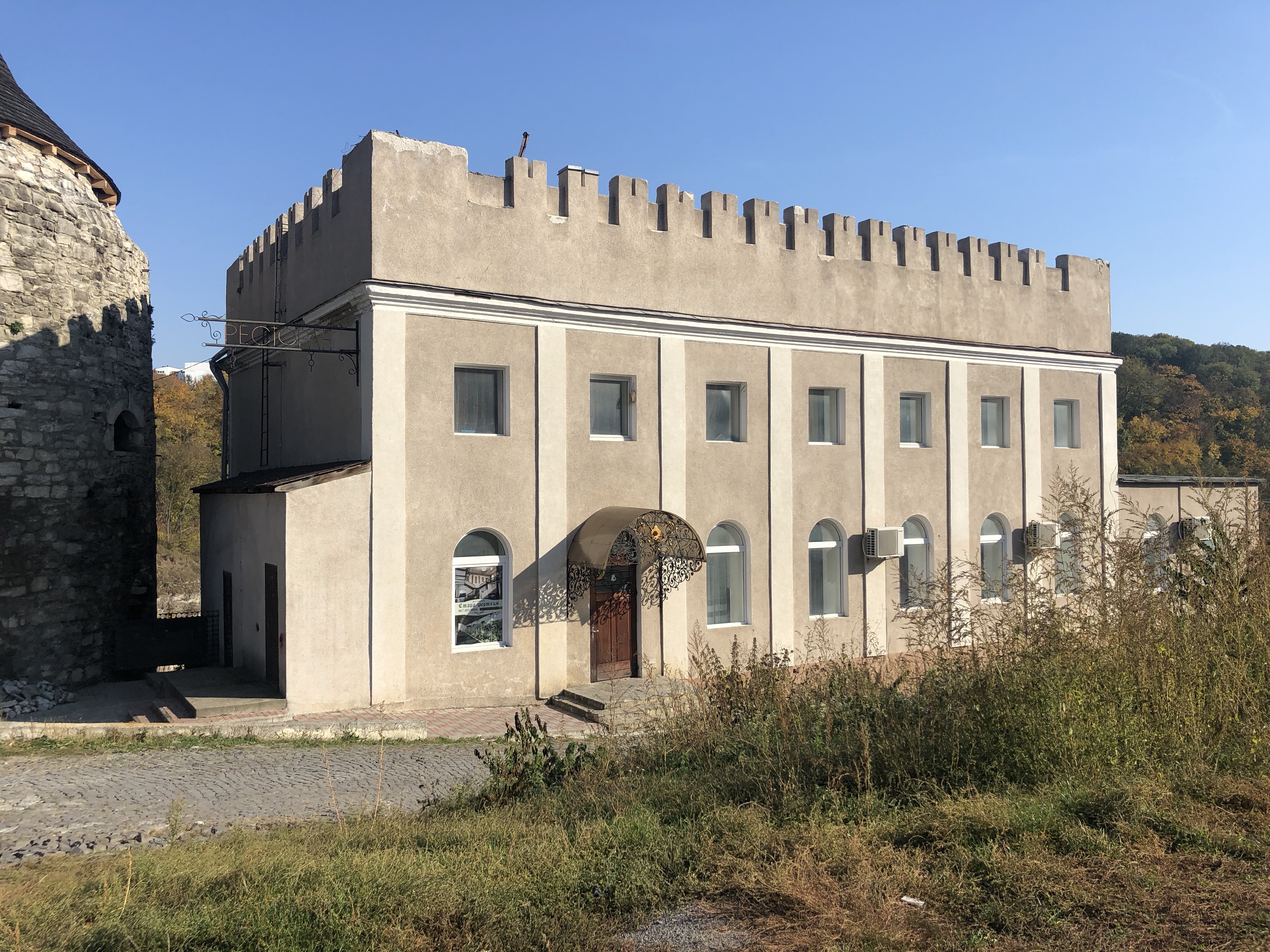
Old Synagogue now a restaurant, on the edge of the island city

Over the centuries between the Mongol and Soviet occupations, there were Armenians, Greeks, Poles, Russians, Jews and Ukrainians all living here in their own ‘quarters’ of the city, all at once, the fortunes of each rising and falling according to which Empire was in charge.  During the Polish empire (very Roman Catholic) the Jews were not allowed to live in the city, and began to live in ‘shtetls’ – small shanty towns – on the outskirts, their trades restricted to certain professions only. Then Russia took possession of much of the Polish-Lithuanian Empire, including Kamanets, now part of what was declared the Pale of Settlement.

View of the castle from the (Polish era) 18th century Jewish Cemetery outside the city

During this occupation by the Russian Empire, by the 19th century, Jews were not only allowed to engage more fully in the life of the town, but had their own quarter in the old city on the ‘island’, facing the castle across the bridge, as well as occupying a large village at the foot of the ravine below the bridge (now the site of a Soviet era power station). Of course, “no Jew could be employed as a teacher, or by banks, by the railroad or in the post office, in telegraph or telephone offices, in the courts or in any capacity by municipal, regional or state subdivisions including the police. Jews were not allowed to serve even as janitors or jail guards.” (Jewish Gen) nor could they travel in Russia beyond the Pale. But life in Kamianets was probably not all that bad. There is, today, both an Armenian Square and a Jewish Square in this part of the old city.

View of the site of the old Jewish village below the bridge, from the Jewish quarter of the old city

The rivers in the ravine – because the area, millions of years ago, used to be a sea – are brackish, and not good drinking water.  There are, therefore, only one or two deep wells where drinking water is available, and, therefore, a limit to the numbers of people the island city can support.  In the late 19th century Kamianets-Podolskiy was very over-crowded.  There were Cossack-led pogroms against the Jews in various parts of the Russian empire, following the assassination of Tsar Alexander II, in 1881, and Jews were expelled from elsewhere to live in the Pale, expanding the population of towns like Kamianets.  Many Jews left altogether, seeking a new life in the West, often passing through London on their way to North or South America, or South Africa, some – like my great-grandfather – staying in England.  I guess coming from such a multi-cultural, multi-ethnic, thriving and crowded city like Kamianets-Podolskiy, London seemed like a home-from-home for Samuel Kreps.   Those Jews that remained in Kamianets-Podolskiy into the 20th century (some 40% of the population in 1939), were all murdered by the Nazis in August 1941.

To crown my visit to Kamianets-Podolskiy, then, I was taken, finally, to the 19th century Jewish cemetery, sadly in very poor condition now, though there are others not far away looked after by Marla Osborn and the Rohatyn Jewish Heritage project.  This was, in many ways, the point of the journey for me.  As I said to Colin, who took the photo, below, there were undoubtedly people there whom my great-grandfather would have known.   I don’t really understand quite why it matters, but it does; it does.  It is important that we never forget.

More photos, as ever, on Flickr.