Nepal-Bhutan May 2026 #5

Post #1 | Post #2 | Post #3 | Post #4 | Post #5

Bhutan
What an enchanting country! Land of the Thunder Dragon, where Gross National Happiness (GNH) is officially more important than gross national production, a land devoted to (mostly Tibetan) Buddhism brought south by the venerated Tibetan Lama Guru Rinpoche in the 8th century CE, but with its own little twists – mainly from the Tibetan Lama Zhabdrung, the founder of the modern nation in the 17th century. These two figures often make a trio of statues, in the Temples here, with the Buddha in the middle.

Here, although there is also clearly some poverty, the country seems better off than Nepal.  The roads and the buildings I see beside them certainly give that impression – and everything has a definite Bhutanese style, which is evident the moment one arrives. 

1/6/26
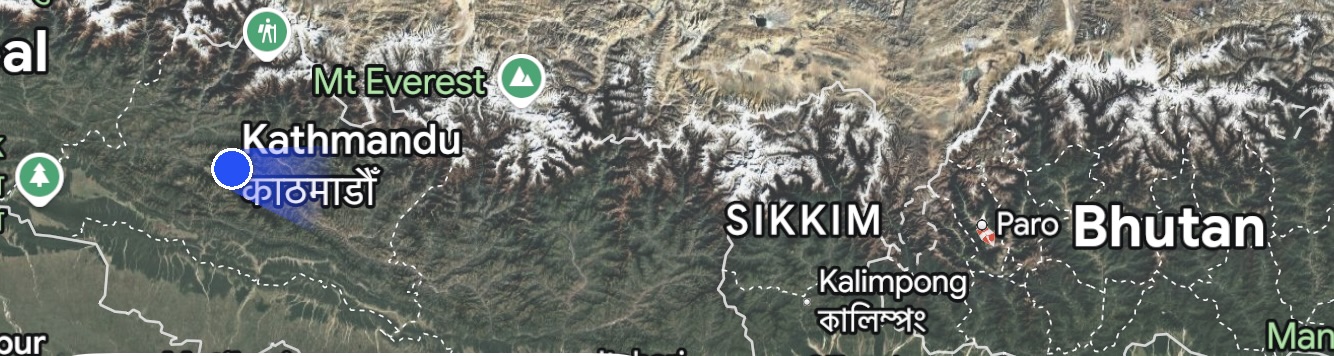
Kathmandu to Paro

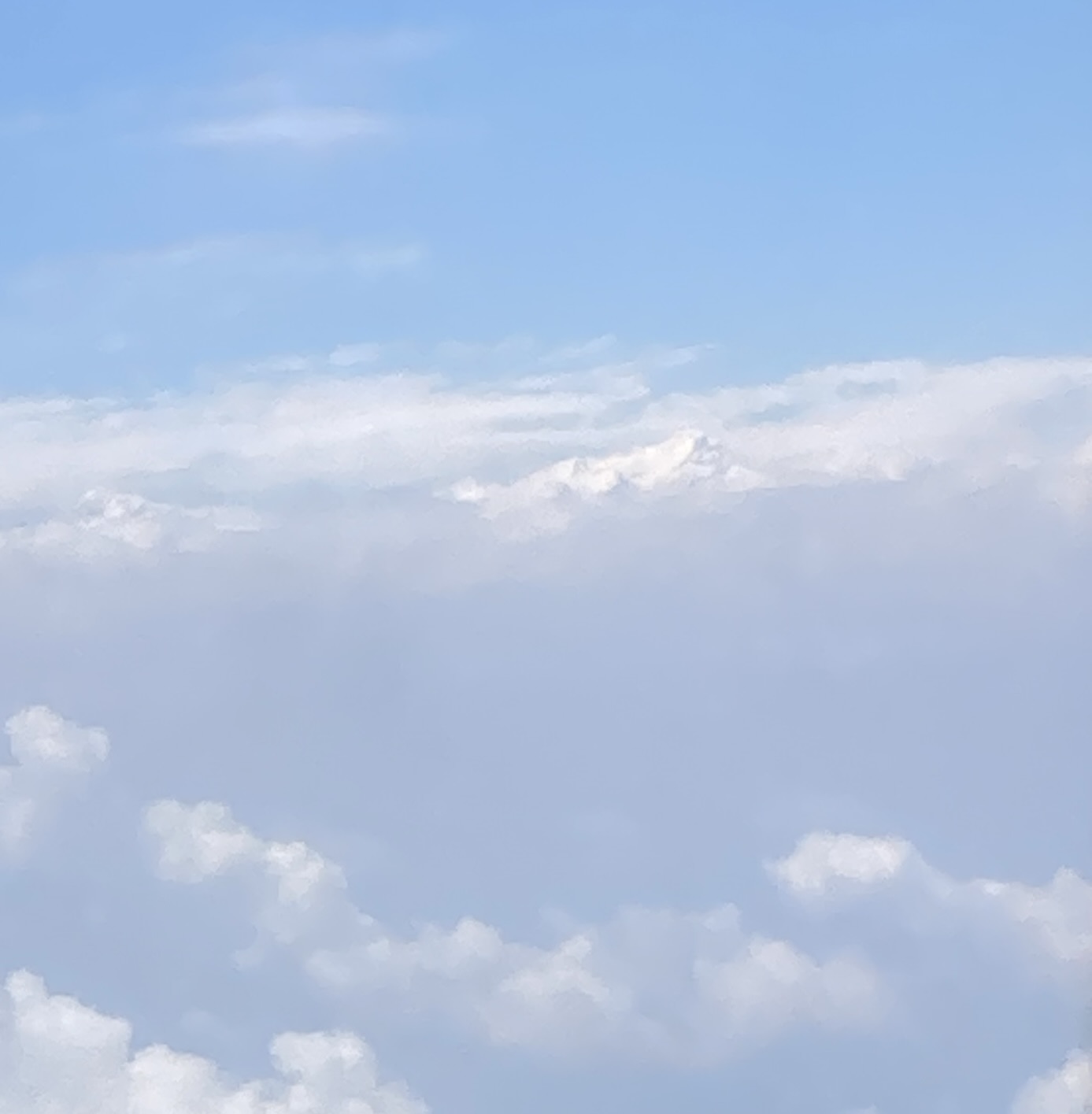
The journey from Kathmandu to Paro – Bhutan’s only International Airport – passes several of the highest mountains in the world, including the iconic Everest.  I am truly blessed with a beautiful morning and an extraordinarily good view of the mountain peaks, from my seat on the left-hand side of the plane (arranged by my tour operator!). 
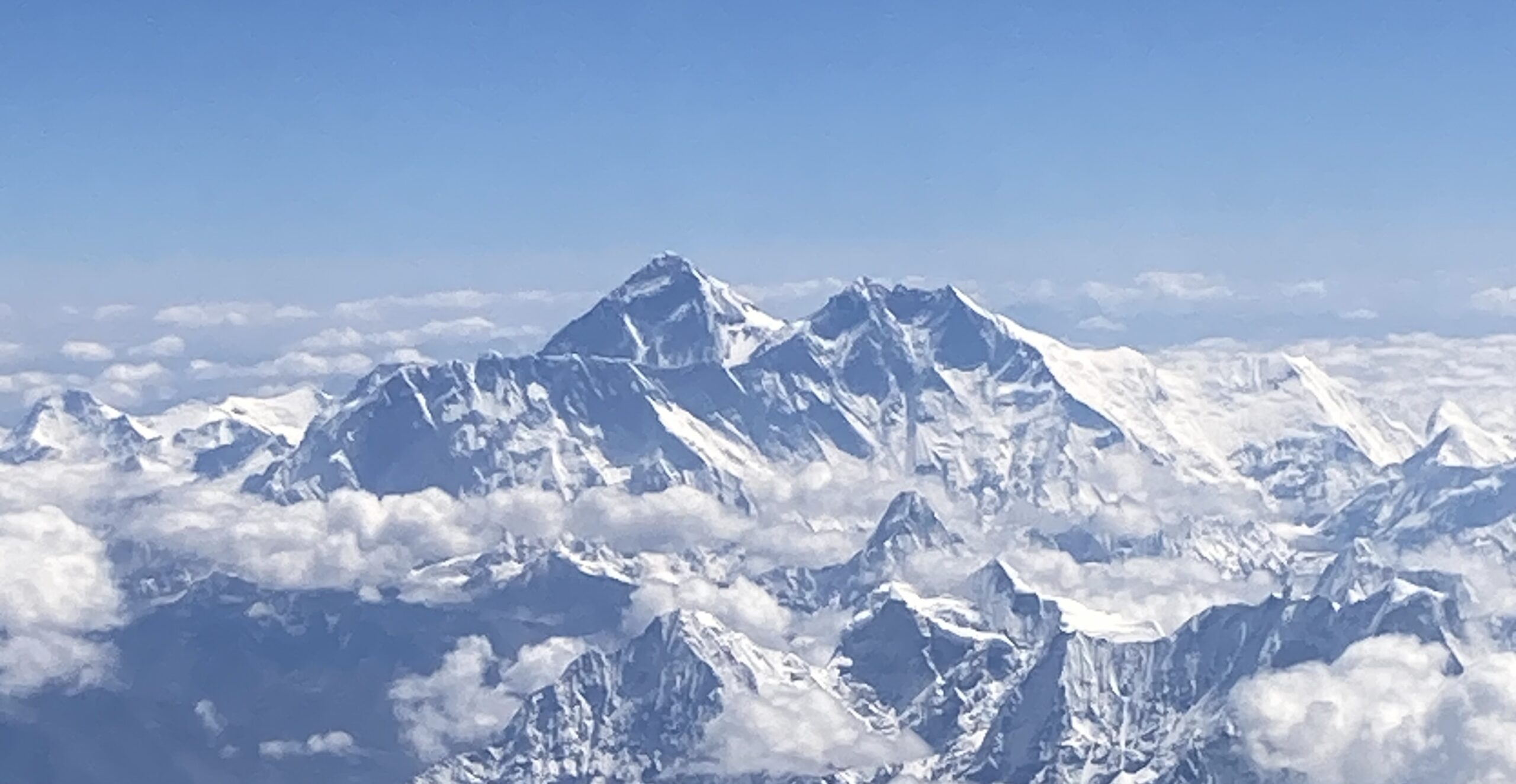
Everest
Mount Everest – from the plane

The final approach, moreover, is like something out of a movie, where the plane swerves and turns through a series of valleys on its way down to land – fine if you’re in a jet fighter but in a Boeing 737 it was an amazing ride!  Apparently there are only about 25 pilots qualified to make this landing at any one time.  I’m not surprised!
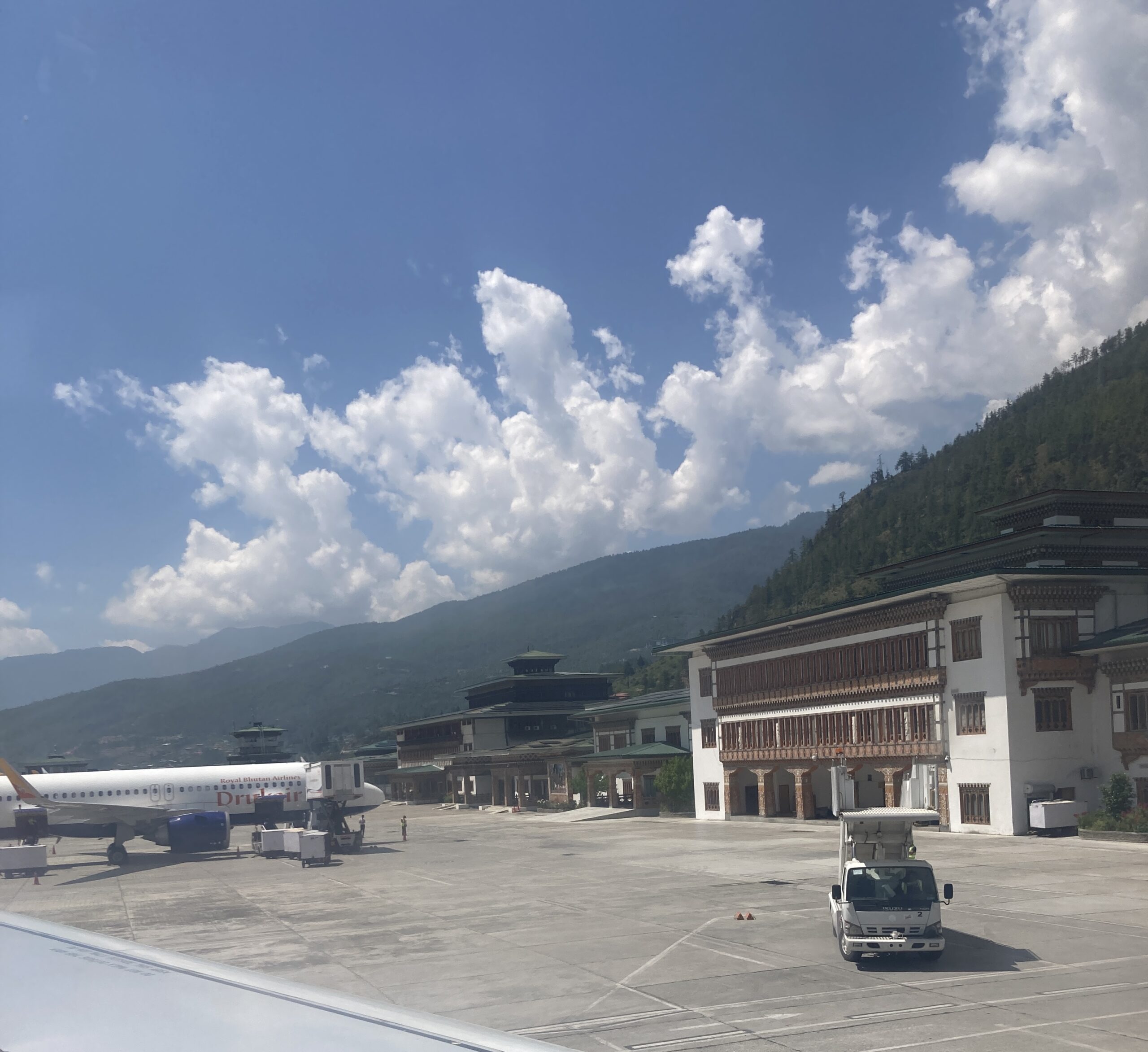
Paro Airport
Paro Airport

Paro Airport is the introduction to the wonder of Bhutan: as in most developed countries, planning permission and construction standards are required for any new building.  Here in Bhutan there is also a requirement to adhere to the national character, with carved wooden facades and everything else (as much as possible) in wood and stone.  Although arguably it makes all the buildings look rather similar, it also means that there is little (if any) of the brashness of global branding, ugly concrete blocks, or half-built brick blocks with steel reinforcements sticking out, as is so prevalent across Nepal.  It makes for a very beautiful place.  When, amongst all the newer buildings, you discover the medieval ones, in the same style, but much older, you appreciate what they have done here.  It is also true that fire and earthquake have destroyed some of the medieval buildings, but they have been completely rebuilt in the exact same style.  Bhutan’s tourism, moreover, follows a policy of high-value/low-impact.  There is a hefty tax all tourists pay just to be here. This keeps out most backpackers, and keeps down the numbers.  The places to visit, moreover, could clearly not handle high volume tourism, in any case.  It all makes for a sense of an exclusive holiday, and I feel truly fortunate.

Dressed in Gho
Dressed in Gho

Sonam, my guide, tells me a great deal about the country, about its history, and about its religion, the highlights of which I shall try to share in this blog.  He and his young driver, Doji, are – like most of the men I see here, attired in the national dress, which is a Gho – a robe which is hitched up in the middle with a tight sash, and arms that fold back on themselves with white cuffs tucked over them.  The robe thus makes for a kilt-like feel above the knee, with long black socks below. They look cool and quite practical in the heat here, and on the spur of the moment I include men’s national dress in the short list of souvenirs I tell Sonam I would definitely like to acquire, hopefully with his advice on where best to get good quality examples.  I, of course, also want some “organs” as he describes them.  For one of things that most fascinates me about Bhutan is that the old religion here, which remained strong right up the 8th century CE when Buddhism arrived, was centred around the Phallus. 
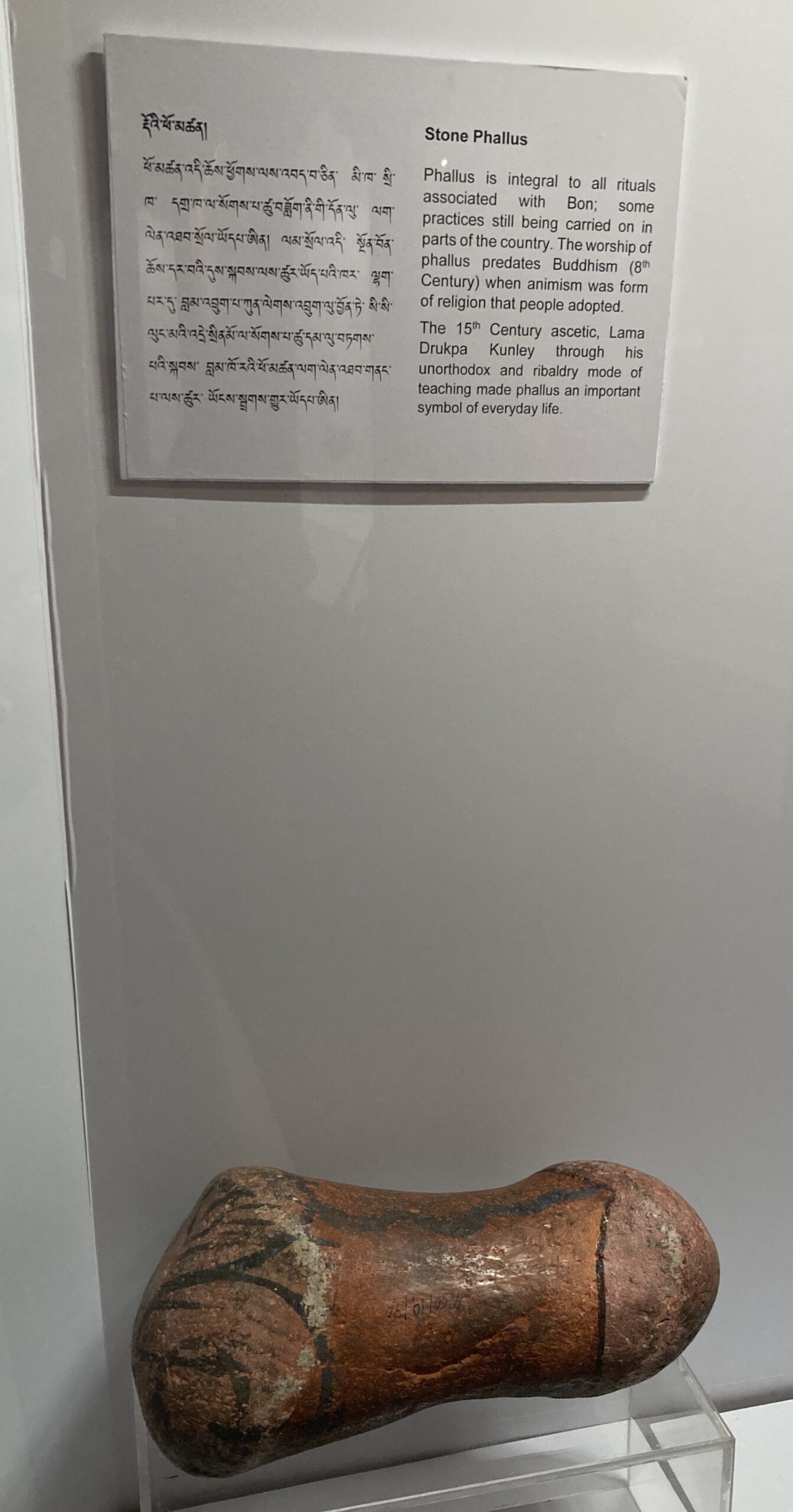
Medieval stone phallus

It was called Bon, and Bonpo Buddhism is a not unrelated development out of it.  But the Tibetan Lama Drukpa Kunley, who came south to teach here in the c15th CE, brought the fascination with the phallus into Buddhism, too, such that representations of it, in paintings on buildings and in wooden and stone sculptures of it, are absolutely everywhere you look.  I love Bhutan. Land of the Thunder Dragon!  The white dragon on the national flag signifies purity, with a yellow triangle and an orange triangle signifying the administration of government twinned with the hierarchy of monastic life.
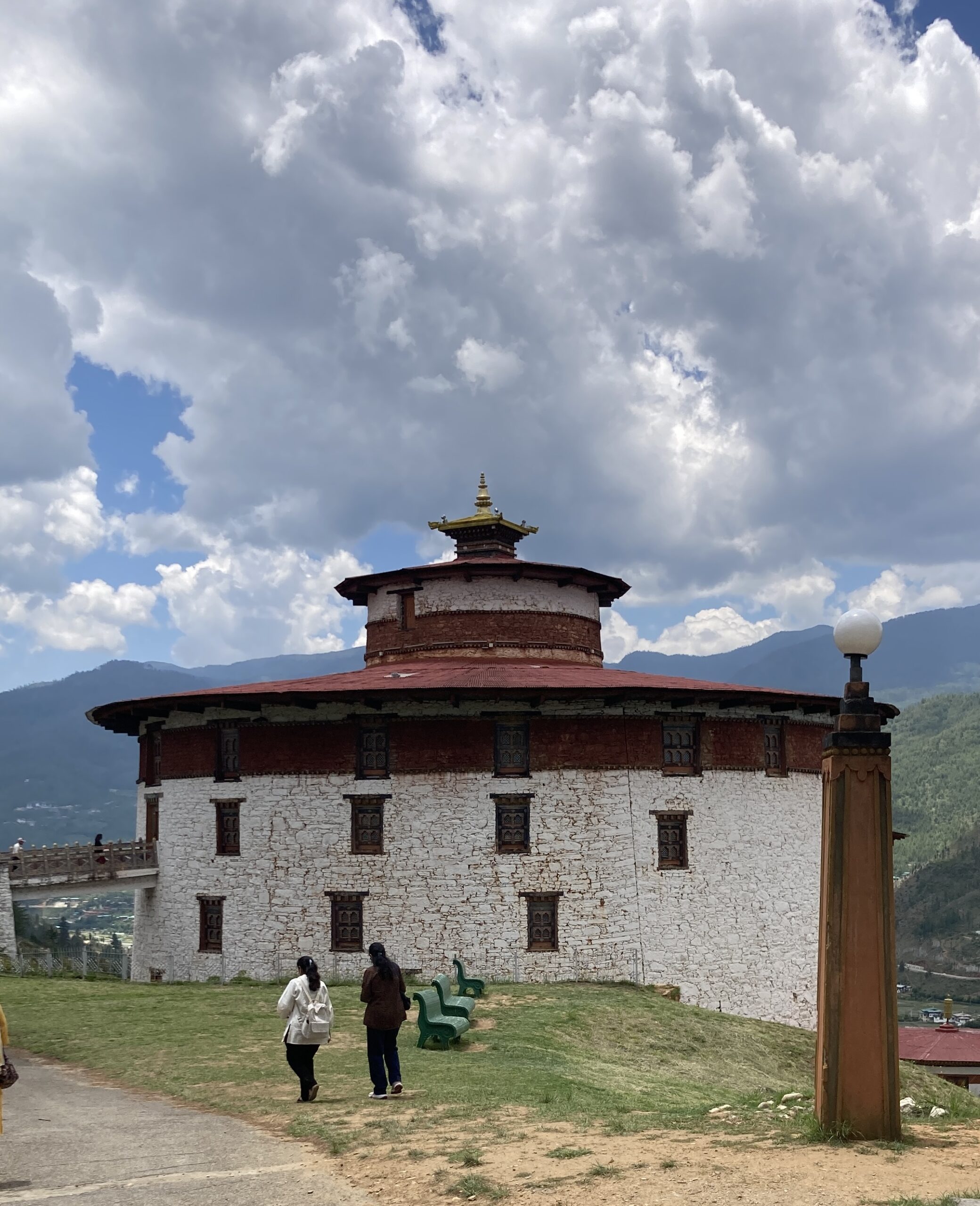
National Museum
National Museum

We visit the Taa Dzong (National Museum) first, which is a medieval building on seven floors filled with artefacts and information plaques, and Soram tells me many stories about the things we see.  It is a fascinating immersion in Bhutanese history and culture.  I am struck by the many Thangka paintings, and delighted by the many varied artefacts we see.  I am also – by the end of it – exhausted by all the stairs, up and down, (having been awake since 4.30am, and up since 5.30am, to get here).  Below the National Museum, the Rinpung Dzong medieval fortress, converted in modern times into an administrative centre for the Paro district and monastic centre, is a stunning building, with a really lovely Buddhist temple, and Soram takes me through explaining all the various statues and their mudras.  
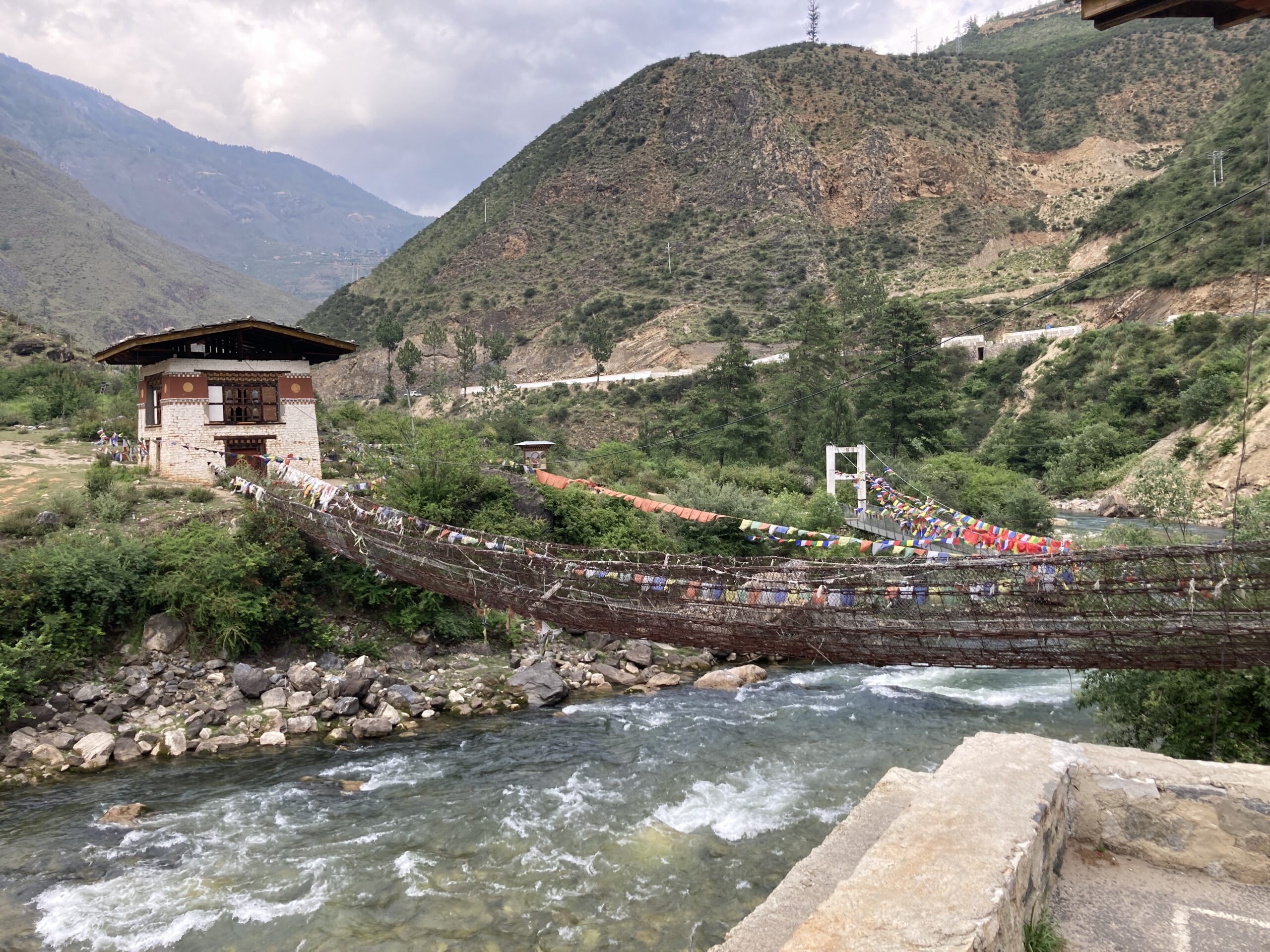
Ironlink Bridge
Ironlink Bridge

On the drive, then, from Paro to Thimpu, we stop off at two smaller temples – Dungtse Lhakhang and Kyichu Lhakhang.  The first is a place where there is a small Buddhist temple inside a stupa – very unusual!  Bhutanese Stupas are square with a wide roof, but inside this one is hollow and incorporates four Buddhas facing in each direction.  The second is perched on a hillside above where two rivers meet, across an iron-link bridge.  The Lama Zhabdrung, who came from Tibet and brought the knowledge of finding iron ore and making iron rings, with which numerous bridges were made across the many rivers, is a very fondly remembered character in Bhutanese history.  He was also responsible for building many temples, and fortresses.

2/6/26
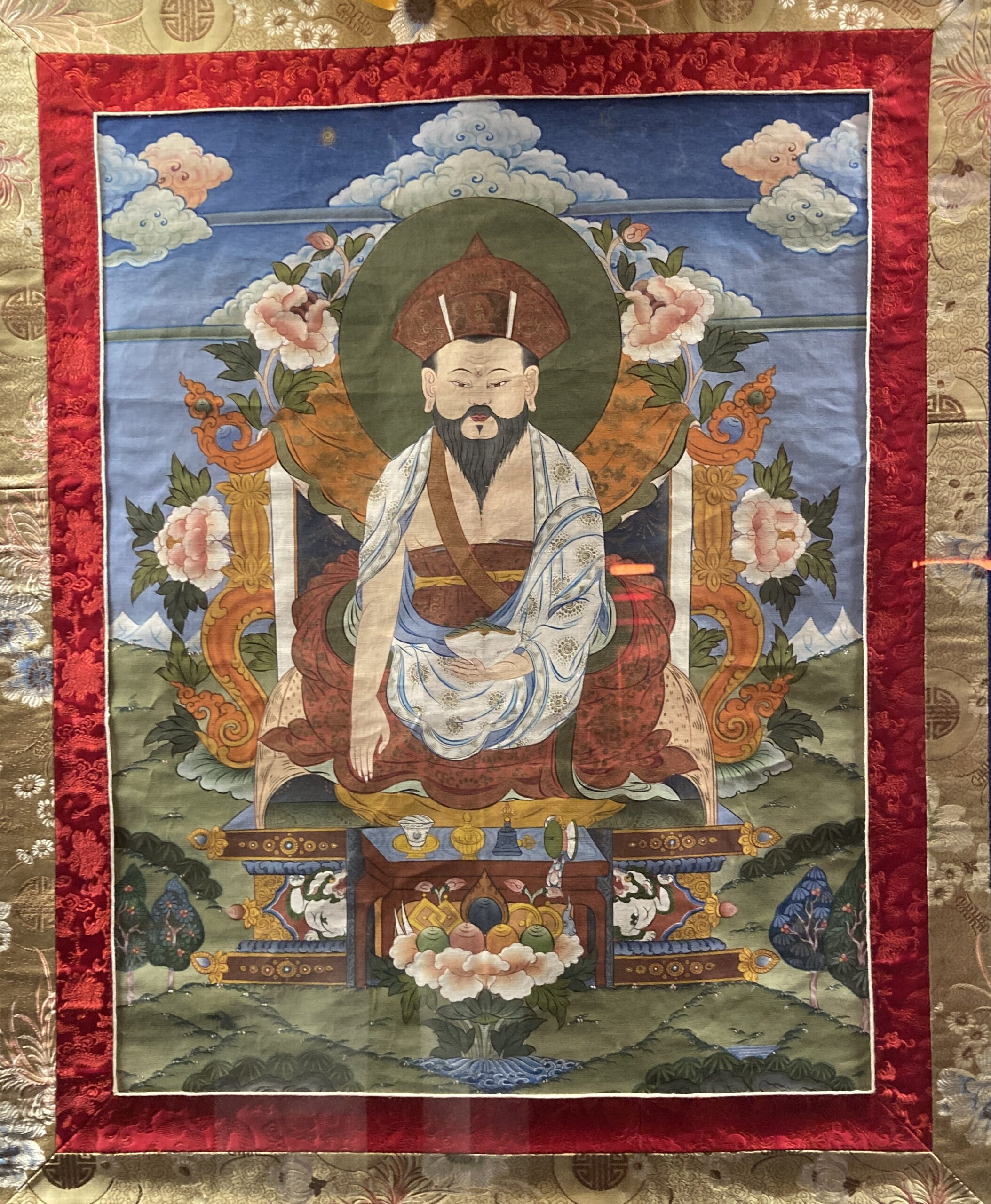
Zhabdrung Ngawang Namgyal

After a lovely stay at Terma Linca Hotel – where I tried some authentic Bhutanese food (very spicy!!) today’s sightseeing took in the Memorial Chorten, the Buddha Dordenma Statue, the Takin Reserve, a Handmade Paper Factory, and the crossing of Dochula Pass.  After breakfast, Soram helped me to dress properly in the Bhutanese Gho I bought yesterday, and all day I am complemented with smiles and appreciation both from the Bhutanese and some of the many Indian tourists that we meet along the way.  With my long white beard, I am frequently told I resemble closely the highly venerated founder of Bhutan, Zhabdrung.  This Lama, my guide tells me, in the 17th century CE, was head of a district of Tibet called Druk, and held that position as a reincarnation of a particular boddhisatva. But the prime minister of Tibet, and a challenger who claimed that he was the reincarnation, and not this Lama, conspired to force him out of his role.  To the south, one of the many small chiefdoms in the area that is now Bhutan gave him sanctuary.  He then was given the leadership of that chiefdom, and began to fight many battles to gradually unite all the chiefdoms into one, new kingdom.  Whilst these battles were underway, however, the usurper of the Druk region of Tibet discovered that the precious relic that was the most sacred possession of that district’s governor had been taken by the Lama when he fled south.  With his ally the Tibetan prime minister, he then began to invade south.  So as well as fighting battles to unite the chiefdoms, he also had to fight off the Tibetan armies invading from the north.  In the end he was successful in both endeavours, and established the new kingdom of Bhutan – which is another word for Druk (the name of his former Tibetan district), which means Dragon.  He held this new kingdom – the land of the Thunder Dragon – together for 85 years, including 50 years after he had died, when his immediate circle kept his death a secret, and only the power of his name kept chaos in check.  Eventually the truth got out, and, as expected, the kingdom quickly fell apart into separate chiefdoms again.  But the precedent had been set, and about another 120 years later, in 1907, a second founder united the kingdom once again and established a new kingdom under the Wangchuk Dynasty – the fifth generation of which is now the ruling monarch.  This new kingdom was set up as a dual space, half monarchy, half monastic order – a diarchal system – which, although essentially a Tibetan form of government, is only extant now in Bhutan, with Tibet itself under Chinese control since 1959.  The King and the head of the religion sit side by side in matters of state, so in some senses it appears like a theocracy – but perhaps not dissimilar to that of the United Kingdom, where the King is also the Head of the Anglican Church and Bishops sit in the House of Lords.  The third king, who modernised Bhutan in the 1960s and 70s, building roads and hospitals and joining the UN, was followed by the fourth and incumbent King who in 2008 stepped back from absolute rule and established the country as a constitutional monarchy, with a democratically elected parliament – and Gross National Happiness as the national measure.  But to prevent religious control of the parliament, the monks, nuns and senior clergy are not included in the franchise: they cannot vote.  Also to prevent corruption any politician campaigning for office found to have even offered sweets to entice voters can be banned from standing; whole parties can be disqualified if there is a whiff of graft.  The result, my guide tells me, is that the tourist taxes we pay don’t end up in people’s pockets, but are spent on the roads and hospitals and education that are all provided for free to the Bhutanese people.  
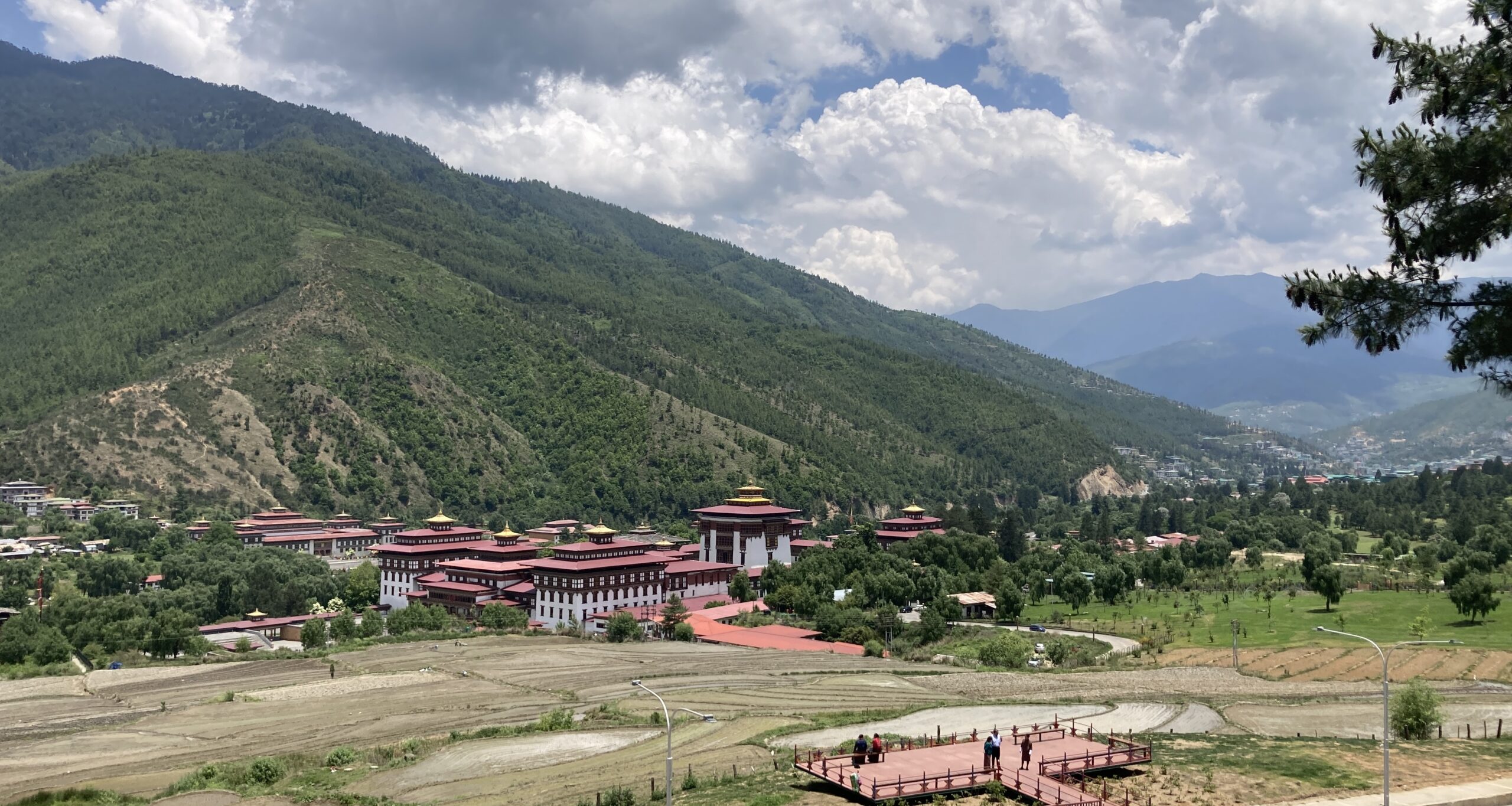
Tashichho Dzong
Tashichho Dzong

So, in my Bhutanese dress and with my long white beard, looking like the original founder of Bhutan is no bad thing.  The Bhutanese love their monarchy.  Most of the great fortresses, (Dzongs) that dot the landscape were built by him, in the late 17th and early 18th century, to fend off the Tibetans.  At Thimphu (the capital) we stopped to take pictures of the Tashichho Dzong along the way – a huge complex that now incorporates the Royal Residence, the Summer Palace of the head of the religion, the Parliament Building, and the Supreme Court.  On our journey we take in some breathtaking views on the way up, at the top, and then on the way down from the mountain pass.  
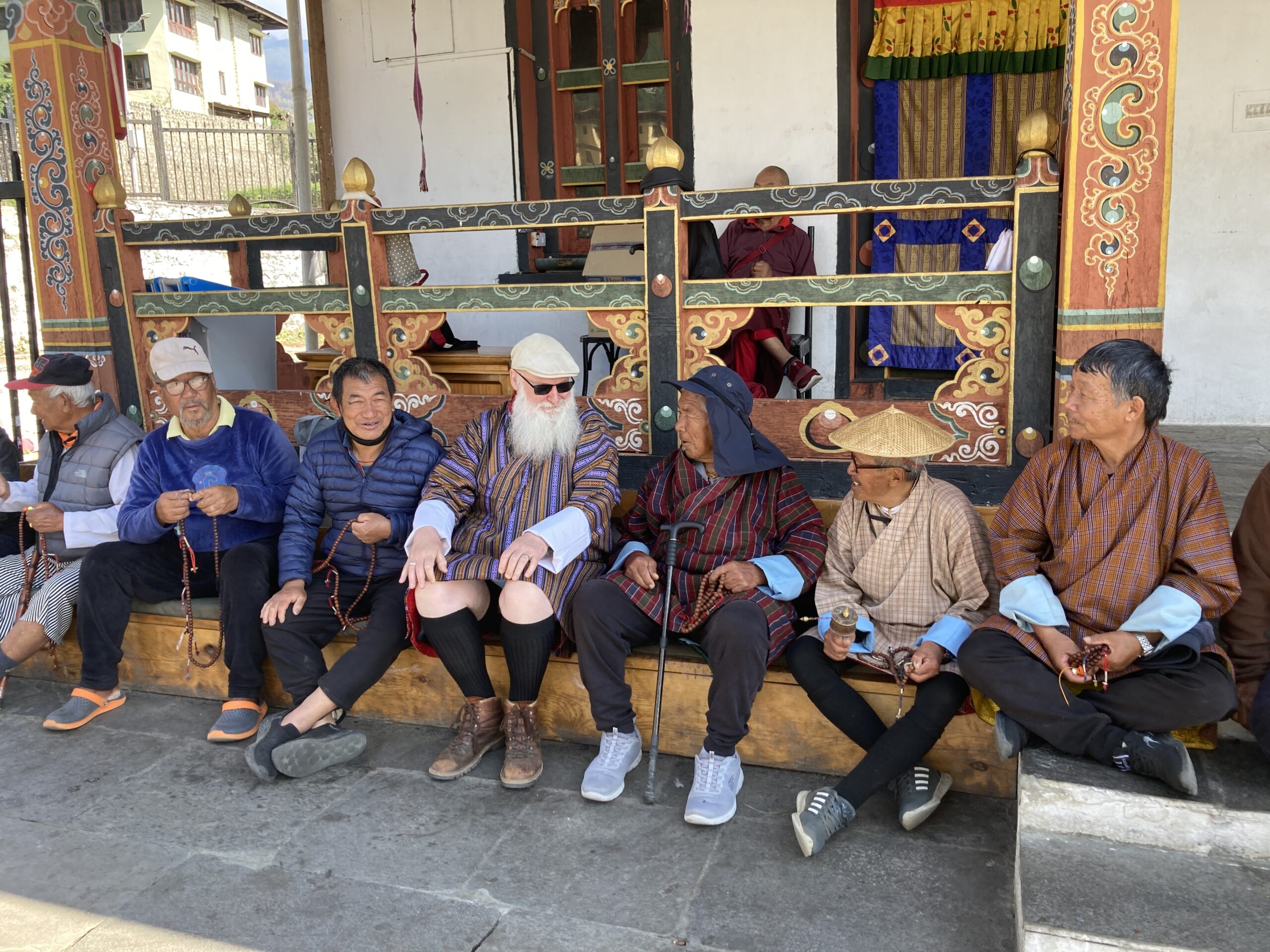
At the Memorial Chorten

The Memorial Chorten, where we started the day, was built in memory of the 3rd King who died young, and is a place where many of the old folks of Thimphu gather, to sit in the shade during the heat of the day.  As everywhere else, it’s no shoes and no photography at these temples, so I am only able to tell you that the artistry, craftsmanship, and incredible stories represented in these places are breathtaking.  It is also true that, by now, I must confess I am starting to reach overload: there has been a lot to take in over the past days, first in Nepal and now in Bhutan, and my brain is getting saturated and less able to retain much of the information that I am being given by my very helpful guide.  All Bhutanese learn English at school, and speak it well, so Sonam and Doji are able to communicate with me very well, which helps! 
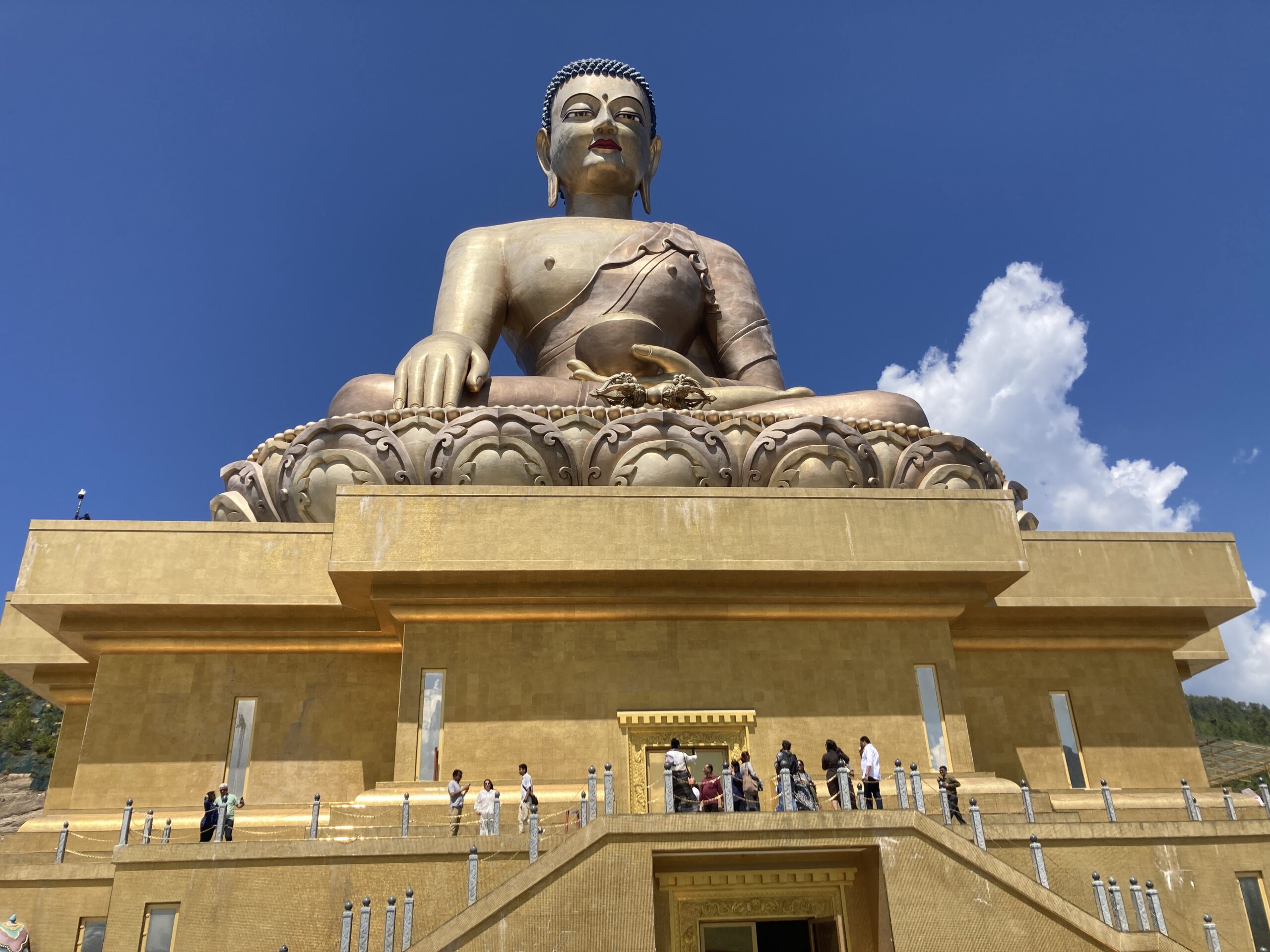
Dordemna Buddha
Dordenma Buddha

The highlight of the day, for me, however, was the Dordenma Statue – an absolutely huge Buddha, with a Dorje (the thunderbolt of indestruction) at his feet, inside of which is an incredibly ornate temple.  The entire project is still unfinished, costing some $100m,  with donations from many other Buddhist countries, and this incredible monument sits on a ridge overlooking the capital, Thimphu, a city which snakes from north to south along a wide valley. 
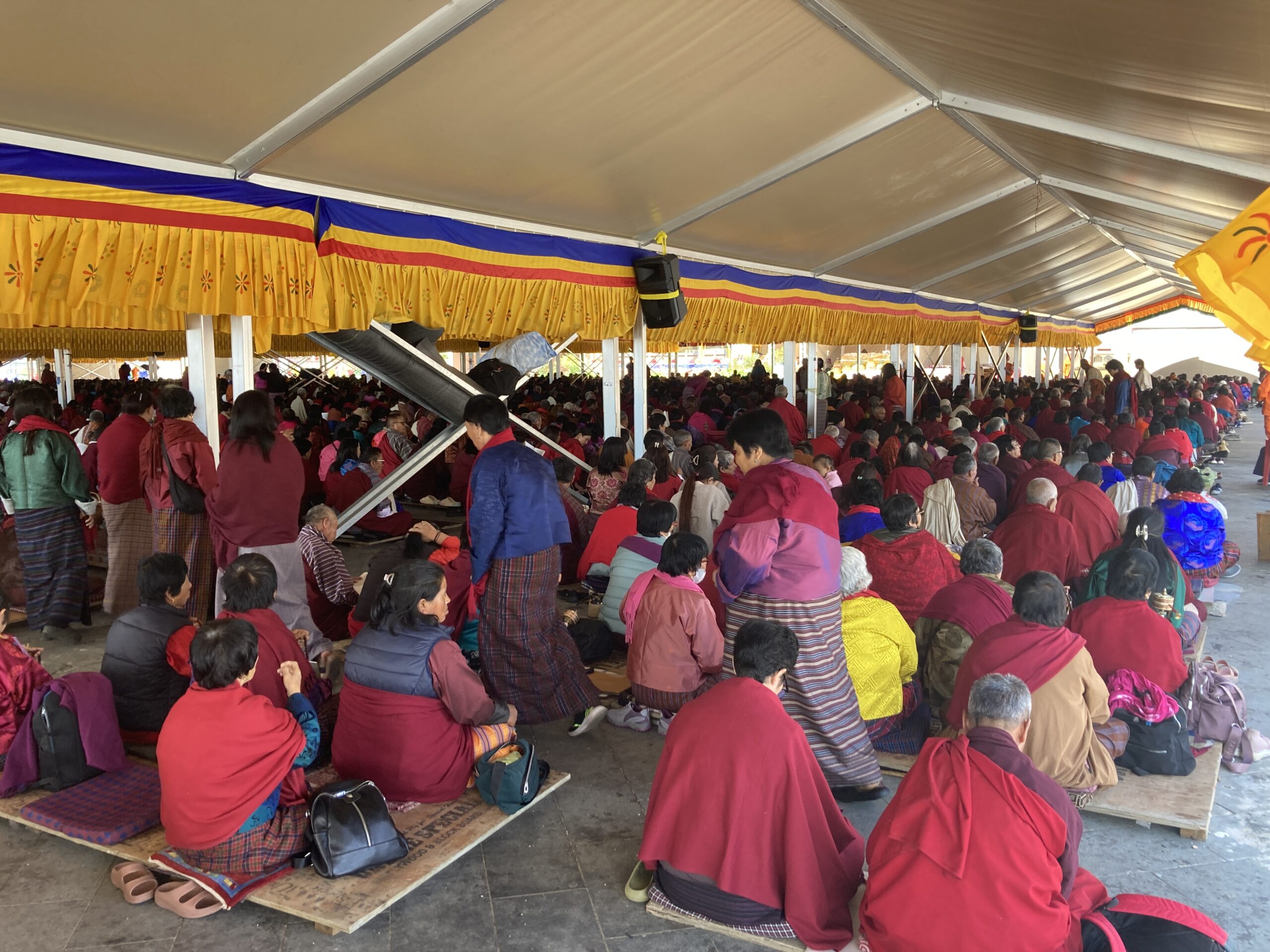
Festival at Dordenma

At the giant Buddha, it is a festival day, and we walk in minutes before a member of the royal family arrives in a cavalcade of 4x4s, to be greeted by an array of Bhutanese army officers, and a range of monks – many in the orange robes denoting they are of the highest rank.  The VIPs take up their places under a separate group of small marquees to one side of the huge marquee where literally hundreds of devotees are gathered, all sitting on cushions on the floor, under the awnings at the feet of the Buddha. 

Over huge loudspeakers, a venerable Lama is intoning mantras: it is an oral transmission, a teaching and blessing from a great master to all who are interested – including, it seems, today, members of the royal family and the military, along with the most senior clergy in the country.  I am amazed, frankly, that we are all here without having been thoroughly searched, frisked, vetted, etc, but then that sort of security is clearly not needed here in the wonderful land of Bhutan.
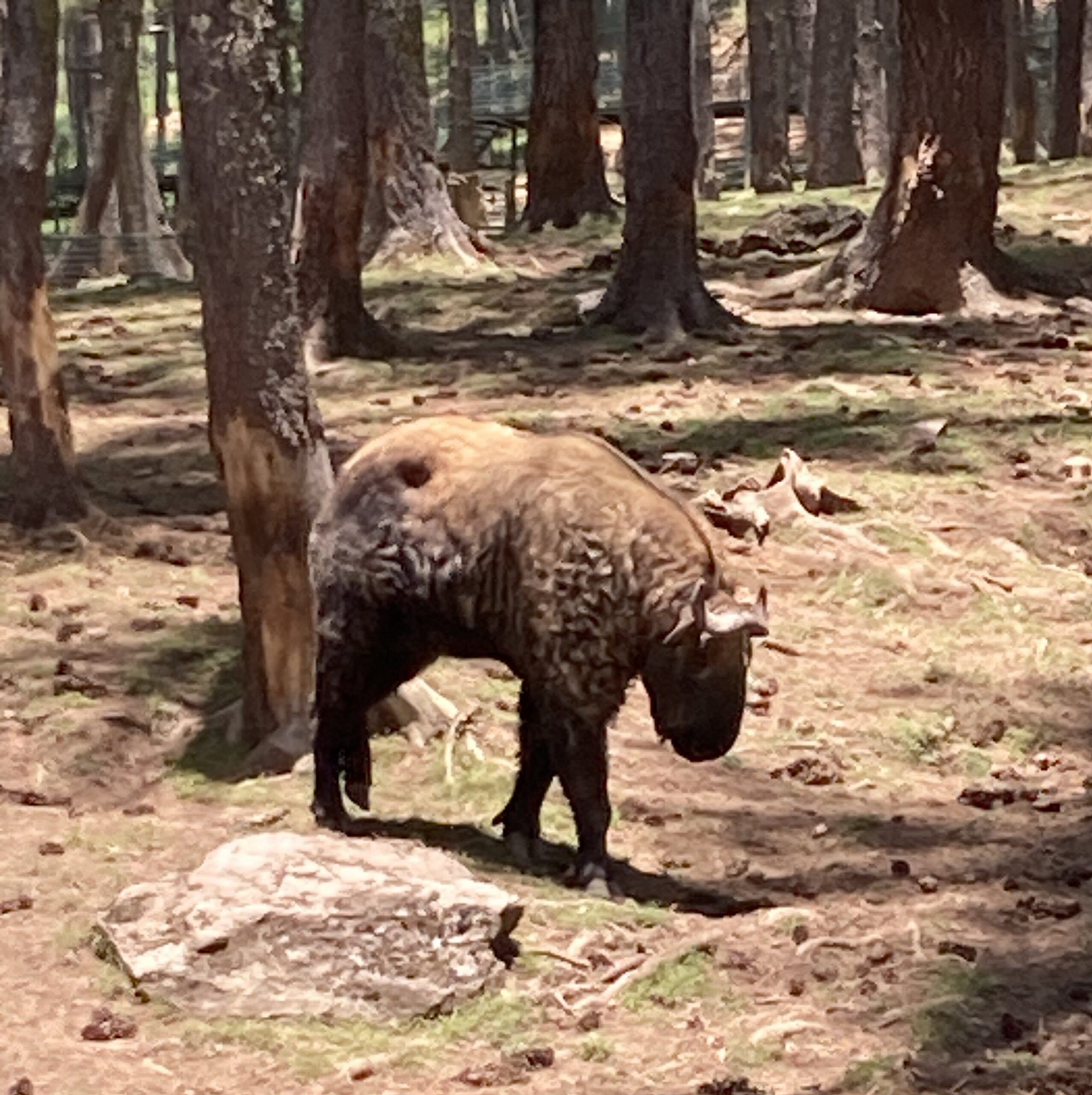
Takin
Takin

On the way to the pass we stop for a coffee and some mo-mo (delicious little dumplings) in a cafe at a preserve (you couldn’t call it a zoo) where some of the potentially endangered indigenous wildlife of the region are conserved and cared for, including the national animal of Bhutan, the Takin.  I hadn’t ever heard of one either.  It’s a kind of a cross between a cow and a goat, and has a low rumble that is neither a low nor a bleat.  There are also Yak and local deer and some very colourful birds here.

The high Dochula Pass (over 3000m) is cool – very welcome after the 23’ heat of Thimphu, and especially welcome as the temperature at Punackha, where we are headed, is likely to be around 30’.  It is 2000 metres below the pass, whereas Thimphu was only 1000 below.

3/6/26

Today – the last proper day of sightseeing – began early at a nunnery only minutes from the hotel.  I was delighted that in fact we arrived at breakfast time, and all the nuns were in the temple, intoning the mantras, banging the drums, blowing the clarinets, and being served butter tea and rice.  Invited in to sit quietly in a corner, it was such a privilege to witness this at the same time homely and devout ceremony.  The nuns ranged in age from toddlers to middle-aged.  Teenagers served the tea and food.  Older women supervised.  On the secondary throne (not the empty one reserved for the head of the religion) the Principal sat, leading the mantras.  This – apart from myself and my guide – was the only man in the room.  At the end of the breakfast, he stood and walked over to the altar side of the temple, and gave a little lecture to the assembled females.  There were titters and some laughter – obviously whatever he had to say he was doing so with humour.  My guide explained to me afterwards that he was telling the women that the ritual cakes they made as offerings should be uniform in shape, and that the tray offered up this morning included quiet a variety of shapes and sizes.  Many of the guides bringing tourists here, he told them, grew up as monks and they will be able to tell; and besides these are offerings to the Buddha and to the Boddhisatvas, and this should be done properly.  For all the criticism it was all clearly done with compassion and humour.  The intoning of the mantras, and the banging of the big drums, and the piping of sacred clarinets, made for a mesmerising and very peaceful start to the day.
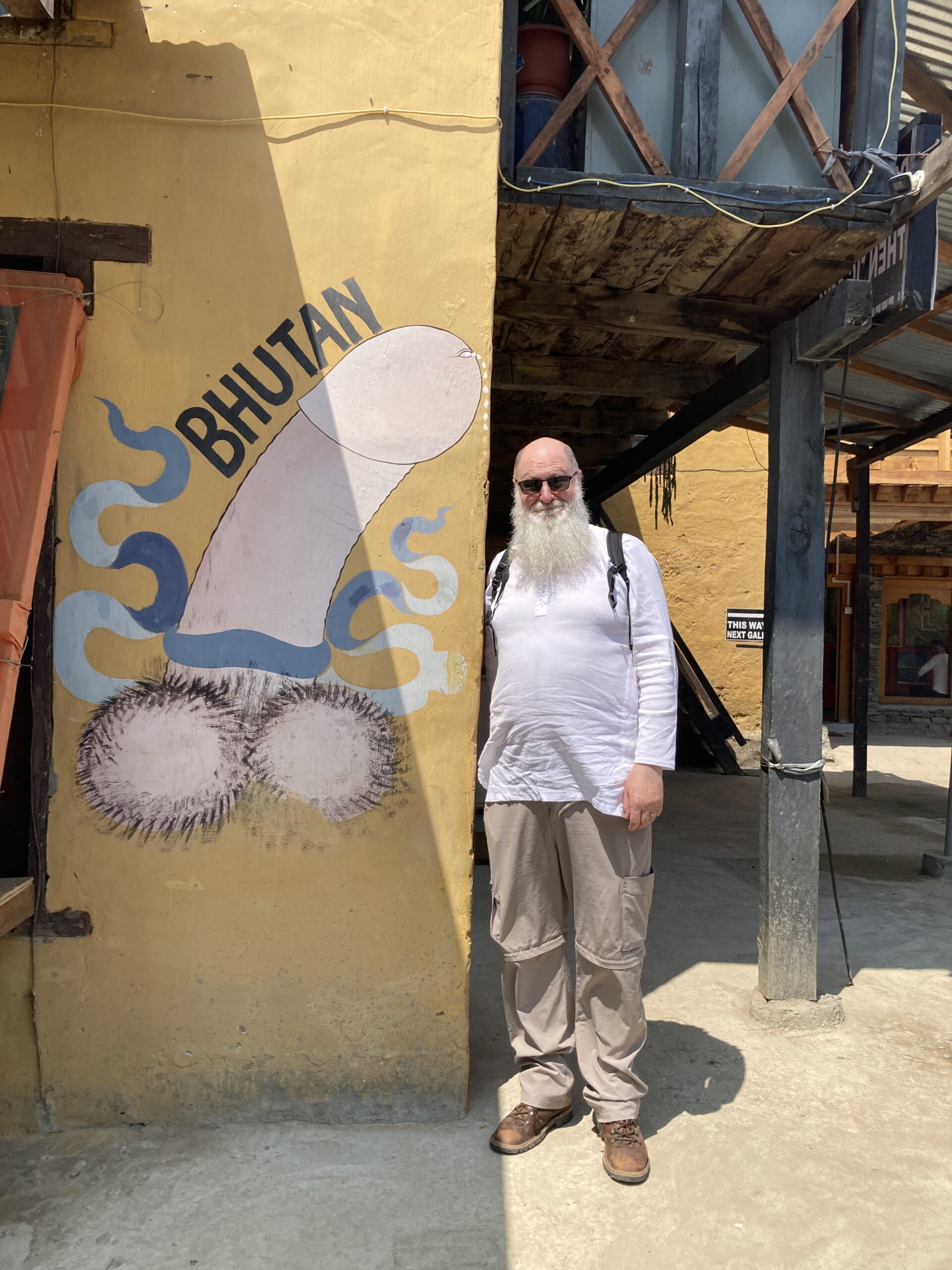
Phallus Wall-Painting

We then drove to Chimi Lakhang, and the little village of Sopsoka – the beating heart of Bhutan’s famous fascination with the erect penis: the phallus.  Readers of this blog may remember that 10 years ago I visited a Phallophoria at Tyrnavos in Greece, and witnessed their celebrations of Clean Monday, where the whole village came out sporting big phalli, the baker made phallic loaves, and there were phalluses everywhere.  I wrote a long blog-post about the Phallus around the world, through history, much of which was later published as a chapter in a book about the Phallus, including many photographs that I had taken in various parts of the world.  
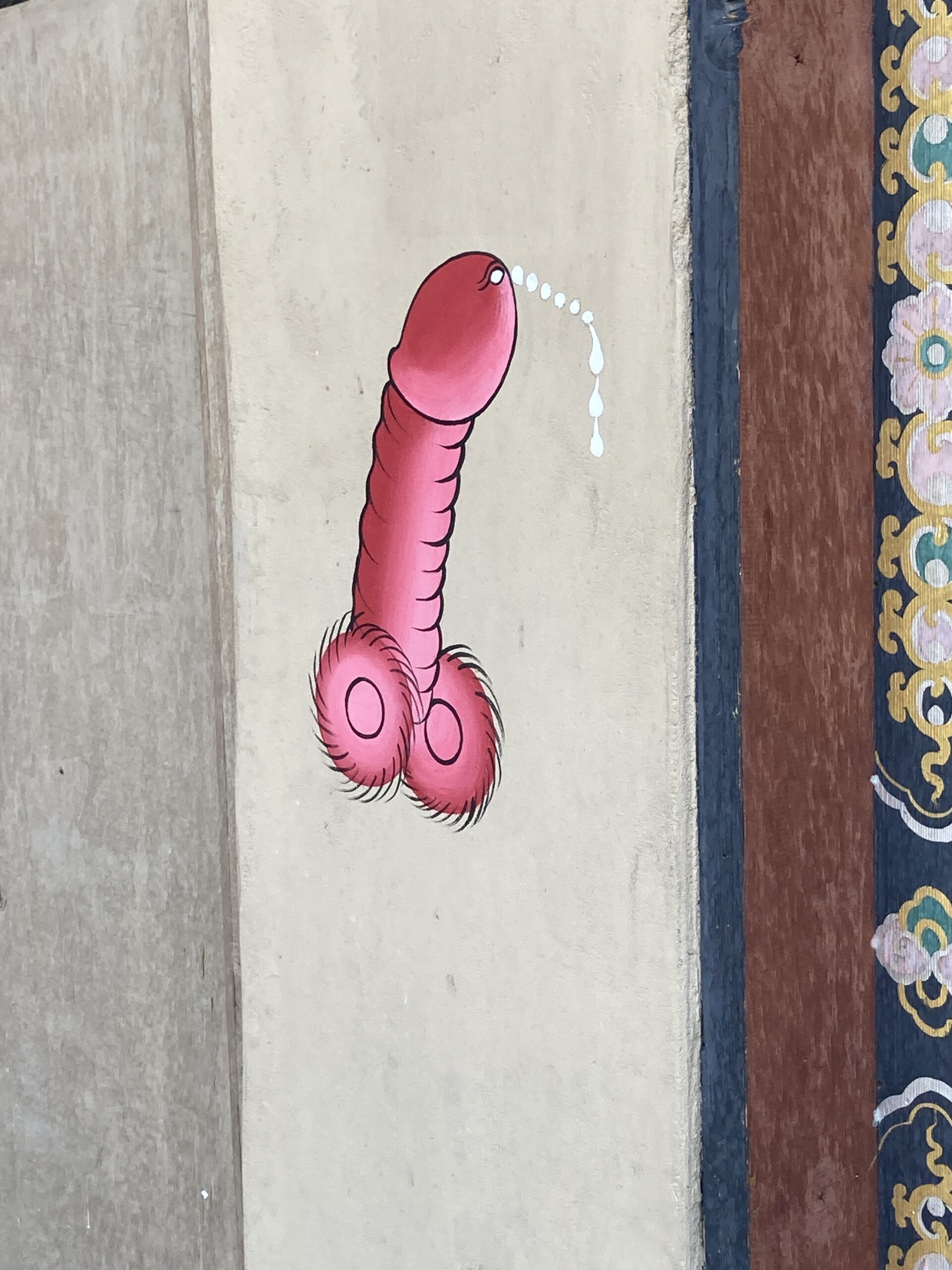
Phallus Wall-Painting

One place that was not represented, which, although dimly aware of it, I did not mention because I had not been myself, was Chimi Lakhang, here in Bhutan.  It is very wonderful to finally be here.  Almost every building here -rather than one here and there in the rest of Bhutan – has one or more large colourful phallus paintings on it.  Many have wooden phalli hanging from the top corners of the roofs.  As you walk into the village, you realise quickly that this is a big high street of Chimi Lakhang ‘tatt’ – a veritable Glastonbury High Street of sacred items, a bit like Paro outside the airport, here. 
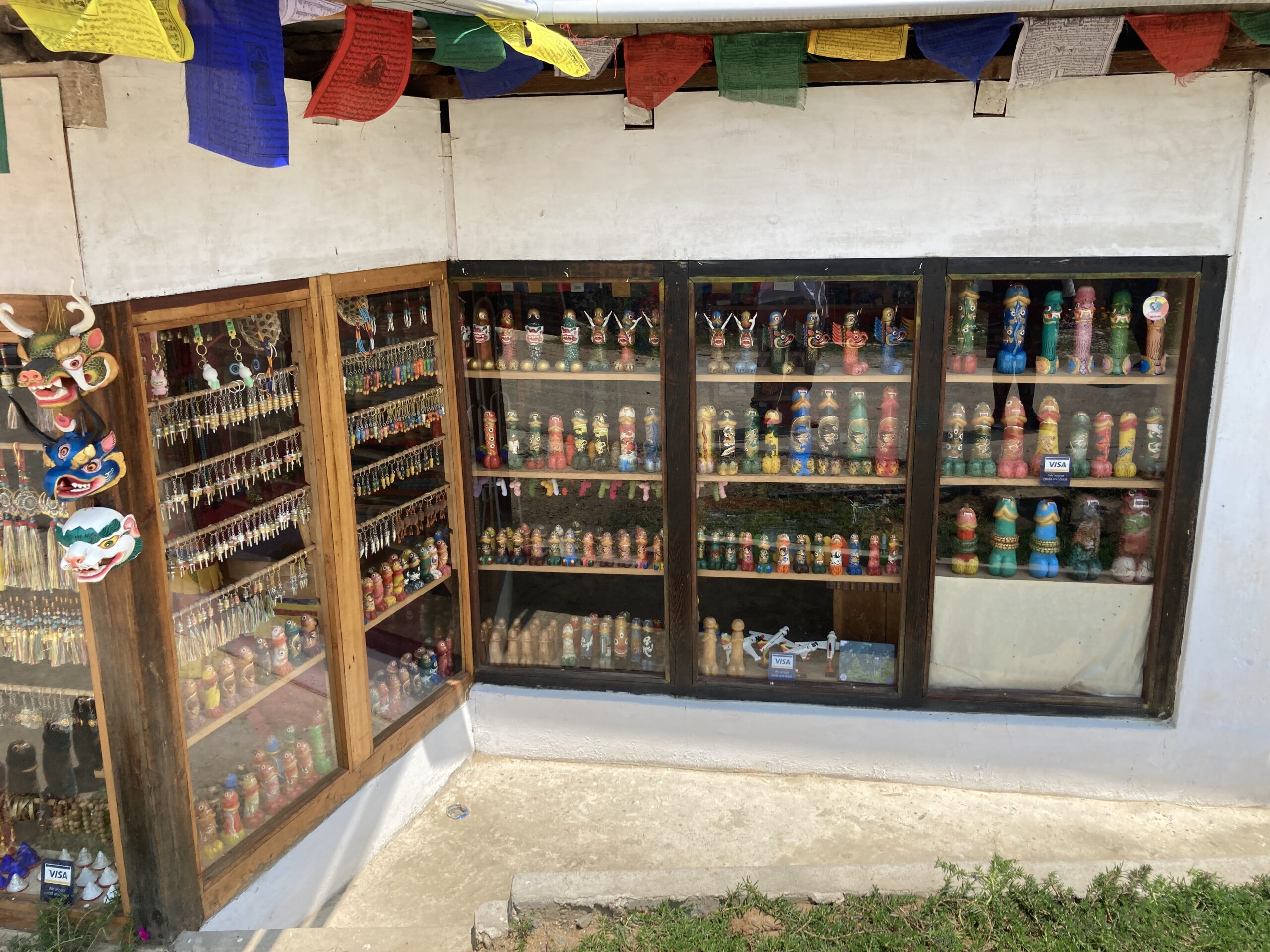
Phalluses on sale
Phalluses on sale

Except that more than half of the items on sale in this village – called Sopsoka – are erect penises. They come in all shapes and sizes, plain wooden, and brightly coloured, and painted with intricate designs.  At one shop I buy a large blue one with a white Druk painted onto it curving round the shaft, and an angry face on the glans at the top. 
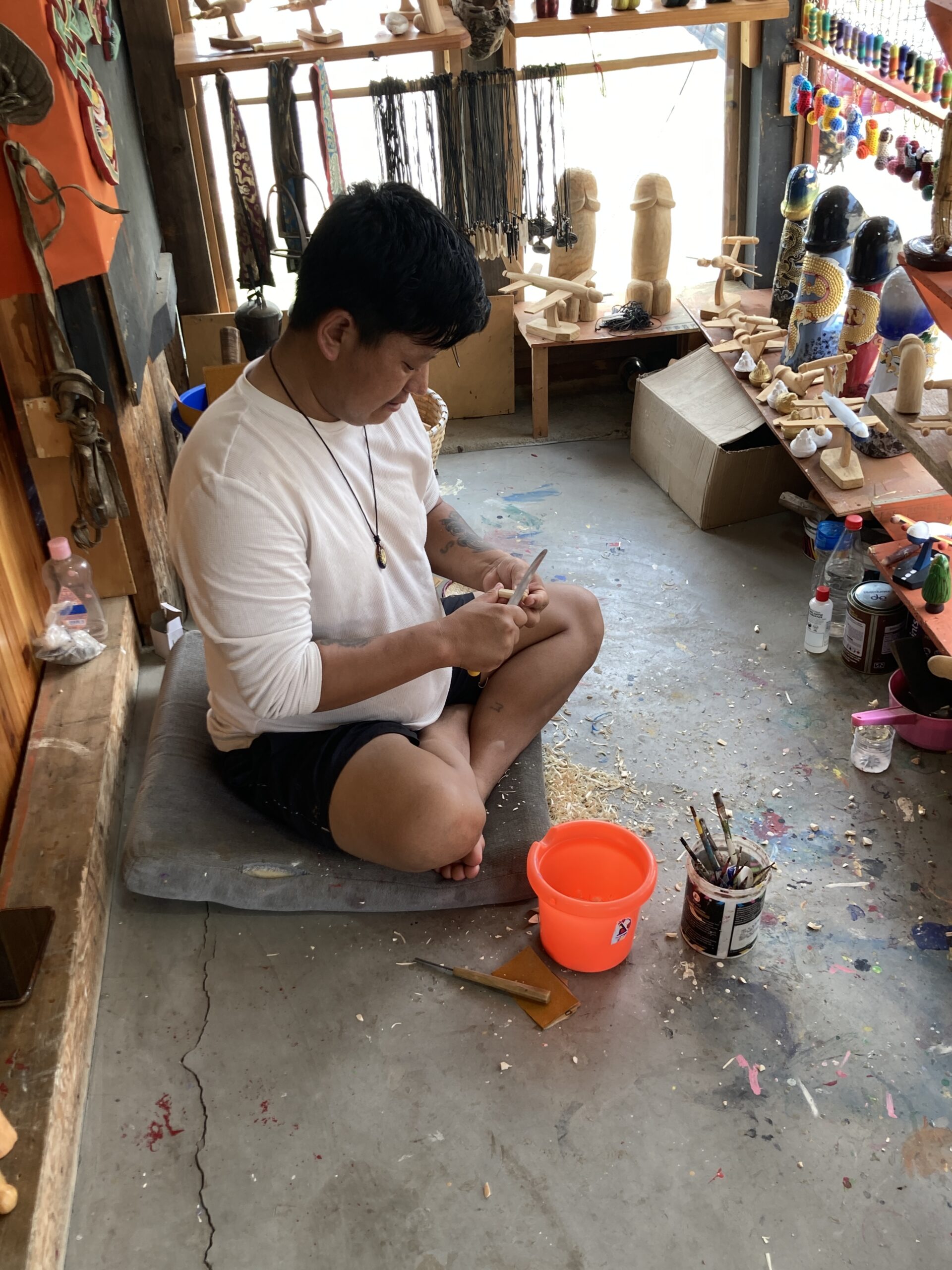
Hand-carved phalluses

At another shop I see the man hand-carving his wares, and buy a pair of plain wooden ones.  Only one is varnished, but he says he will varnish the other for me and I can collect them both on my way back down by which time it will be dry.  At the top of the village we come to the entrance to the Chimi Lakhang Temple, and take the short climb up the steps to the top.  It is hard going in the 31’ heat, up the steep steps, but I manage it, excited to be here at last.  The view from the top is wonderful. Under a tree my guide tells me the story of 15th century CE Lama Kinley Drukpa, the Divine Madman – the Tibetan Lama who came to this area and gave the most unorthodox teachings of all. 
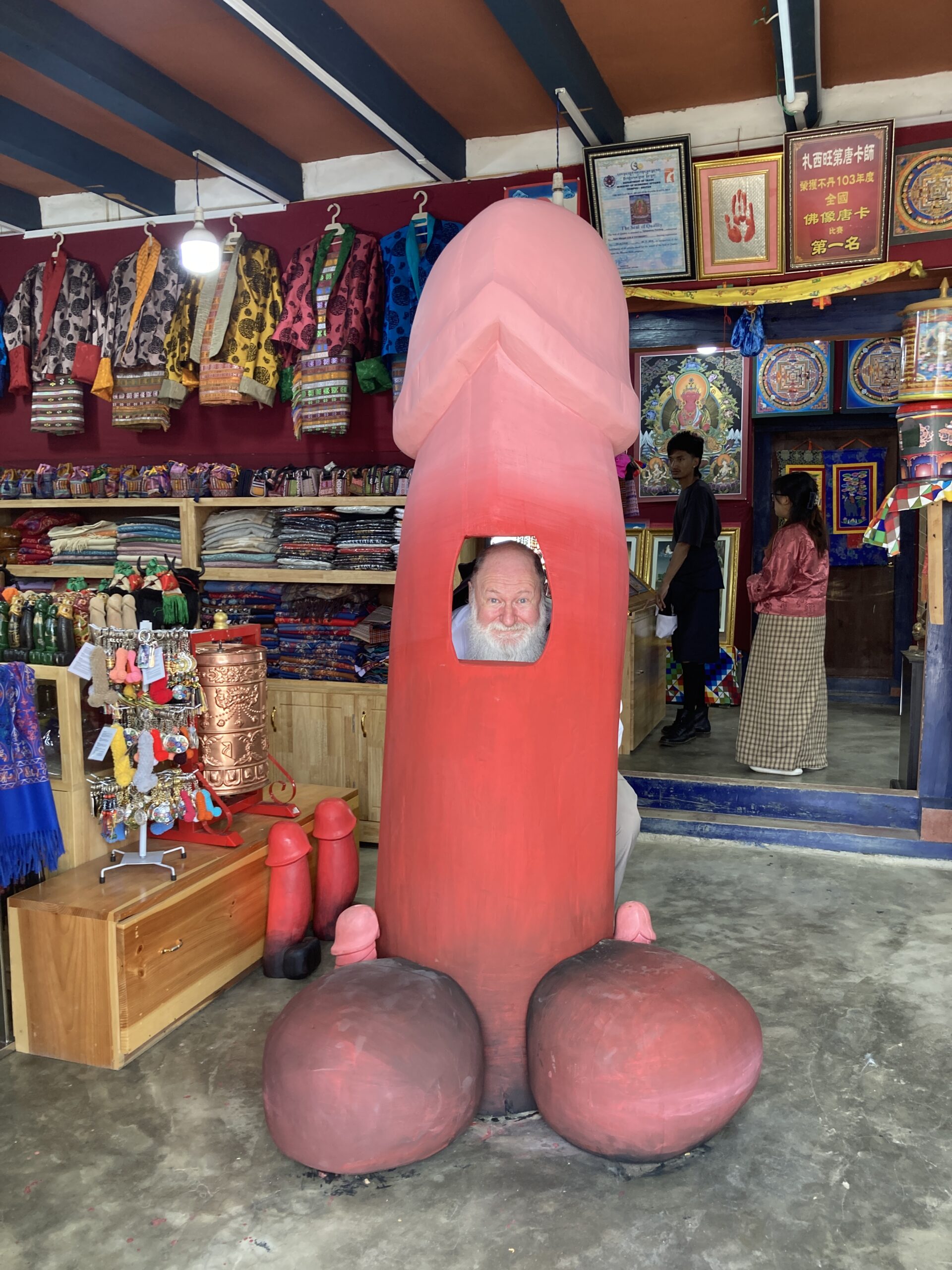
Phallus shop fun
Phallus shop fun

He used sex and alcohol and drugs and behaved in an outrageous manner to prove that the hierarchy and the establishment and all the ‘right way’ to do things were not necessary, if you had the right attitude inside. It seems clear he also found – in the pre-Buddhist Bon spirituality of this region, focussed around the phallus – a fascination with it that could not/would not/should not be dislodged, and so he  assimilated it.  Using his own phallus, shooting fire with it, he vanquished evil forces that were terrorising the traders trying to use the passes in and out of this valley: protecting the people.  He set up his Temple here, and gave teachings.  A couple having trouble getting a child to live beyond a few months brought their latest dead child to him, begging him for help.  He took the child and threw it across the river.  The parents were shocked, but then saw a demon leap out of the child’s dead body and run away, shouting over his shoulder that he would never trouble Lama Drukpa again.  
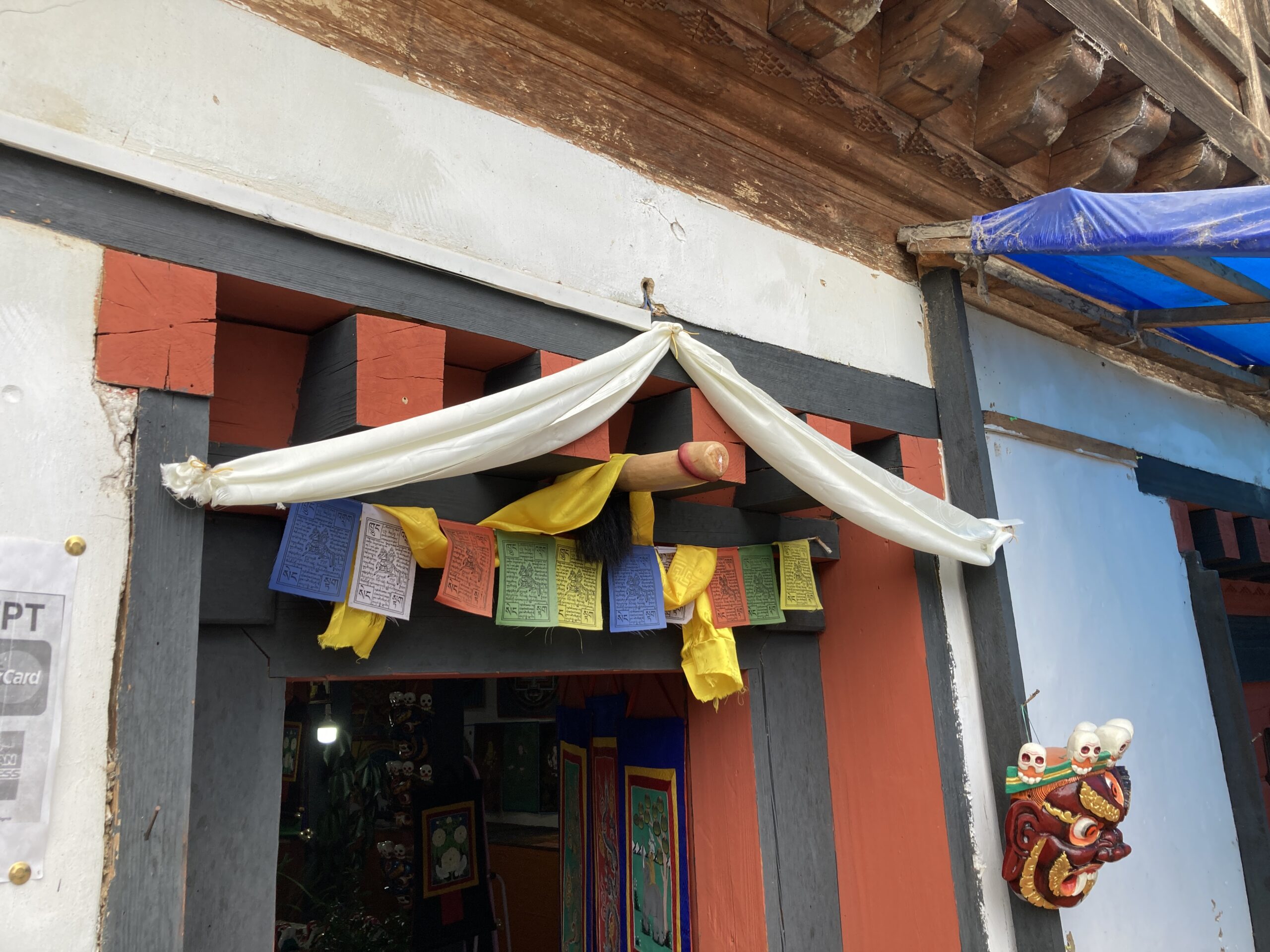
Phallus above the door

Ever since then Lama Drukpa and his Phallus have been associated with protection, and with fertility, and couples come from all over the world to circle around the giant wooden phallus in the Temple for aid with fertility.  Of course there is no photography in the temple, but I can tell you it was a big one, and very beautifully carved.   The monks inside give tourists little coloured threads to tie around wrist or neck, which you must wear for several days, to bring you fertility and good luck.  Descending once more from the Temple, back through the shops, I buy a nice ritual dagger – the three-sided blade with which the three great sins of delusion/ignorance; greed; and hate are vanquished, through wisdom, compassion, and power.  We return to the shop with the carver, and he presents me with the pair of wooden phalli, the freshly varnished one already dry in the sun.  Driving away I am very pleased to been able to visit here at last.
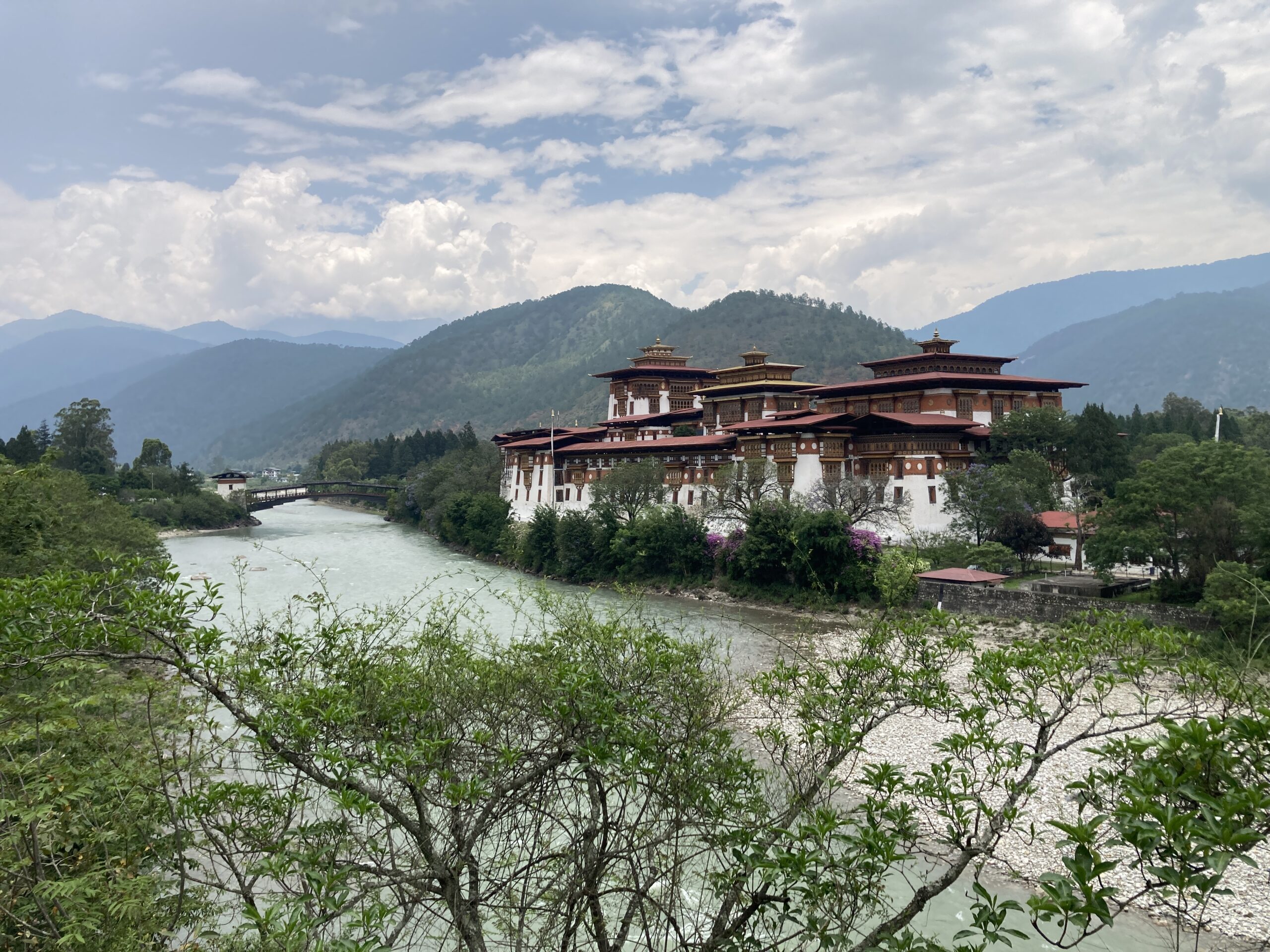
Punacka Dzong
Punakha Dzong

Our last big stop of the day is the Punakha Dzong, probably the finest and most famous Dzong in Bhutan.  It is breathtakingly beautiful.  Built – by Zhabdrung – in 1637 as a fortress (and maintained ever since) at the confluence of the Mother River and the Father River, the Mother-Father River flowing on from where they join, it is simply magnificent.  Today, as with the other Dzongs, it remains in dual use; part for the Government administration of this district, and part as a monastery.  As we are quite high up here, it is the Summer Palace of the Head of the Religion, with the Winter Palace at the much lower Thimphu Dzong.

Exhausted by now, in the heat, I am glad to return to the air-conditioned car, for the long drive (some two and half hours) up and over yet another pass, to my Hotel for this night, the Gangtey, overlooking the broad marshy valley that is the habitat of the black-necked crane, birds which I shall see in their sanctuary in the morning.  

4/6/26
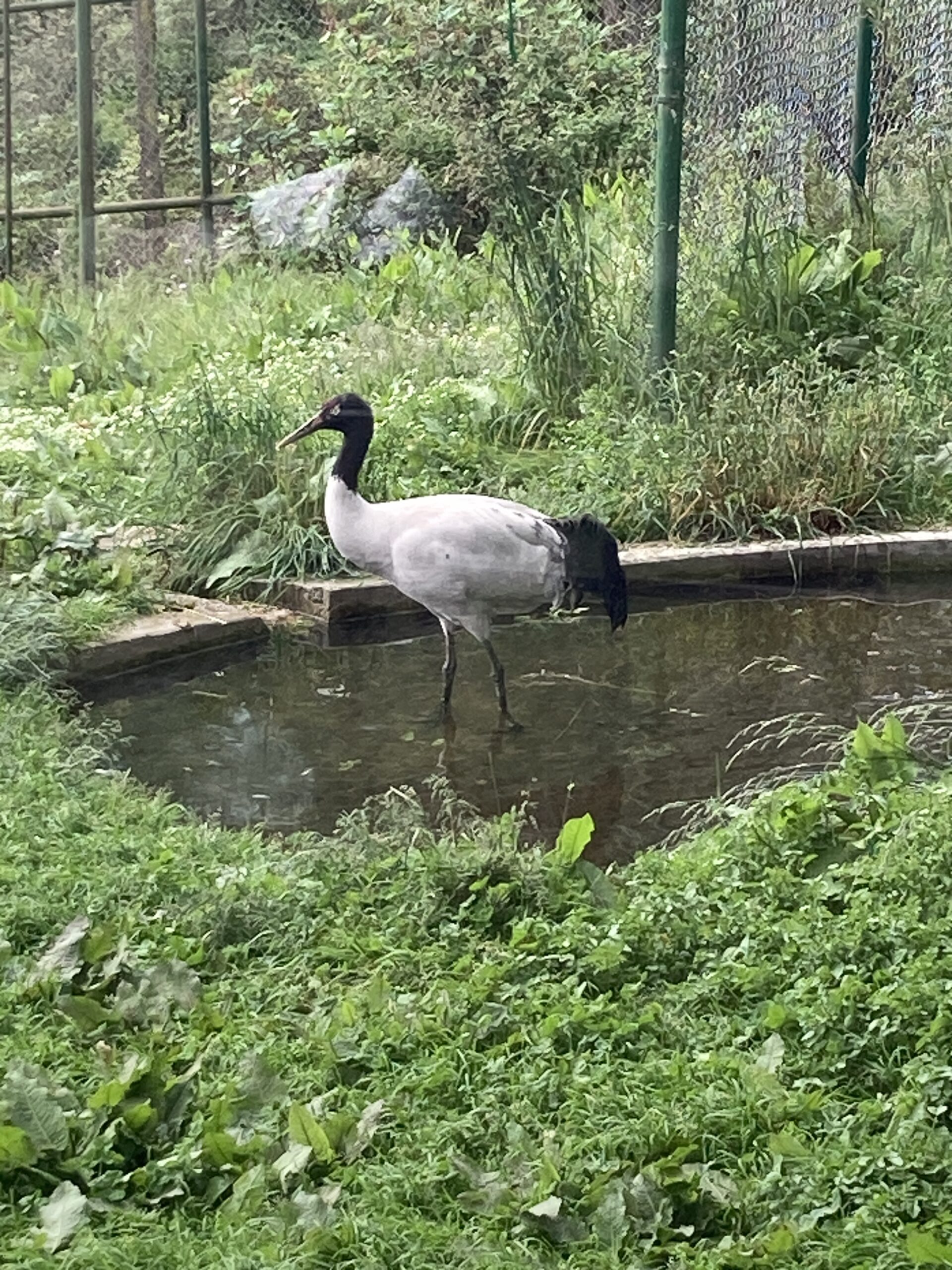
Black-necked Crane
Black-necked Crane

This centre for conservation effort takes pride in looking after two cranes wounded by predators – one a wild dog, the other a leopard – and enabling people to get up close to see them. There is a good deal of information and an excellent documentary in the centre, where I learn that one of the most important tasks of the centre is in educating the local farmers, who have become very successful in exporting their potato crops.  A balance between development and conservation is the mantra of this centre.

Lastly then, a visit to hilltop Gangtey Monastery, where the migratory cranes circle three times, each autumn, on their way down to the marshy valley bottom where they winter.  This is a peaceful and friendly farewell to this lovely country, before my 5hour drive, back over the Dochula Pass, where we have coffee, to Thimphu and at last to Paro, where I check-in for my last night before the journey back to Kathmandu in the morning.

5/6/26
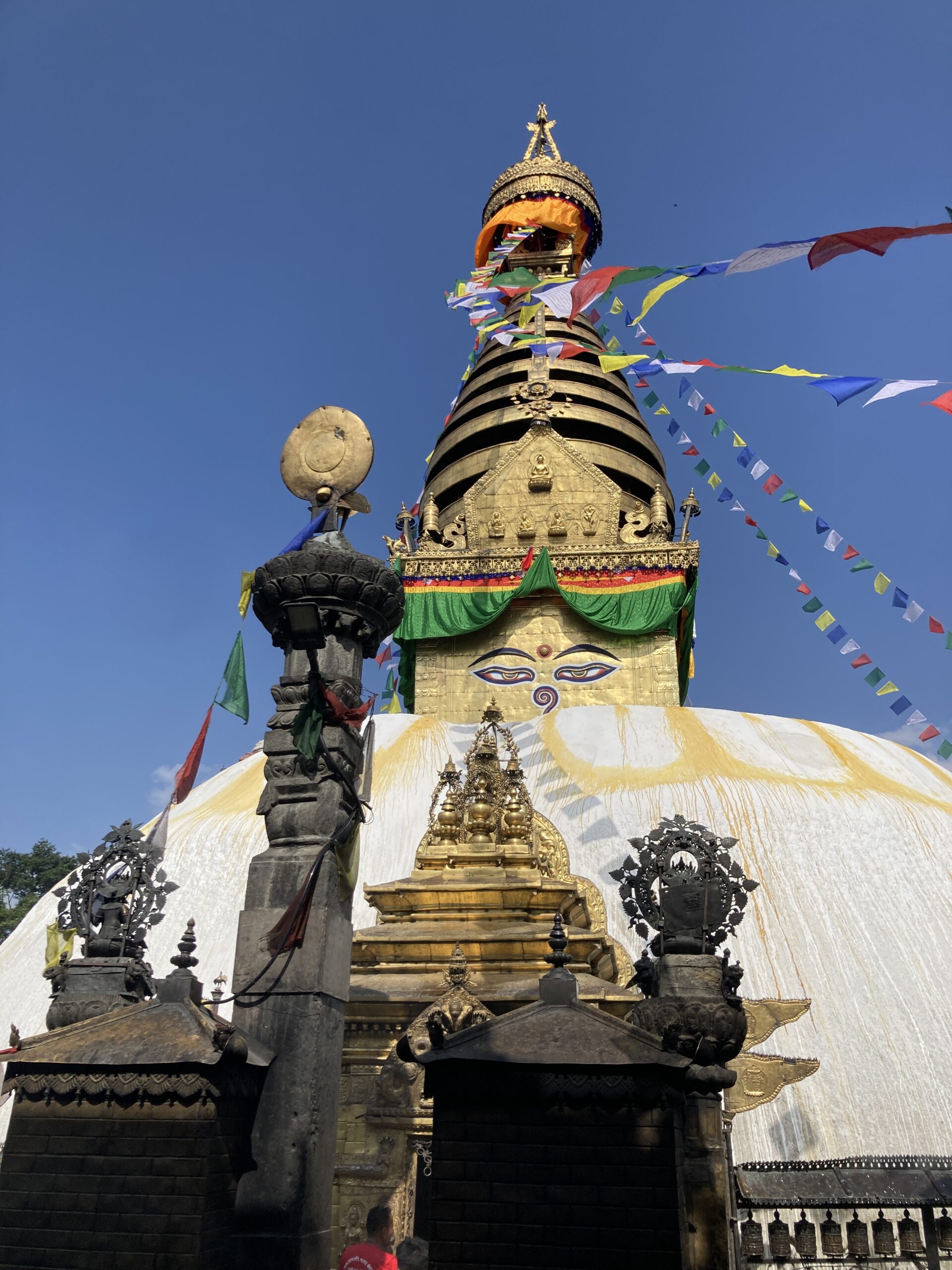
Swayambanath

Finally, it remains for me to visit Swayambanath, on my last day in this trip – a Buddhist centre second only in importance to Boudhanath, here – and to take in the breathtaking splendour of this Stupa and Temple.
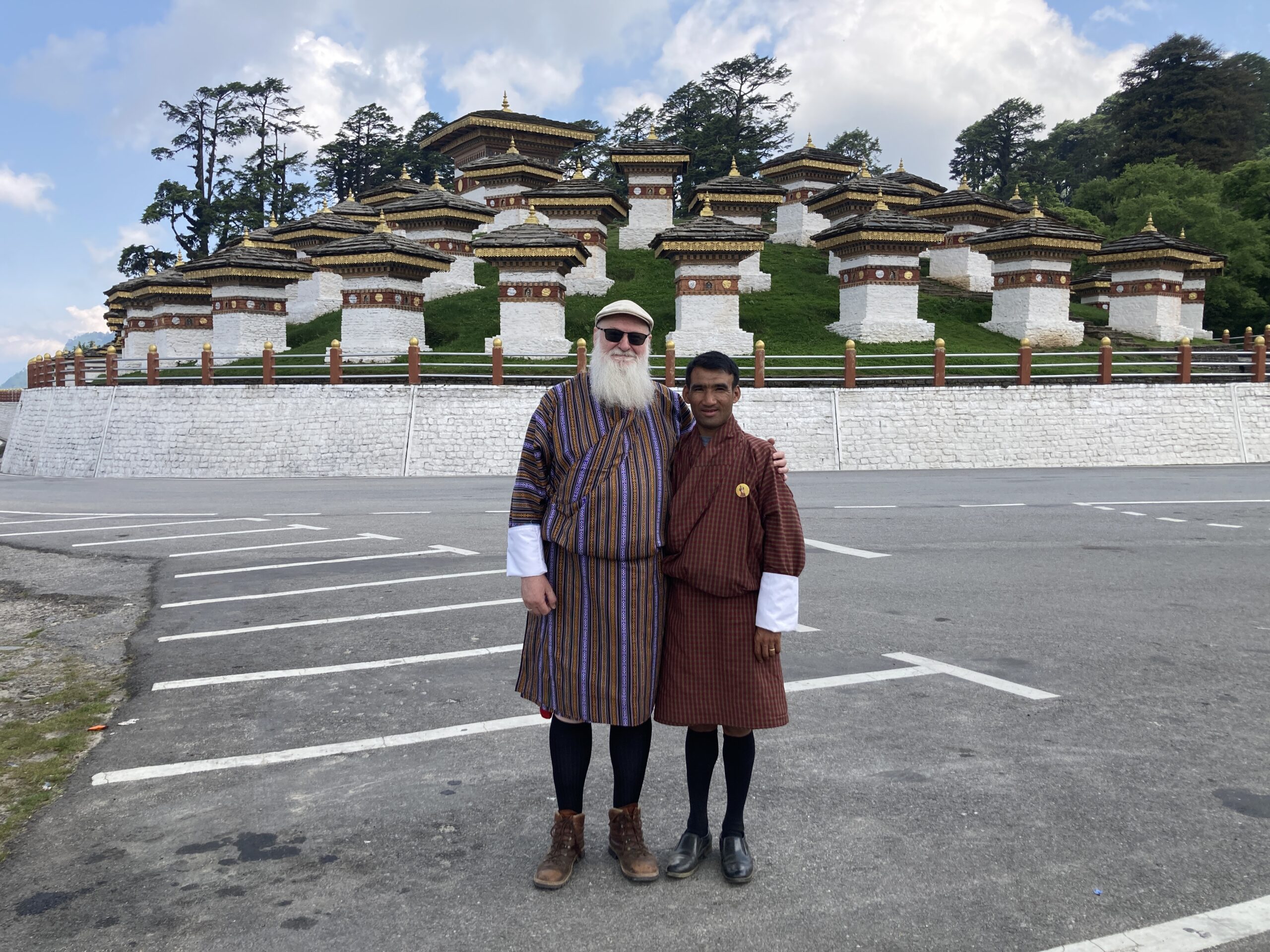
With Doji my driver, Dochula Pass

But before I finish this blog, I must put in a good word for 3rd Rock Adventures, my tour operator. Naba, with whom I have been in very regular contact, first organising the tour, and then during it, and all his guides and drivers, have been attentive, knowledgeable, friendly, helpful, on-time, informative – I could go on but really, I couldn’t have asked for better and couldn’t recommend them more highly if you are considering a trip to this part of world. I did converse with one or two others, back in February, but even then Naba stood out as someone whom I could do business with, someone I could trust. It was a great holiday, and I am grateful.

In summary, I think I have seen and experienced as much as I am able and keen to of Bhutan, but that I would come back to Nepal again. There is Pokhara (Nepal’s 2nd city) and Chitwan National Park, which I did not have time to visit on this occasion, and I would welcome the opportunity to visit Pashupatinath again – probably my favourite place of this entire trip, if I had to choose – and to stay again at the wonderful Barahi Hotel, which did much to make my stay in Kathmandu so comfortable.
Nepal-Bhutan May 2026 #4

Post #1 | Post #2 | Post #3 | Post #4 | Post #5

30-31/5/26

Mountain view from the aircraft

For the weekend I have been on an excursion out of Kathmandu, to see a little more of Nepal while I am here. Having visited Namobuddha and Kopan Monasteries, Bouddhanath Stupa and the Triten Norbutse Bonpo Monastery, it seems only fitting that I take the short flight to the south west to visit Lumbini, the birth-place of Siddharta Gautama Buddha, and the ruins of Tilurakot, the palace where he lived until his 29th year.

Domestic flights in Nepal are notorious for being delayed, and my 9.15am flight doesn’t actually take off until 11.45am, in the end.  There is little in the way of information, but everyone seems sanguine about it all, and I take their cue; I am not, after all, in any hurry, and my tour operator is very attentive, in regular contact, and arranges my tour guide for Lumbini to collect me based upon my notification that I am actually on the plane!

The guide’s driver meets me at Bairahawa’s Gautama Buddha Airport, after a wonderful short 35minute flight over the foothills of the mountains arcing over some of the many great rivers that flow down off the peaks onto the plain – with a glimpse of the Himalaya in the distance!  The heat down here is a good 3-5’ hotter than in Kathmandu, and I am grateful to get into the air-conditioned Leapmotor EV that whisks me away from the airport.  As everywhere else in Nepal, these past few days, I sit in the air-conditioned EV surrounded by mopeds, overtaking huge 1970s trucks and little tuk-tuks, everywhere we go.  Every now and then, a BYD or Tata EV swoops by on the other side of the road.  Apparently the tax on a new car is over 100% – to pay for road development no doubt – which is why so many opt for a scooter, moped or motorbike.  Many of these are also electric.  China’s presence here is palpable; Kathmandu from the air glitters with all the solar panels on the roofs.  At the end of the short drive to Lumbini Park I am met by my guide, Suroj, who will tell me about the places I am to visit here, and escort me around them.  Lumbini Park is an enormous and global project, overseen by UNESCO and the Nepalese Government.  The project began in 1972, and reached an agreed Master Plan in 1978.  The building of the park continues, with only some of the planned buildings complete, many still under construction, large areas as yet untouched.  It is far too large to see it all in one visit, but Suroj has curated a representative sample of what there is to enjoy here, and we take the car between each place.  

Japanese Peace Pagoda

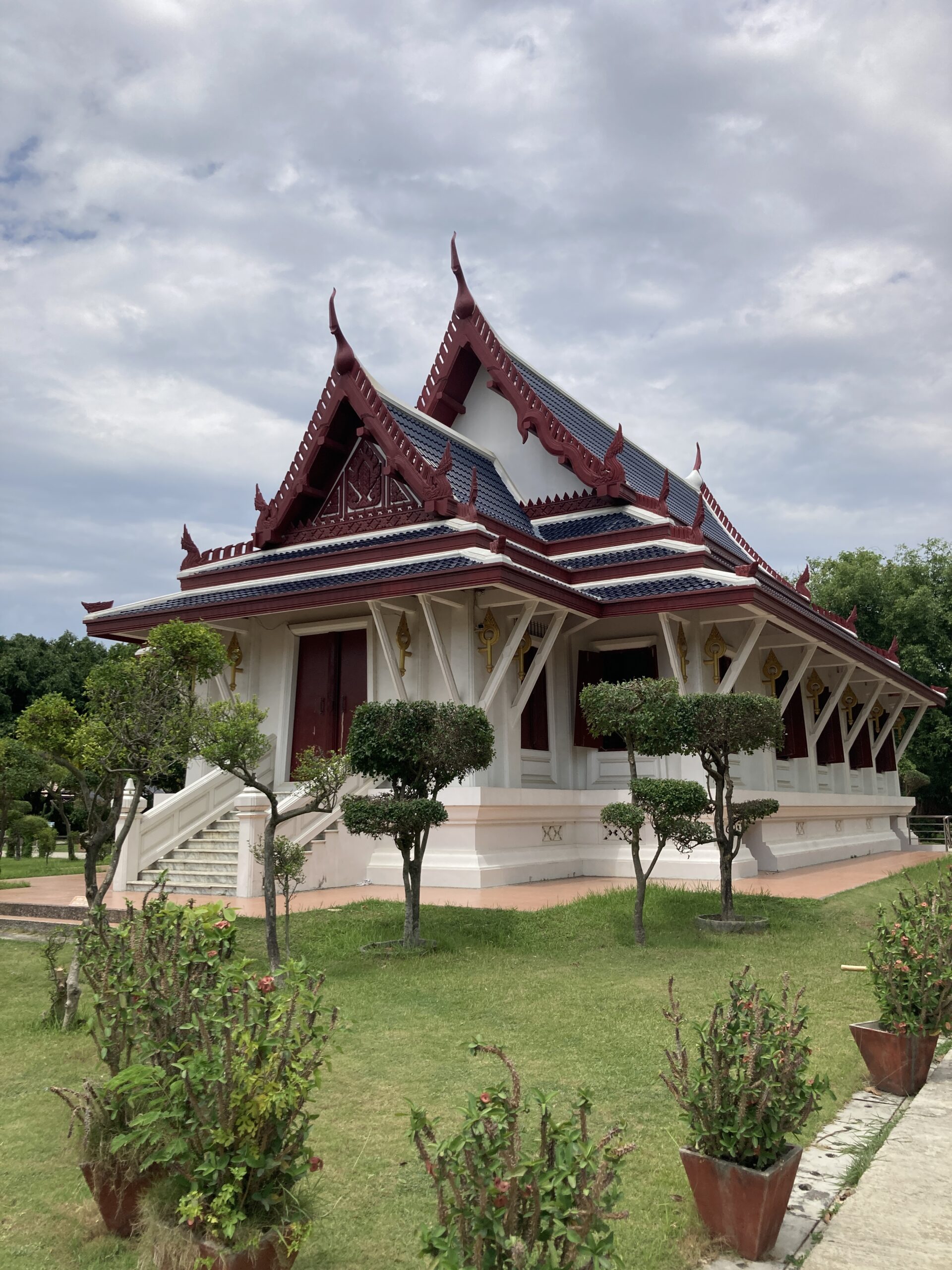
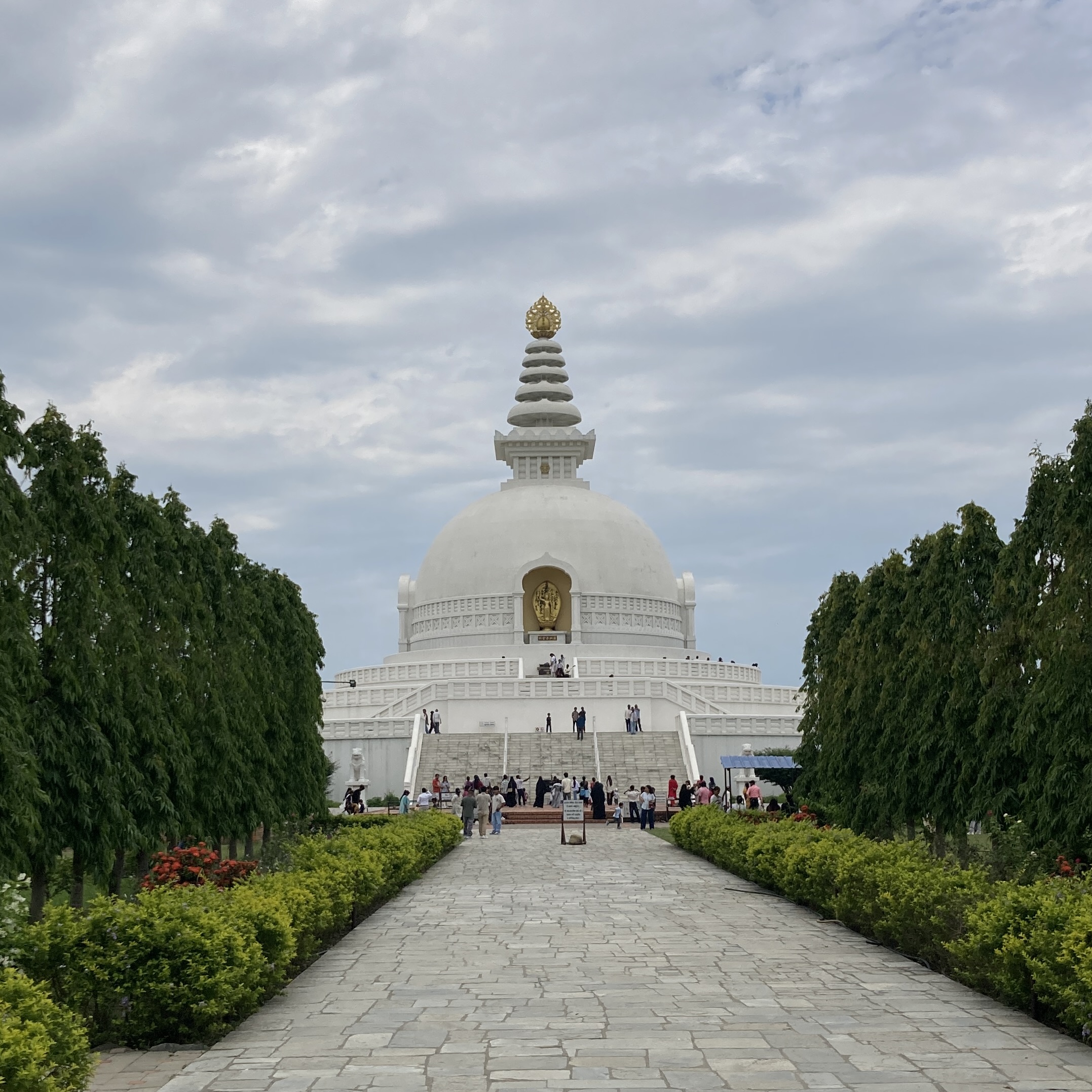
Our first visit at Lumbini is to the huge Peace Pagoda built by Japan – finished in the year 2000.  All the signage is in Japanese, some also in Nepali, occasionally in English. It is a brilliant white, and very shiny in the 32’ heat.  I take my wide-brimmed sun hat from my bag and place it on my head.  I hate it as a hat, but it is very practical and quite necessary!  I also apply sun-block – frequently – while we are at the park.  My guide tells me about the four stages of the Buddha’s life – birth, meditation, enlightenment, and death – represented on the four sides of the pagoda.  He points out the great long vista from the Pagoda across the park to a small white building in the distance – where the spot where the Buddha was born can be seen.  I am glad we won’t be walking there!

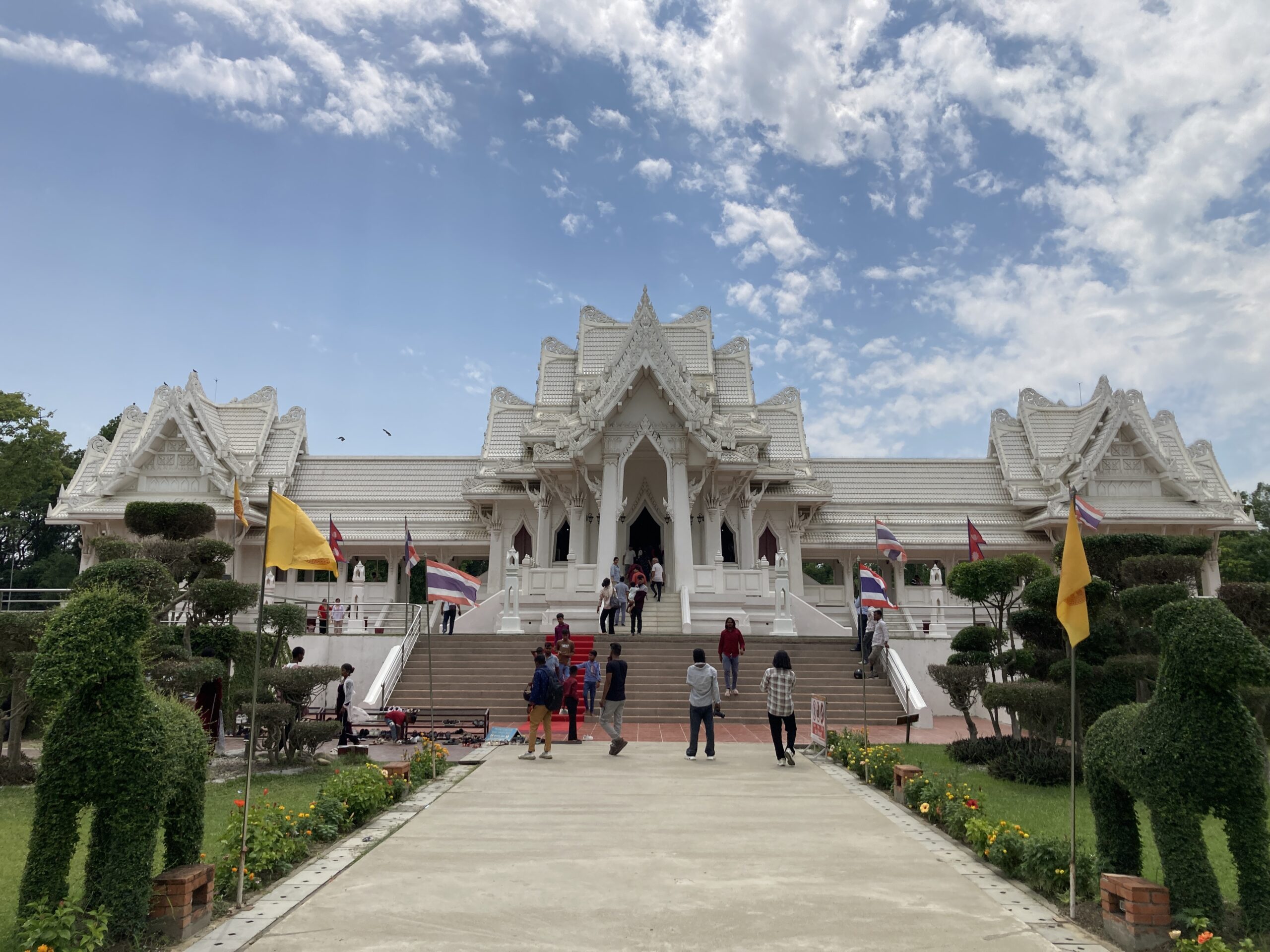
Thai Royal Palace

Glad to be back in the air-conditioned Leapmotor again, even if only for 5mins, we drive to our next visit in the park: the Thai Royal Temple, built by Thailand.  Suroj explains that the Thais are very active in Buddhism, graduating 1000 monks a year, and collecting and distributing large sums for the relief of the poor in many countries: Buddhist Relief.  The royal palace reminds me of some of the Temples I visited in Bangkok, and behind it, still under construction, a new building with echoes of the architecture of the ancient temples at Ayutthaya that I visited on a day-trip from Bangkok.  I tell Suroj about them and he knows of Ayutthaya and agrees that yes this new building is more like those ancient temples. 

Thai Monastery
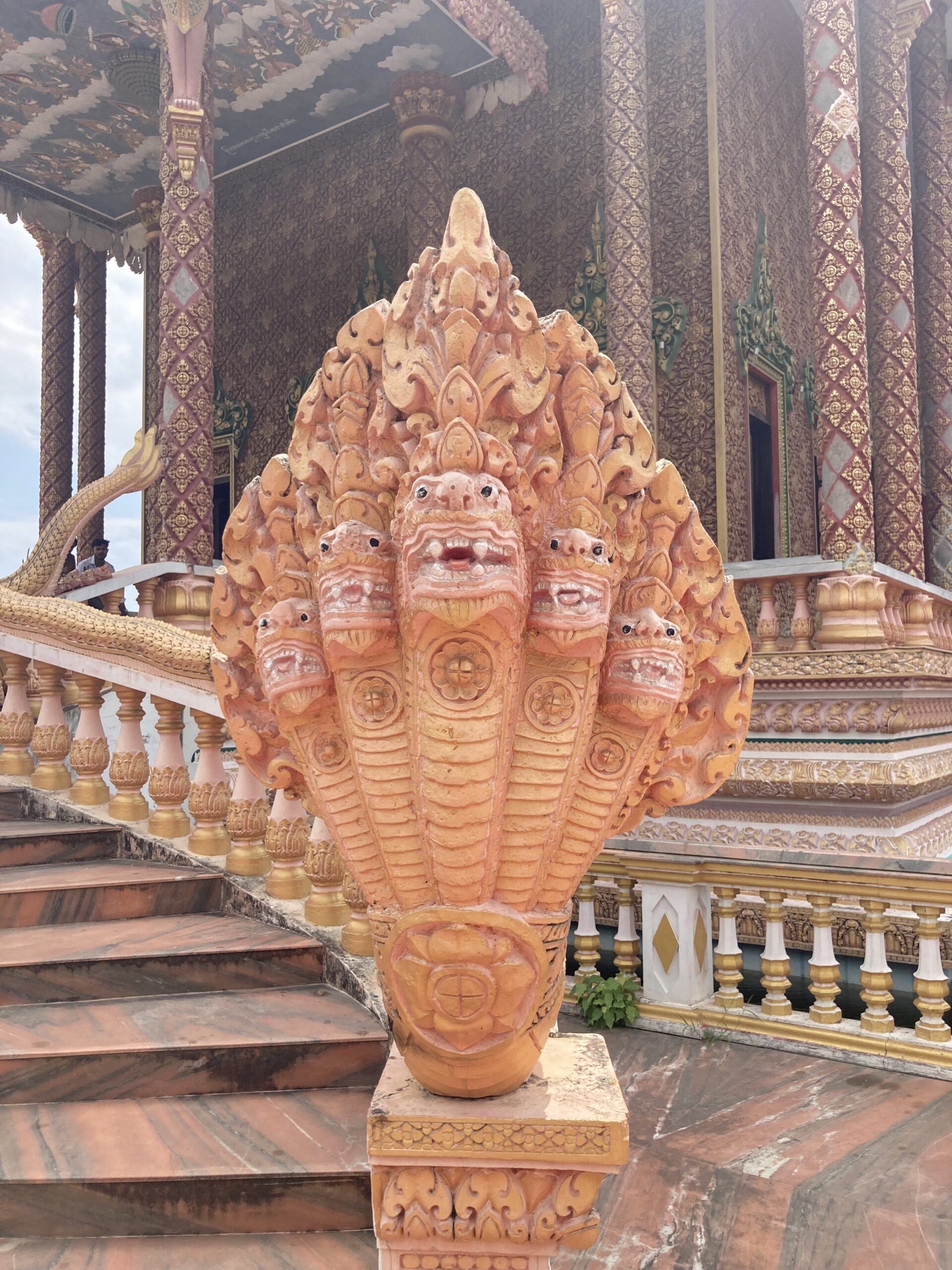
Cambodian Naga
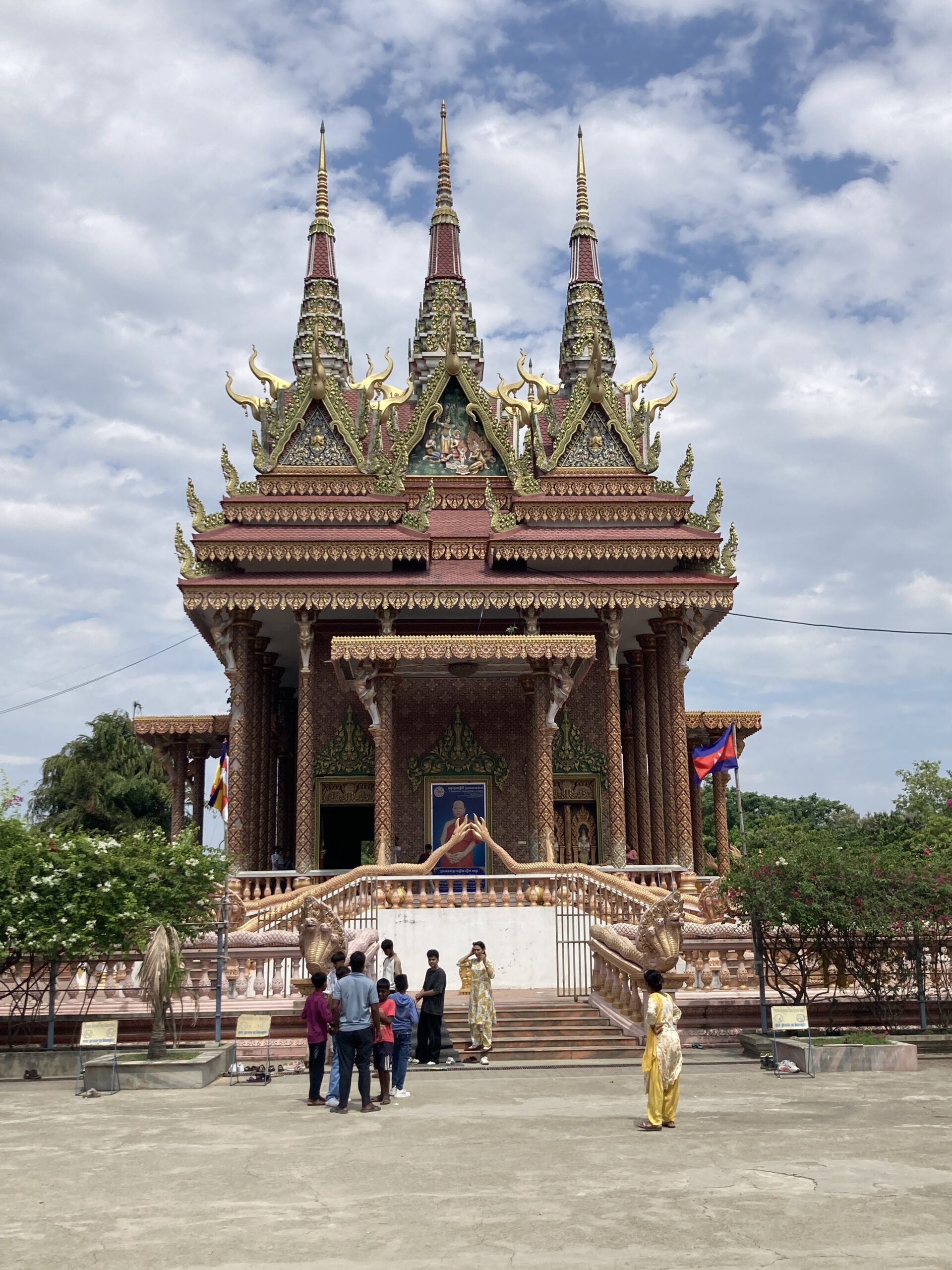
Cambodian Monastery

After another welcome few minutes in the air-conditioned car, our third visit is to the Cambodian Monastery.  Here the echoes are of Angkor Wat, as far as I can tell from photos I have seen.  [Note to self – Bucket list must include Angkor Wat, both for its Hindu and Buddhist temples!!].  The Cambodians have excelled themselves here with a truly amazing building, surrounded by Naga. 


Lastly – after another 5mins in the air-conditioned car – we arrive at the carpark from where we can take the walk along the great approach to the Birthplace itself.  There are many pilgrims – Japanese, Chinese, and Korean faces amongst the browner faces of India, Nepal, Cambodia, Thailand….. and I realise I stand out as one of the very, very few white faces.  Apparently Western tourists only really come to Nepal between September and February, because of the weather.  I tell my guide that I was here for work, and could not choose.  Besides, I think to myself, it is quite nice to be here when it is relatively quiet, by comparison.  I have met two other UK tourists, whilst here, this week.  

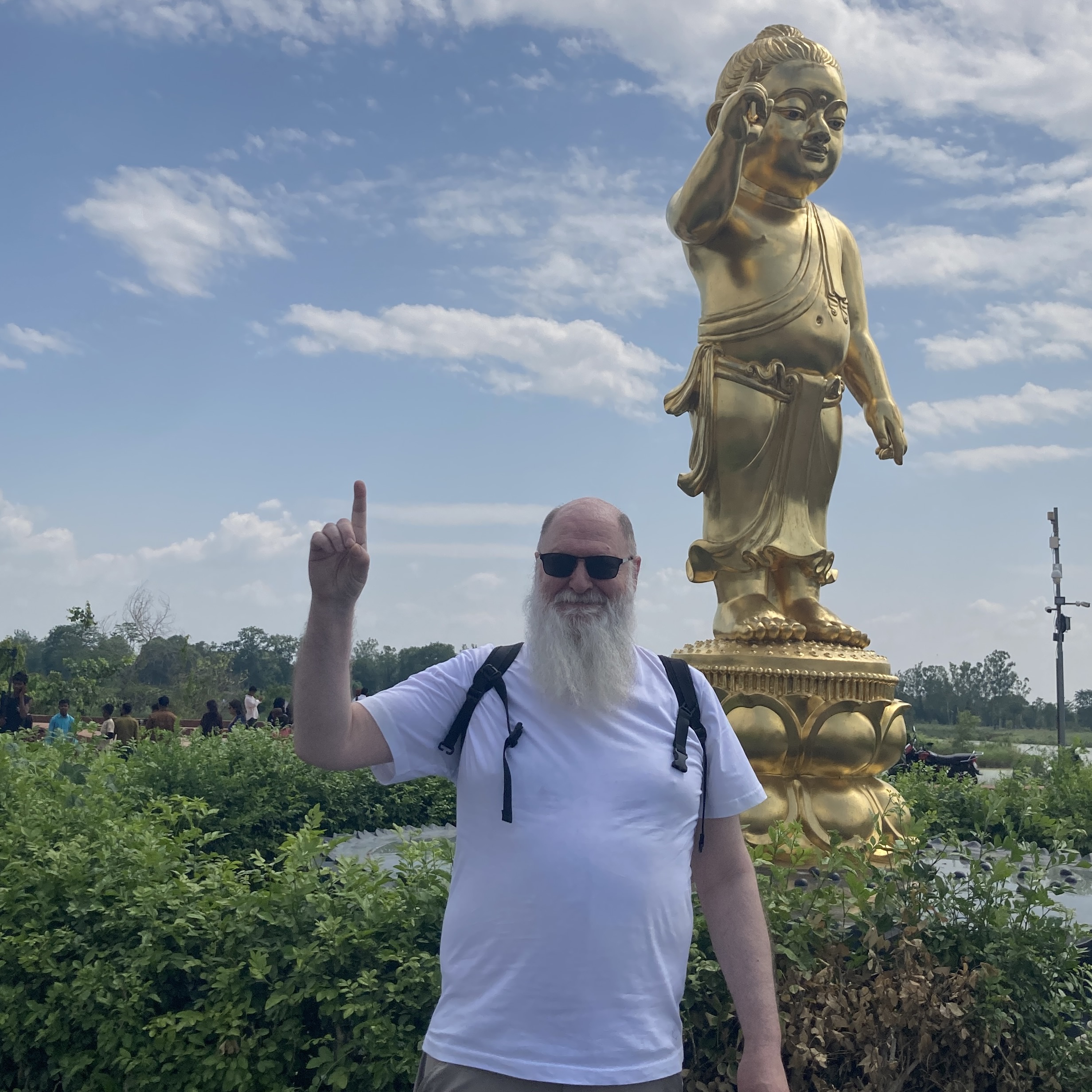
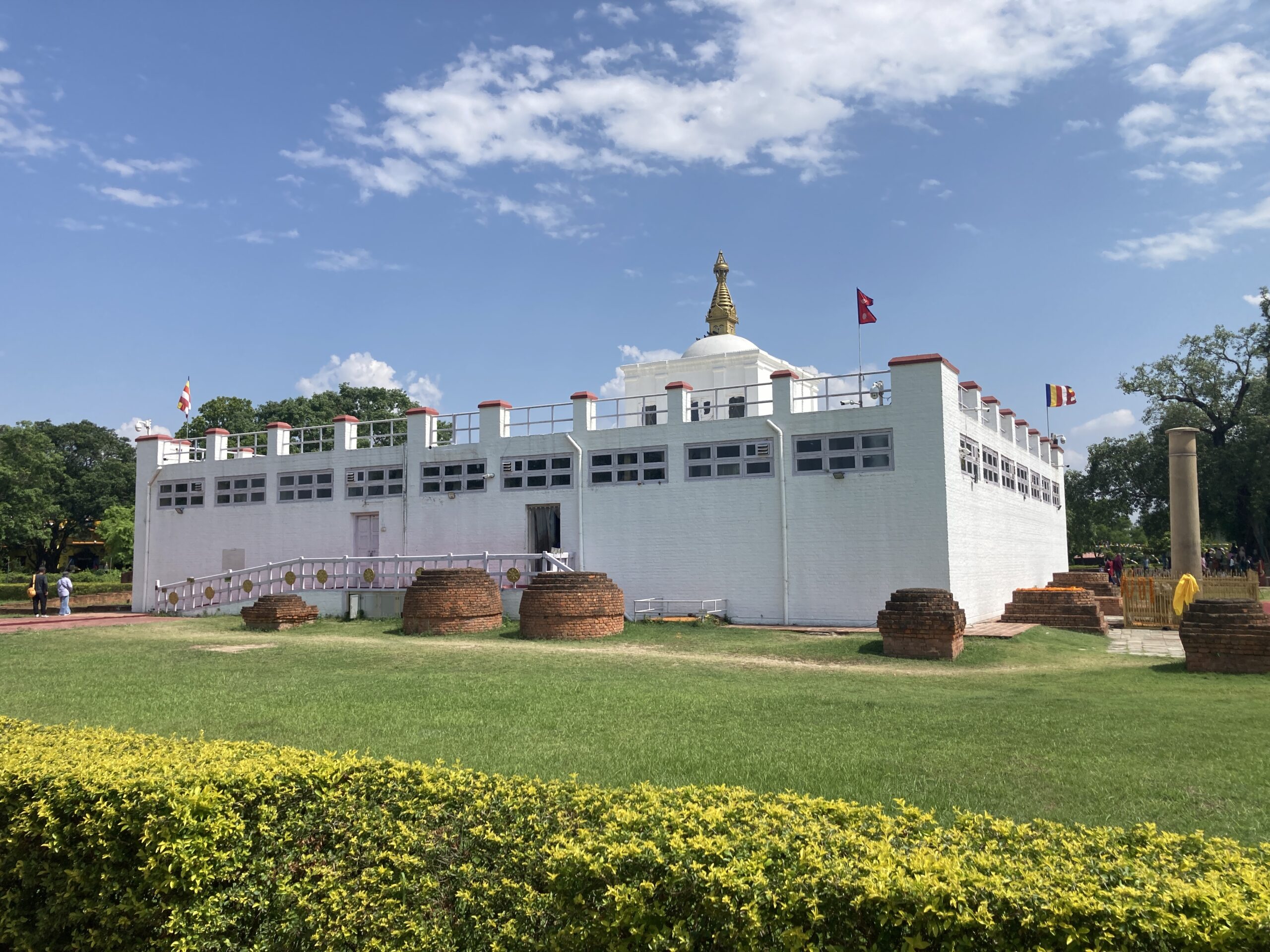
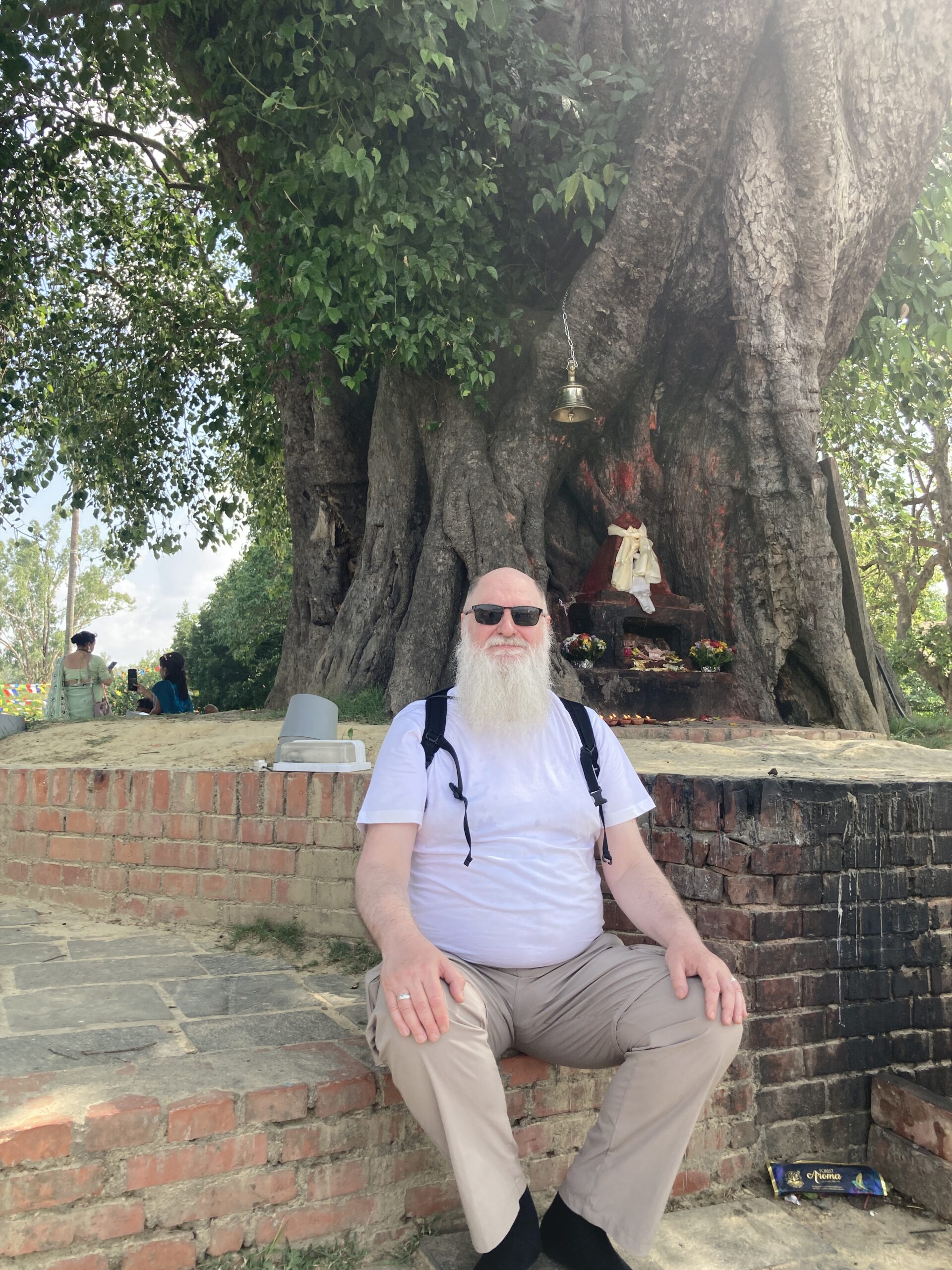
The long walk includes a lovely statue of the baby Buddha, right hand raised and finger pointing to the sky.  It is said that he took seven steps when he was born, pointing the way, announcing that this would be his last incarnation.  At last we arrive at the little white building that encloses the spot where he was born.  We sit under one of the great bodhi trees here for Suroj to tell me the story.  There were two kingdoms, here in this part of what is now Nepal, back in the 7th century BCE.  And the King of one of the Kingdoms, and the Queen of the other, decided to marry, so that they could unite their kingdoms into one.  They waited long, but at last the Queen fell pregnant.  It was the custom for a birth to take place at the home town of the mother, so the Queen set out from the King’s capital, where they lived, to her own.  But the King was afraid for his pregnant wife and would not let her travel on a donkey or an elephant, insisting in a litter. This proved to be slow going, and before she had got much more than half way home, she suddenly realised she had gone into labour and would give birth here, at the tiny village of Lumbini.  Standing under a bodhi tree, holding one of the branches, she gave birth standing up; and the buddha made 7 steps and held his hand aloft.

Birthplace of Siddharta

All around the white building are the low brick remains of temple buildings from the 2nd century CE.  In front of it stands the pillar erected by Emperor Ashoka in the 2nd century BCE.  We pass, then, through the door into the modern white building.  Inside no photography is allowed.  It is an open plan building, covering more of the 2nd century CE ruins.  In the centre, a wooden walkway surrounds a plinth.  We file slowly behind the crowds, each person taking the opportunity to briefly look over the banister of the walkway, down into the centre of the hollow plinth.  There – under glass – and surrounded by ancient brick walls, is the Marker Stone – a horizontal slab of stone marking the very spot where the Buddha was born.    I bow and touch the banister with my forehead, muttering Om Mane Padme Hom. We walk around the banister where there is a second view from the other side.  The crowds are gradually thinning, short well dressed Indian ladies bustling with their children.  Suroj speaks to a guard and we are allowed past a tape barrier to sit with our backs to the wall of the building, a few feet from where a monk is quietly meditating.

Sitting beneath the Bodhi Tree

 We sit for some 10-15minutes, silent, meditating ourselves, drinking in the calm and peace of this sacred spot, that has been venerated continuously for two and half thousand years.  Unfortunately – as at Pashupati – my back simply isn’t up to sitting cross-legged (even with the wall behind me) for very long, and we rise, leave the modern white building, and go to sit at one of the benches around the trunk of a bodhi tree for a while, to watch the local monks filing through the white building, to come and gather under another of the trees and begin to chant together.  It has been a special visit.

Suroj and my driver then take me back to Bariahawa to my hotel – the Landmark – where I am treated to a lovely Thali, (though I cannot say much for the wine, I’m afraid … never mind!). In the morning, at 9am, I am collected once more and this time the drive is somewhat longer – a good 75mins or so – out into very rural southern Nepal. 

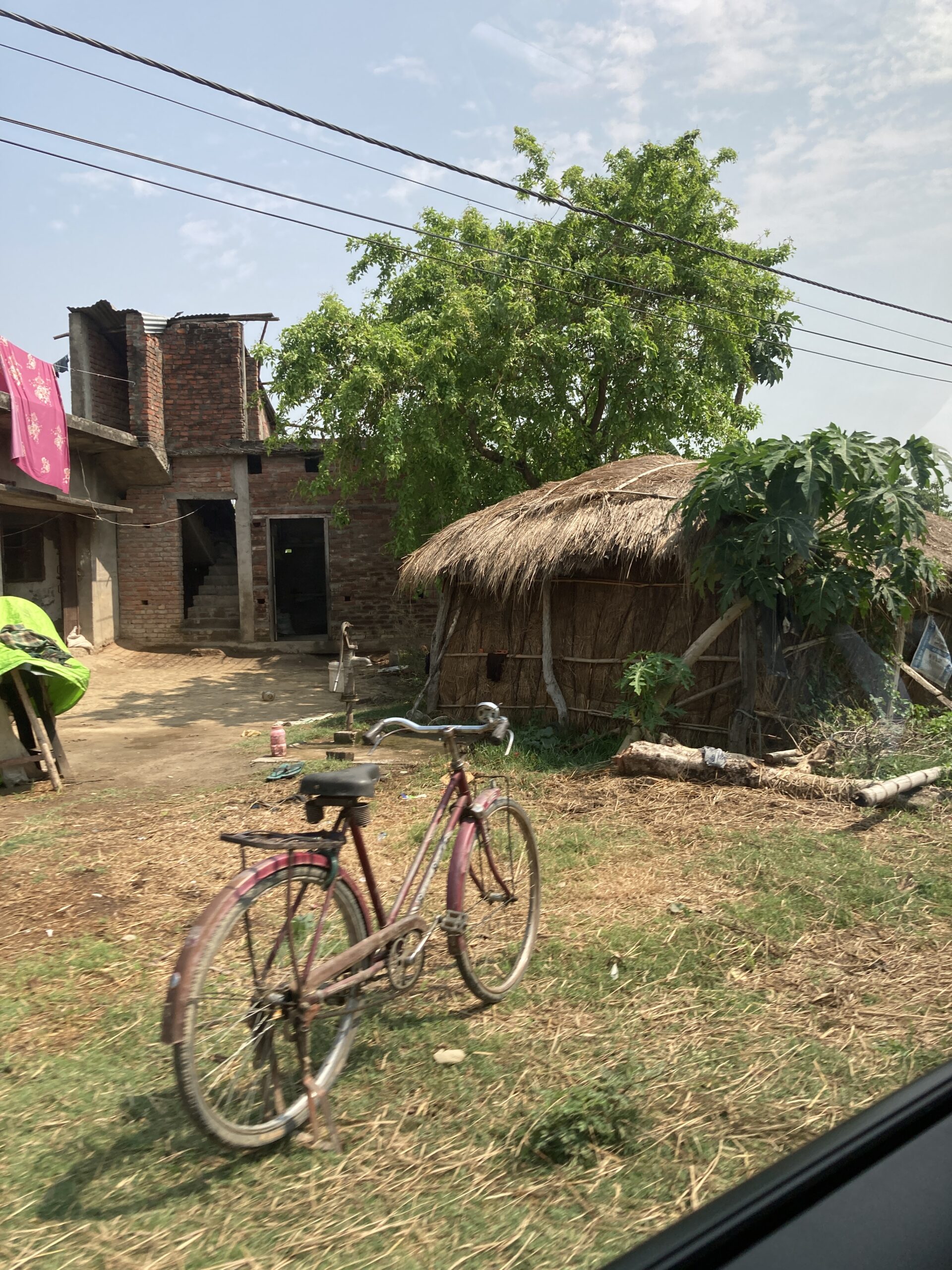
Nepali poverty

Here the poverty of this poor country is much more obvious; some of the ‘buildings’ (if they can be described as such) are not even of brick, but circular and seemingly made of straw.   Everyone I have met here has a phone – gateway to the world of today – but I guess the people living in these places may not – or perhaps a family shares one, as I have heard is not uncommon now.


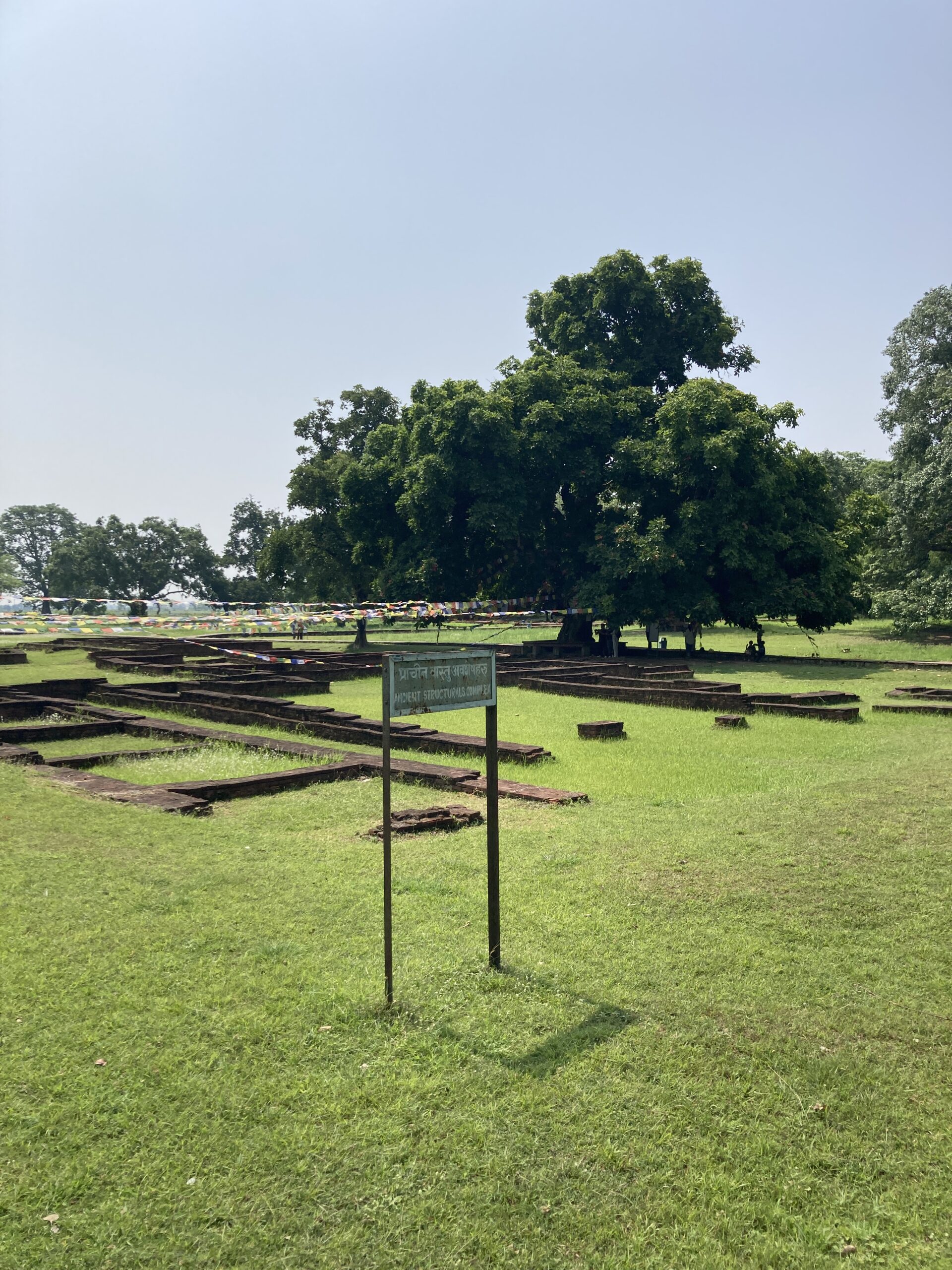
Ruins at Tilurakot

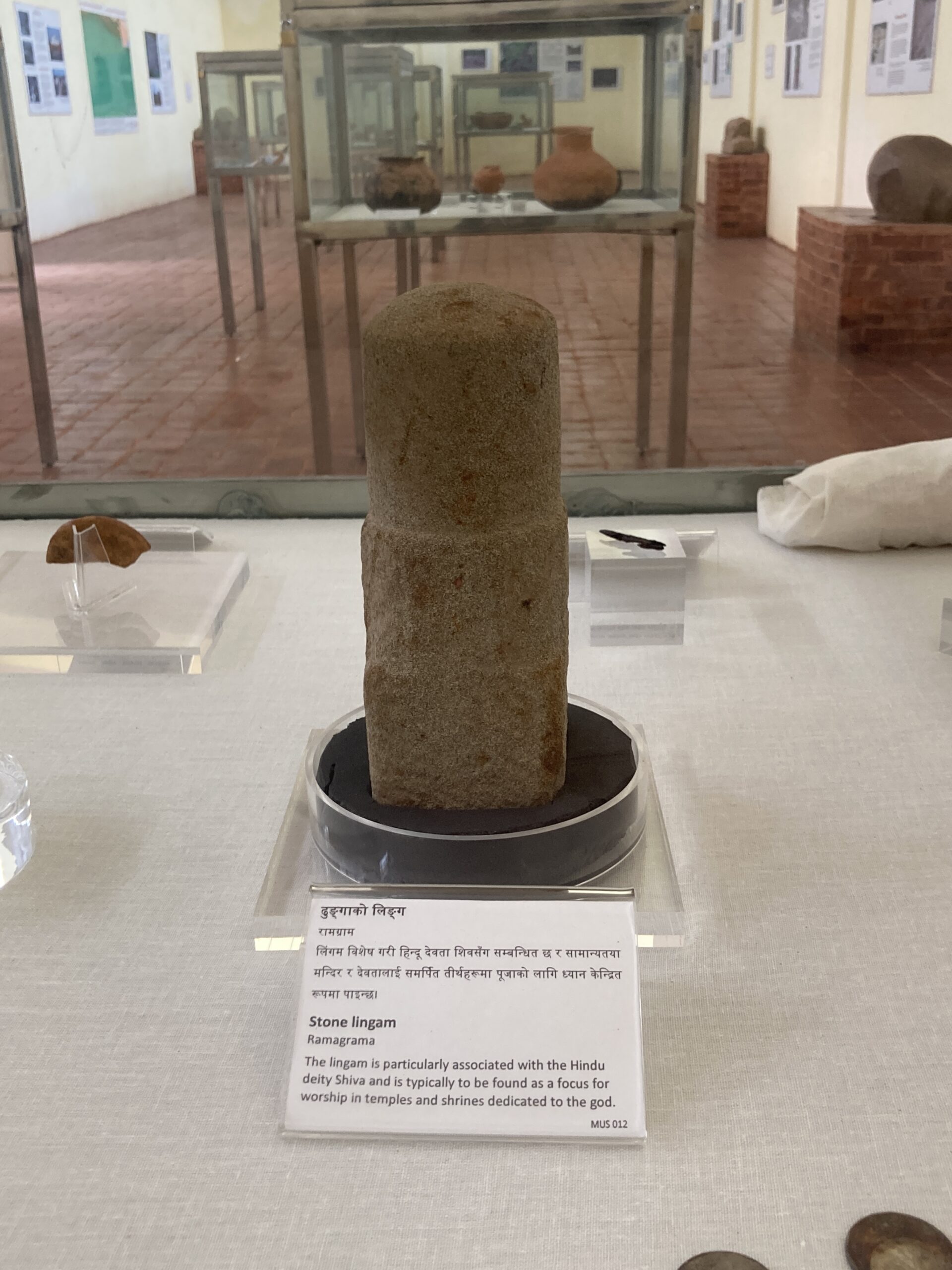
But the drive takes us, at last, to Tilurakot – the archaeological site and associated ruins of the palace where Prince Siddhartha grew up in the luxury of a royal household, got married, had a son, but – throughout this time – was somehow never satisfied.  His mother had died 7 days after his birth, Suroj tells me, and indeed his wife died 7 days after the birth of their son, Rahul.  Always Siddharta spent time in meditation, trying to find wisdom.  Then, one day, he escaped from the sheltered life in the palace grounds which was all that he had known, and discovered the poverty, suffering and sadness of the real world outside the palace.    He determined to find a solution, and began six years of searching, which would take him south, deep into India, and, at last, to Bodh Gaya, where he found Enlightenment, under a bodhi tree.After touring the ruins, we also visit the little museum here, where some of the artefacts found by archaeologists are on display, along with lots of interpretive information boards and photographs.  It is an excellent little museum with some fine pieces, including a very ancient stone lingam.

Ancient Stone Lingam in the Tilurakot Museum

Next ->

Nepal-Bhutan May 2026 #3

Post #1 | Post #2 | Post #3 | Post #4 | Post #5

29/5/26
Today is a more peaceful – and shorter – day of sightseeing, than yesterday.

Kopan Gompa
Kopan Gompa

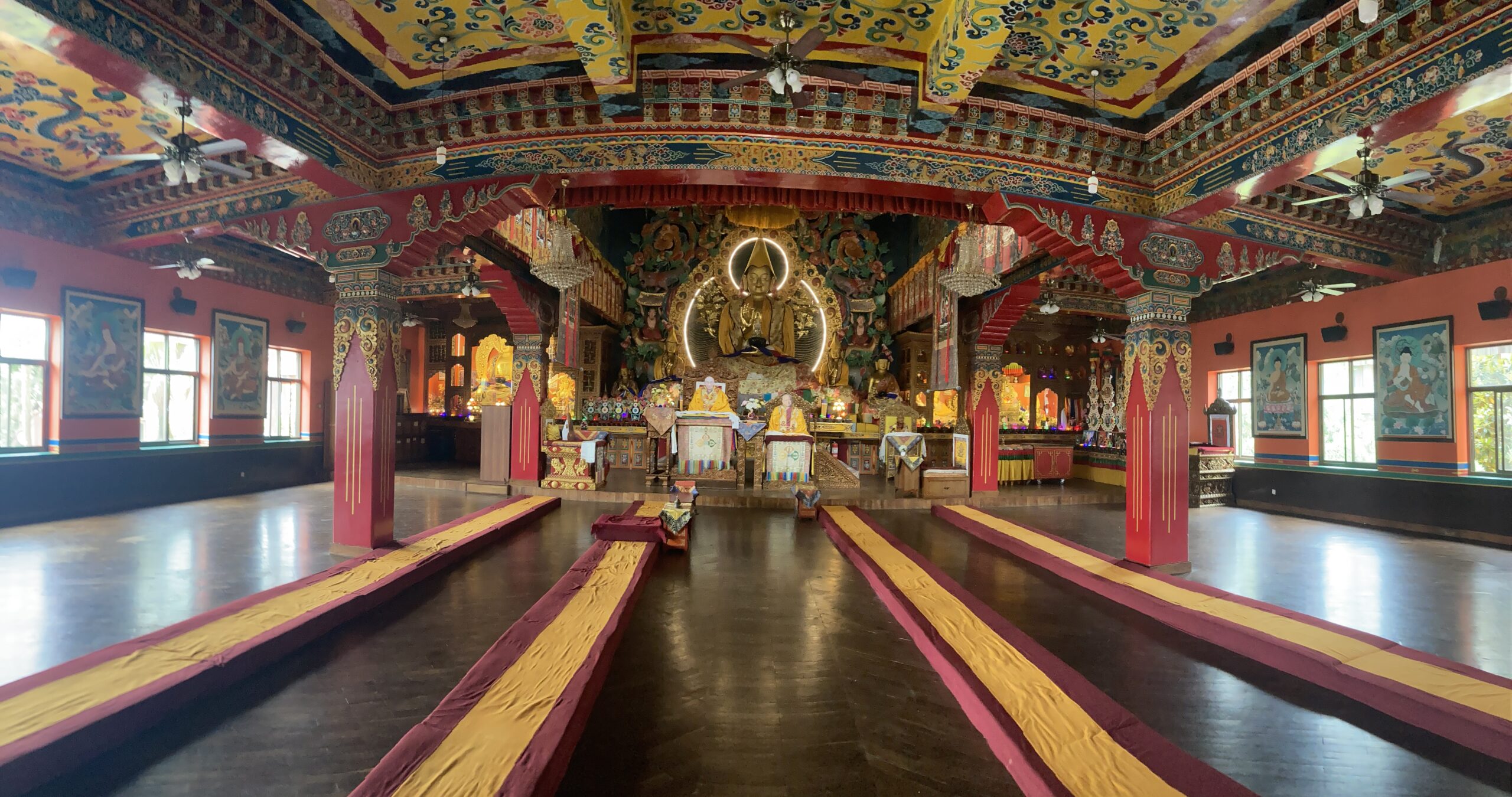
We begin at Kopan Gompa (Monastery), home of Mahayana Buddhism in Kathmandu, where I find, in the library, a little bookshop, and – amongst one or two other finds – buy a copy of Hermann Hesse’s Siddharta, a book which I read in the early 1980s, and which it would be good to read again.  In novel form it tells the story of the Buddha’s life, which is the centre of all the various forms of Buddhism.  The main shrine is beautiful- like that at Namobuddha – but somehow the Dalai Lama seems more prominent here. Tibetan Buddhism is a form of Mahayana and very strong here.   Mahayana Buddhism includes many boddhisatvas along with the teachings of the Buddhas, and their own many and varied guides to the Way. Very strong here at Kopan is the Boddhisatva Avalokiteshvara, whose specialisation is compassion.

At the Sleeping Vishnu

We then go to the Sleeping Vishnu – the Buddhanilthankah Temple.  This 7th century carving from a single slab of basalt rock is sacred to the Buddhists, too, as an emanation of Avolkiteshvara.  Completing a trinity of sanctity, this statue is also regarded by the Shaivites as the emanation of Shiva known as Nilakanta Shiva.  Young boys trained at the Temple monastery preside here, chanting, and placing tika on foreheads and garlands of flowers around necks.  I am very touched by the whole experience, despite the long queue!  The chanting here is quite mesmerising, and learning it from my guide, I repeat the mantra as I pay homage to the shrine.

Lama at Triten Norbutse Bonpo Monastery

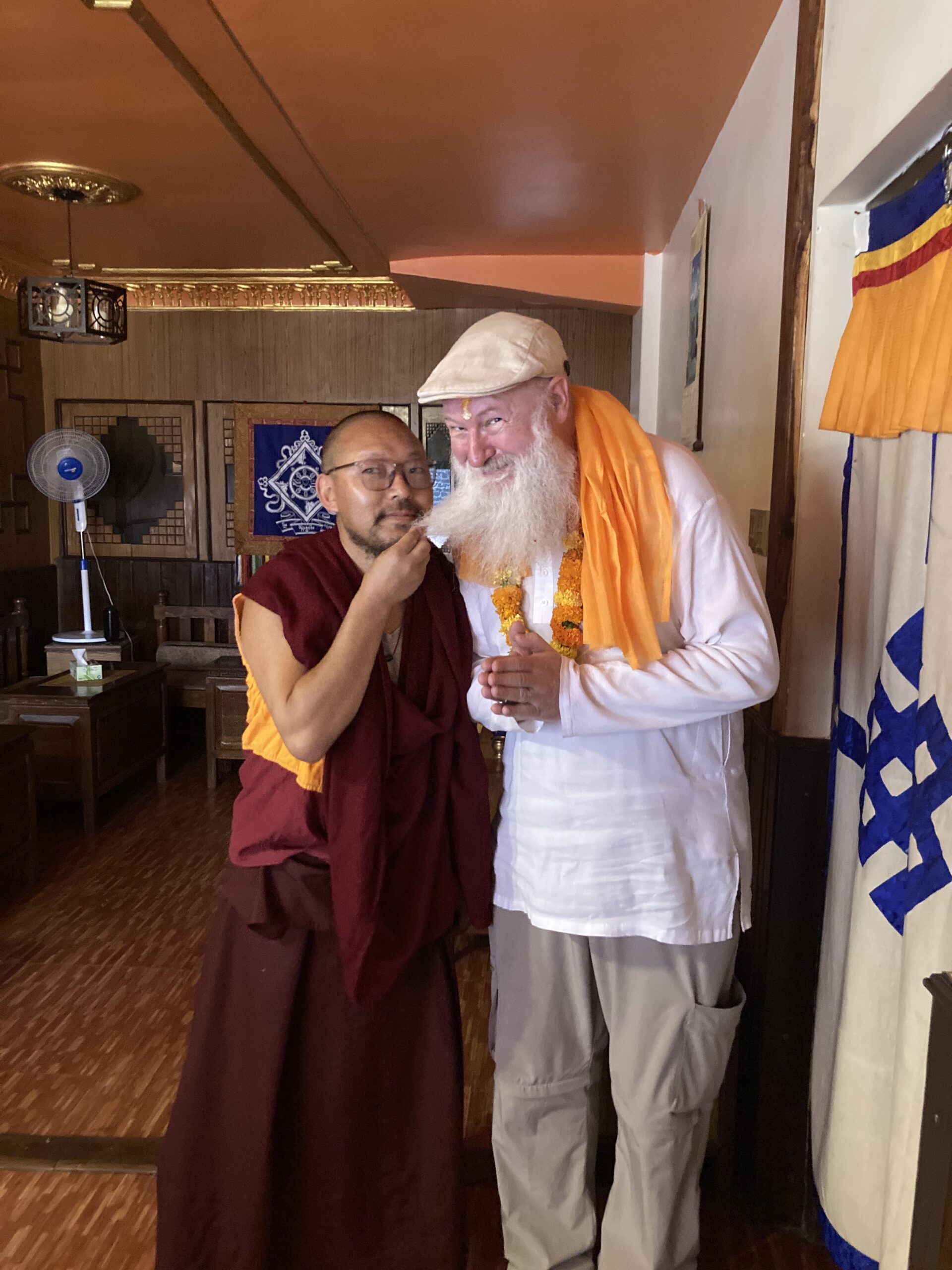
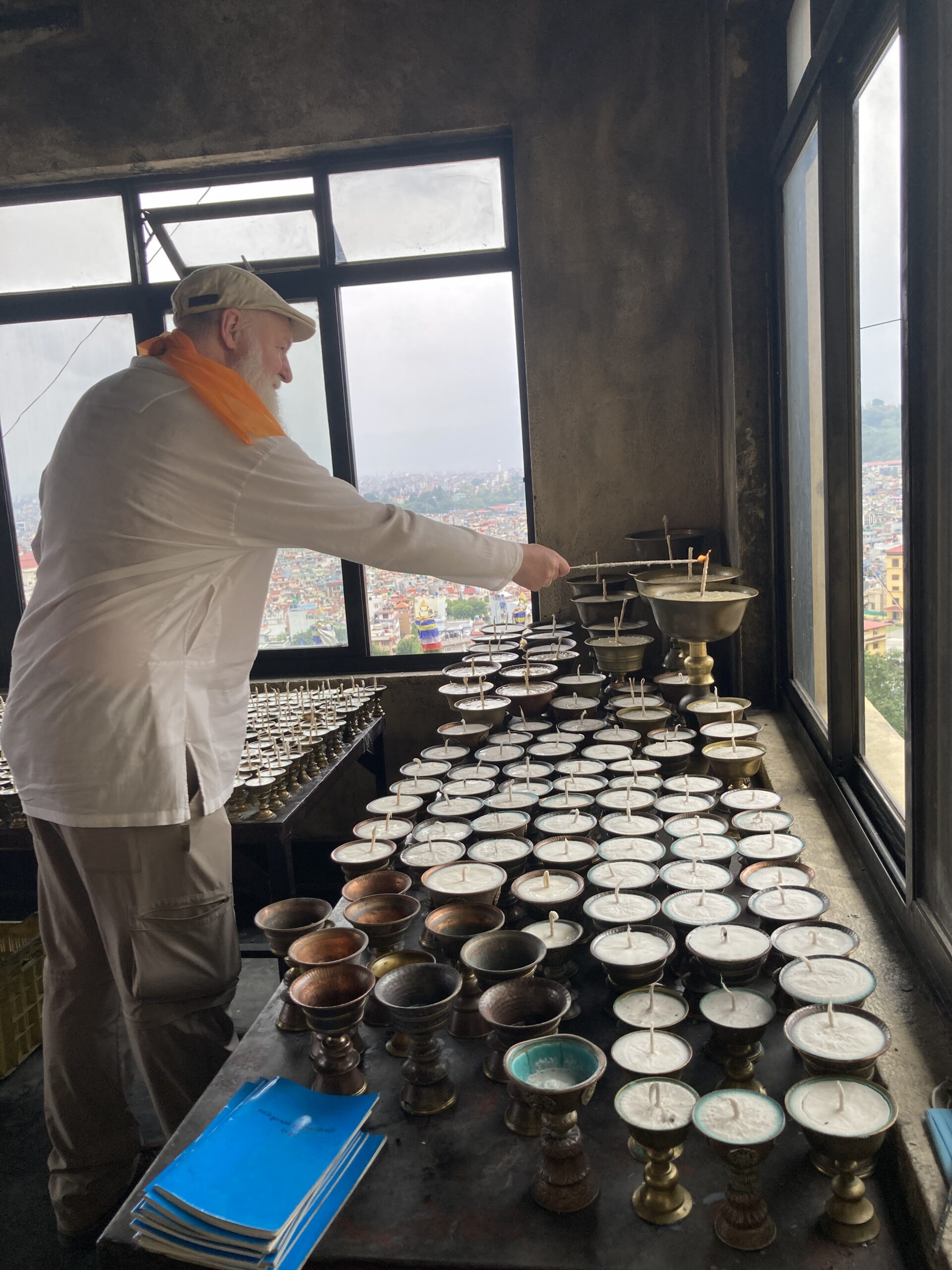
Thirdly we climb up into the hills again for our second Buddhist Temple of the day, this time the Triten Norbutse Bonpo Monastery.  Bonpo is one of the lesser known schools of Buddhism, with its stronghold in the West of Nepal, rather than in Kathmandu, but there are 280 monks here, and I met a lama – who liked my beard – and invited me to light a large butter candle, saying a prayer for my loved ones, before going in to see the main the temple.

Lighting a butter candle
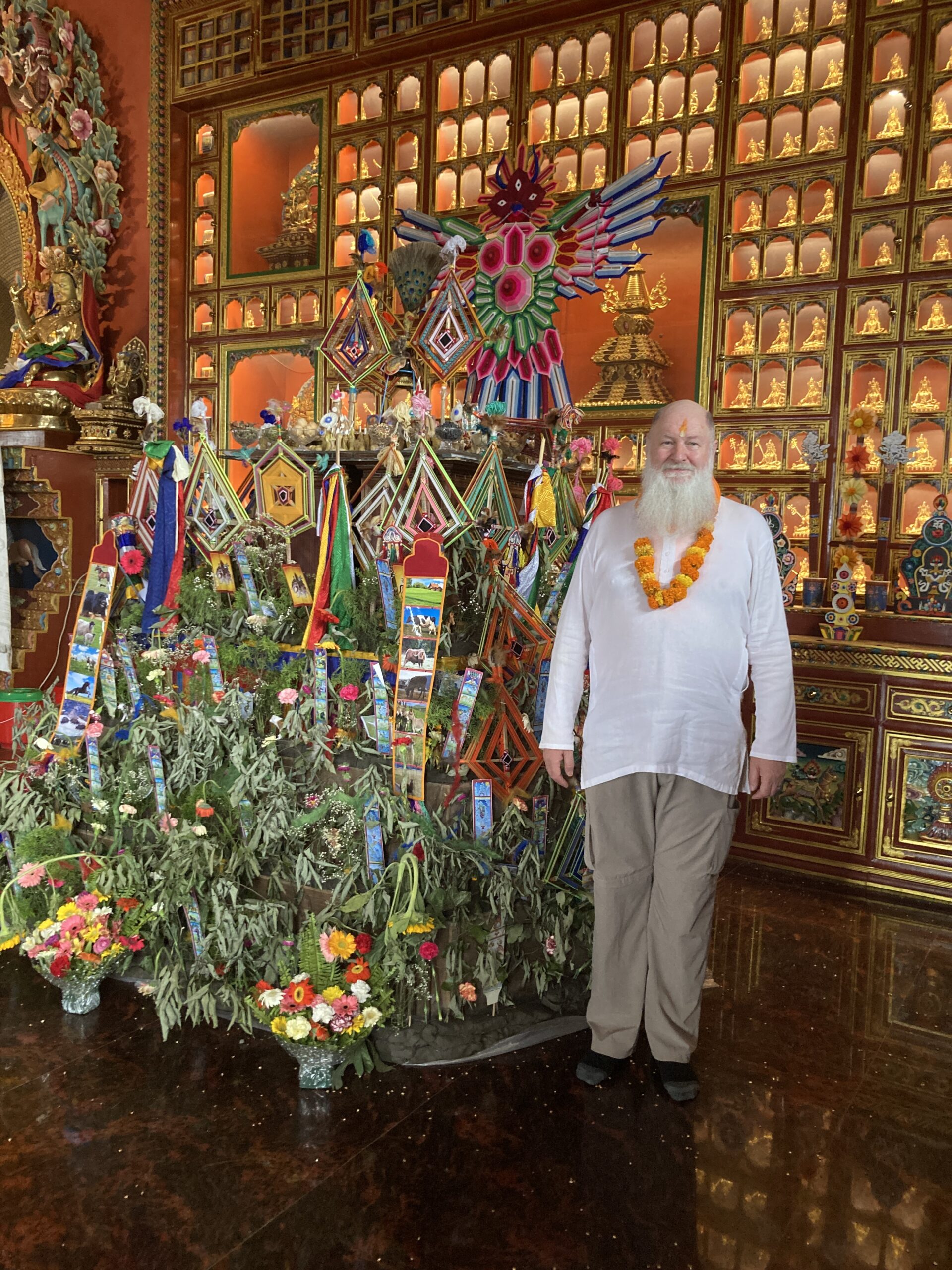
Cotton Mandalas in the Main Gompa

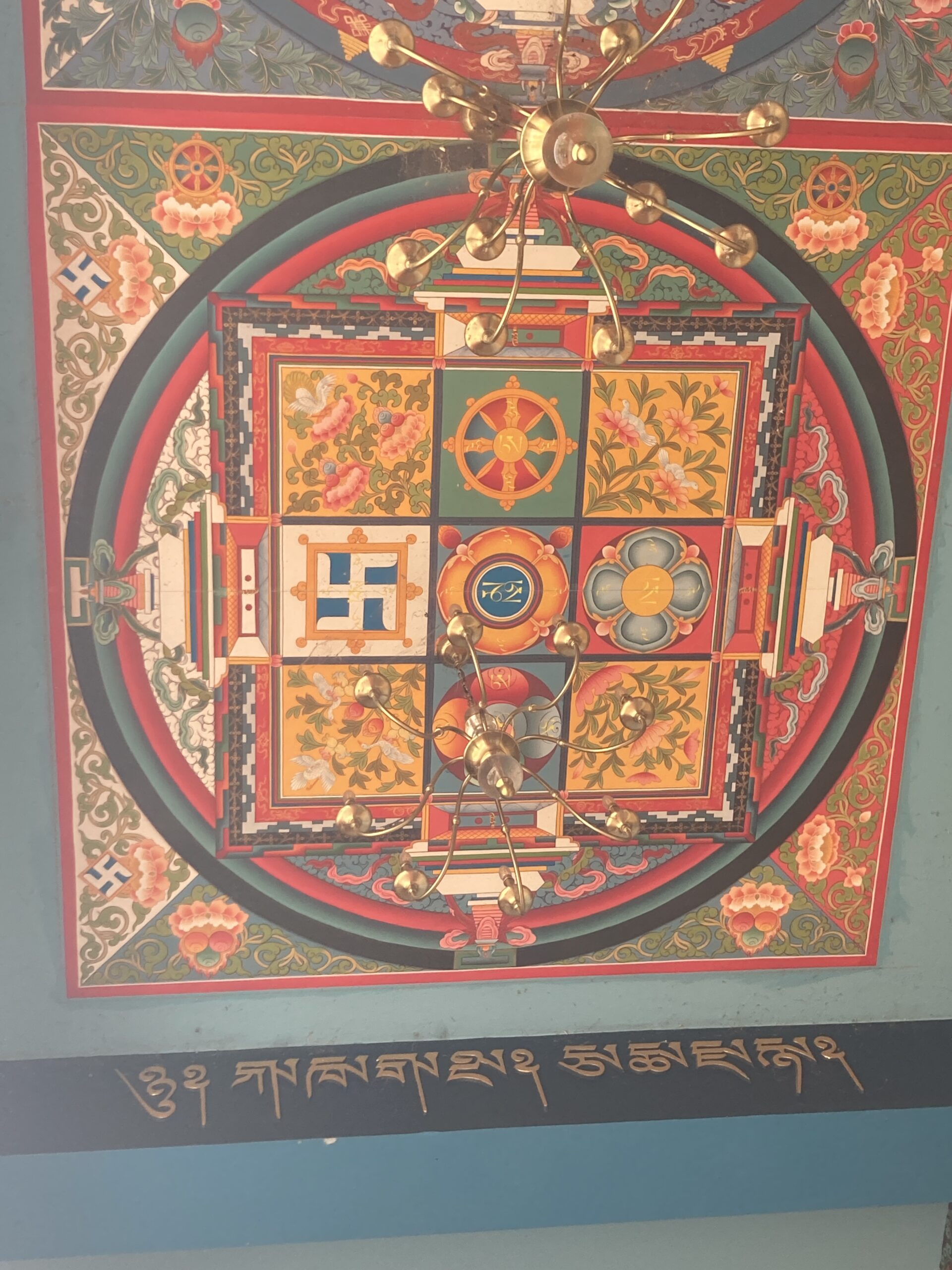
Here the very ancient (pre-Buddhist) roots of Bonpo are visible in the unique cotton mandalas, and the intensity of their relationship with the Buddha in the – equally unique – and huge mandalas painted directly onto the ceiling.

Huge painted mandalas on the ceiling

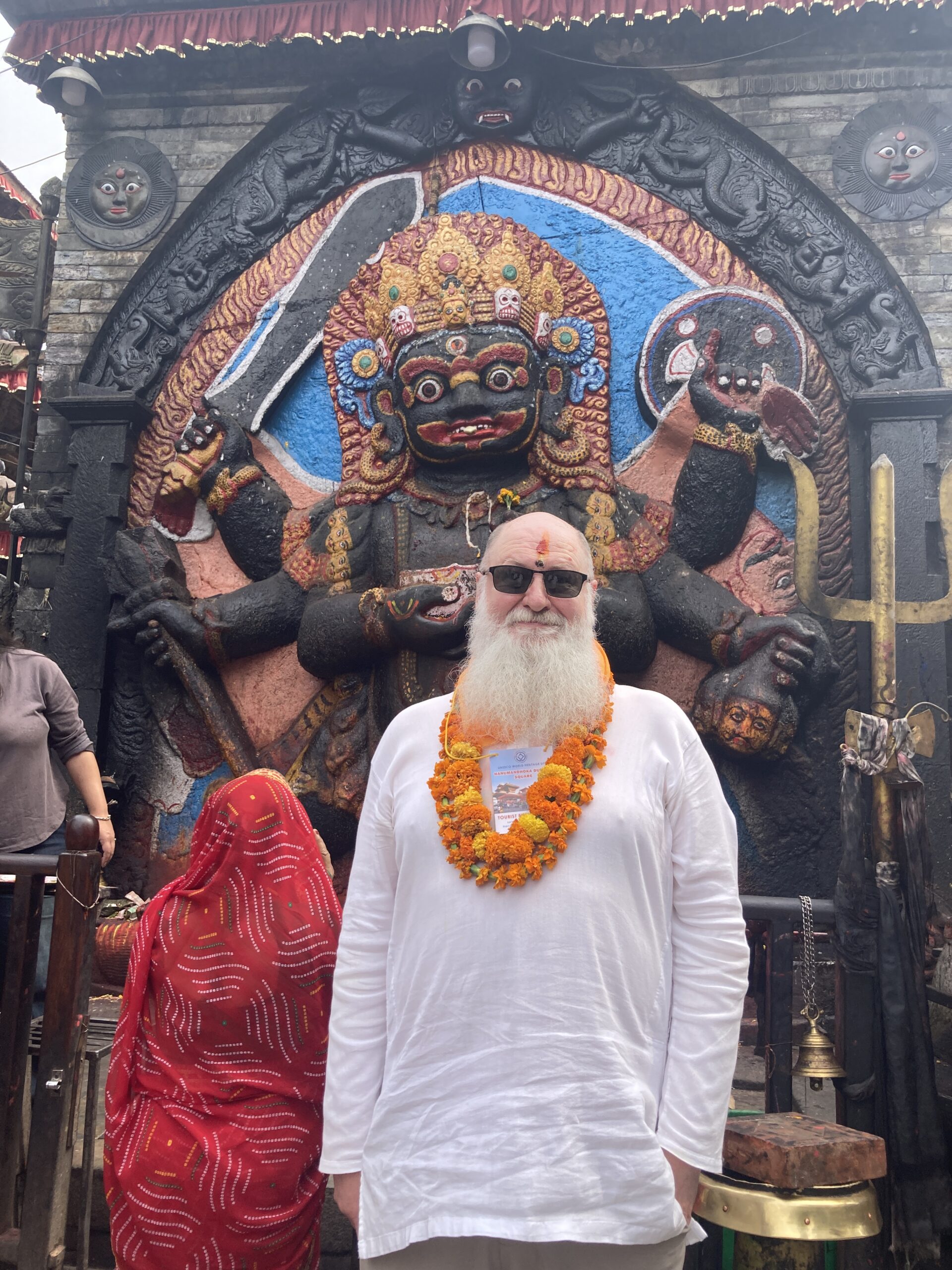
Lastly, we pass through Kathmandu Durbar Square, the medieval royal heart of the city, with its 15th and 16th century pagodas, and its early 20th century neo-classical dictatorship palace.  Most interesting, for me, is the Kaal Bhairav – the great Shiva in his aspect of destroyer and protector.  The presiding priest places the unique black tika of this emanation of Shiva on my forehead.  In one of the many shops, I acquire a brass Kaal Bhairav to take home.

Kaal Bhairav


Next ->

Nepal-Bhutan May 2026 #2

Post #1 | Post #2 | Post #3 | Post #4 | Post #5

28/5/26
This was a huge day.  Conference done – my paper on the Buddhist concept of anatman presented on Tuesday – I awoke this morning excited to begin a true holiday.  I didn’t count on it being such a deeply moving day.

Collected by Jaya, my guide, and my driver, Ram, in our little Hyundai (they let me sit in front, thankfully, to stretch my long legs) I discover they are friendly and knowledgeable, and clearly pleased to have a tourist who seems not just genuinely interested in their religion and culture but both vaguely knowledgeable about it and keen to learn more.

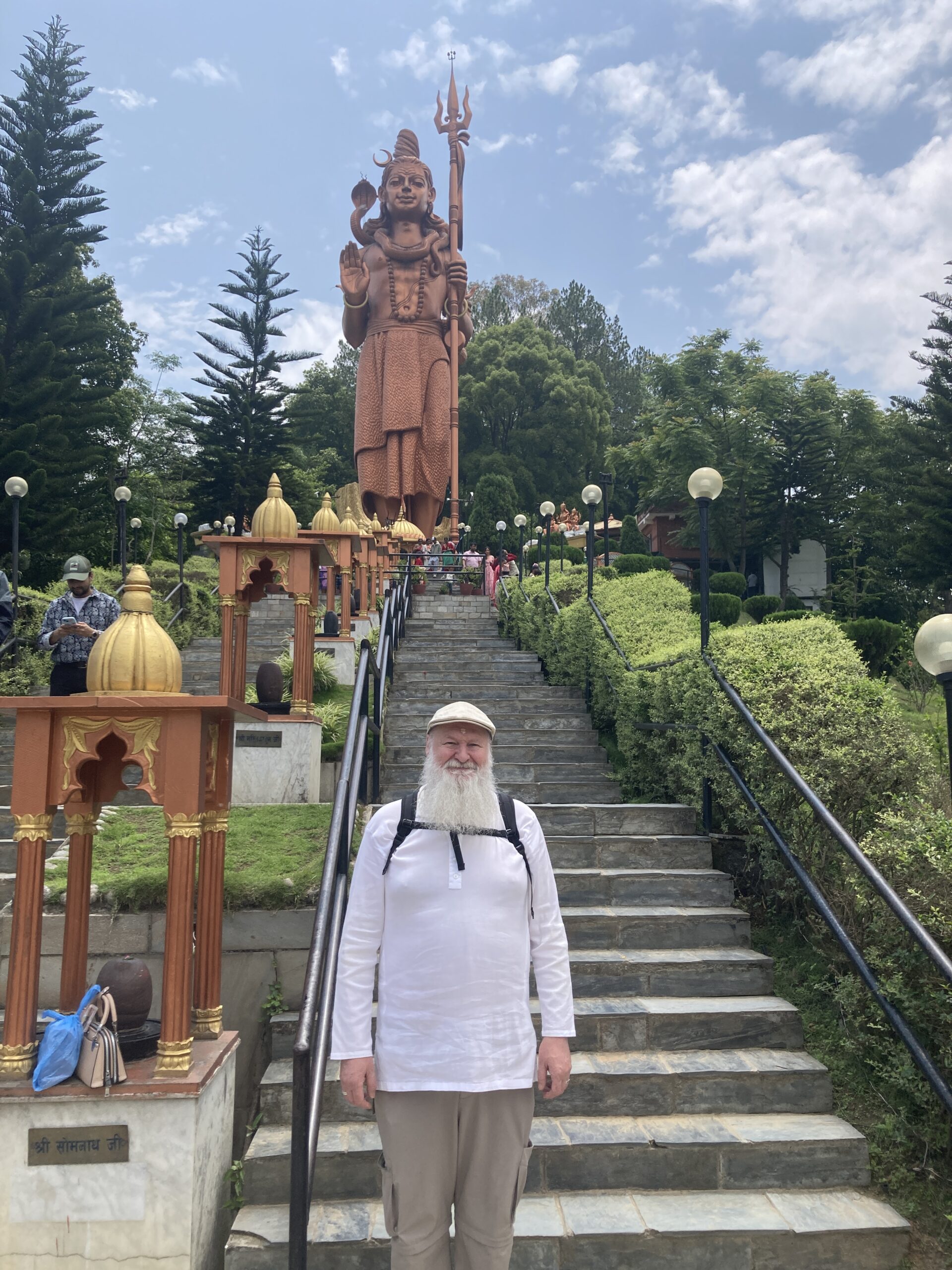
Shiva
Shiva

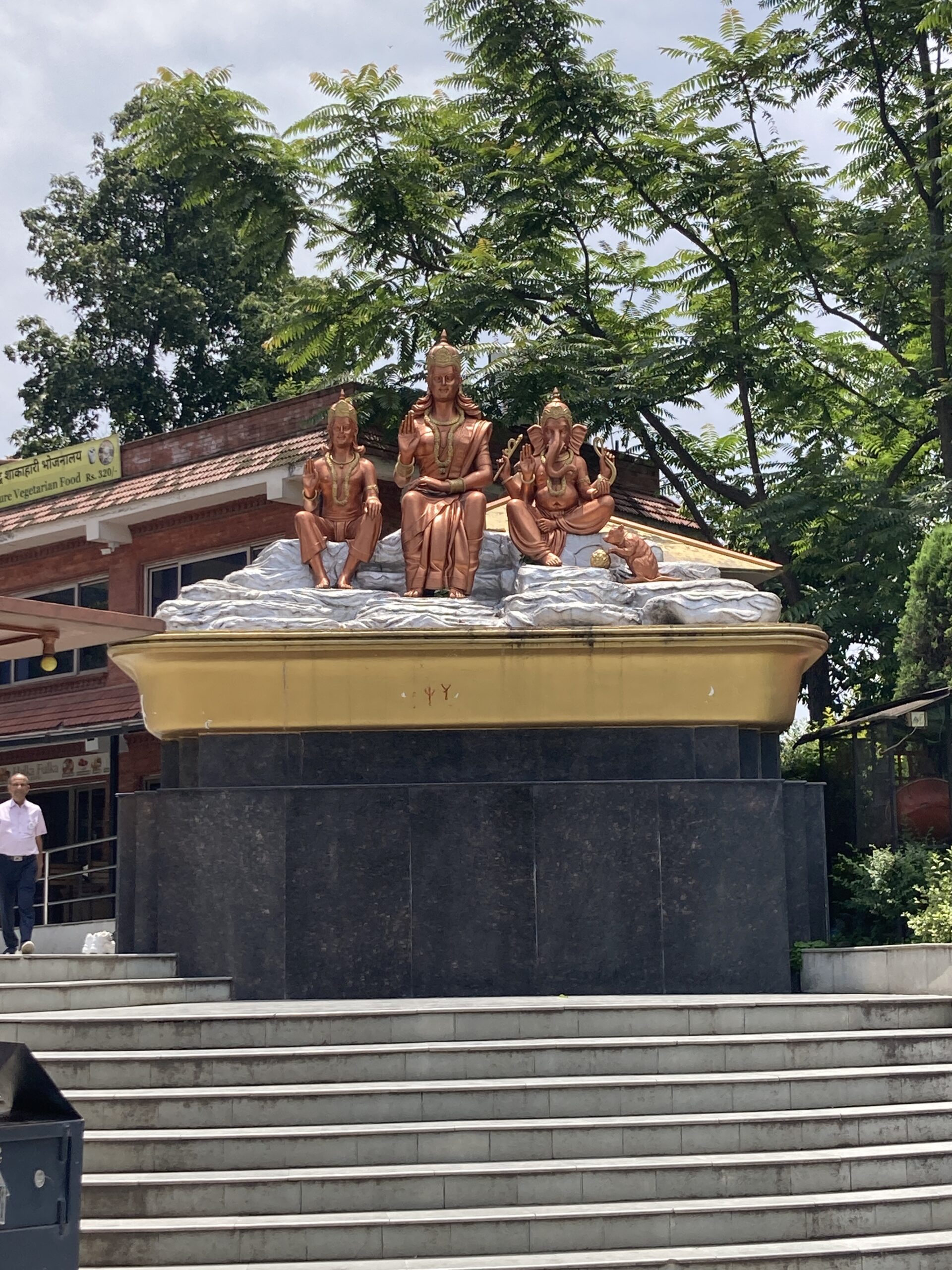
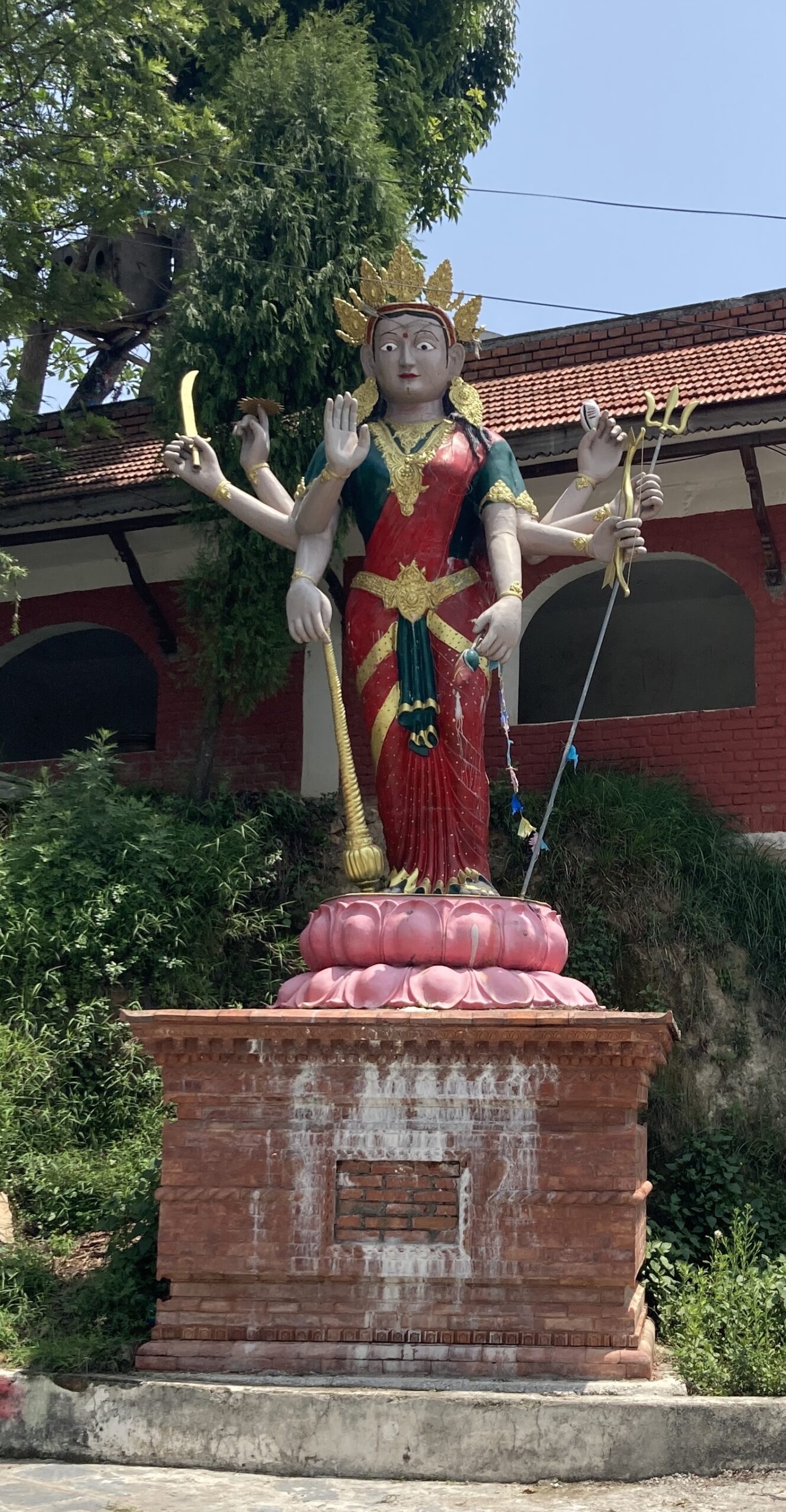
Our first visit was to the largest Shiva statue in the world.  Very impressive. 144feet tall, with Parvati, Ganesh and Skanda on a little plinth at his feet, Mahadev is here in his purple splendour with trident and cobra.

Ganesh, Parvati and Skanda

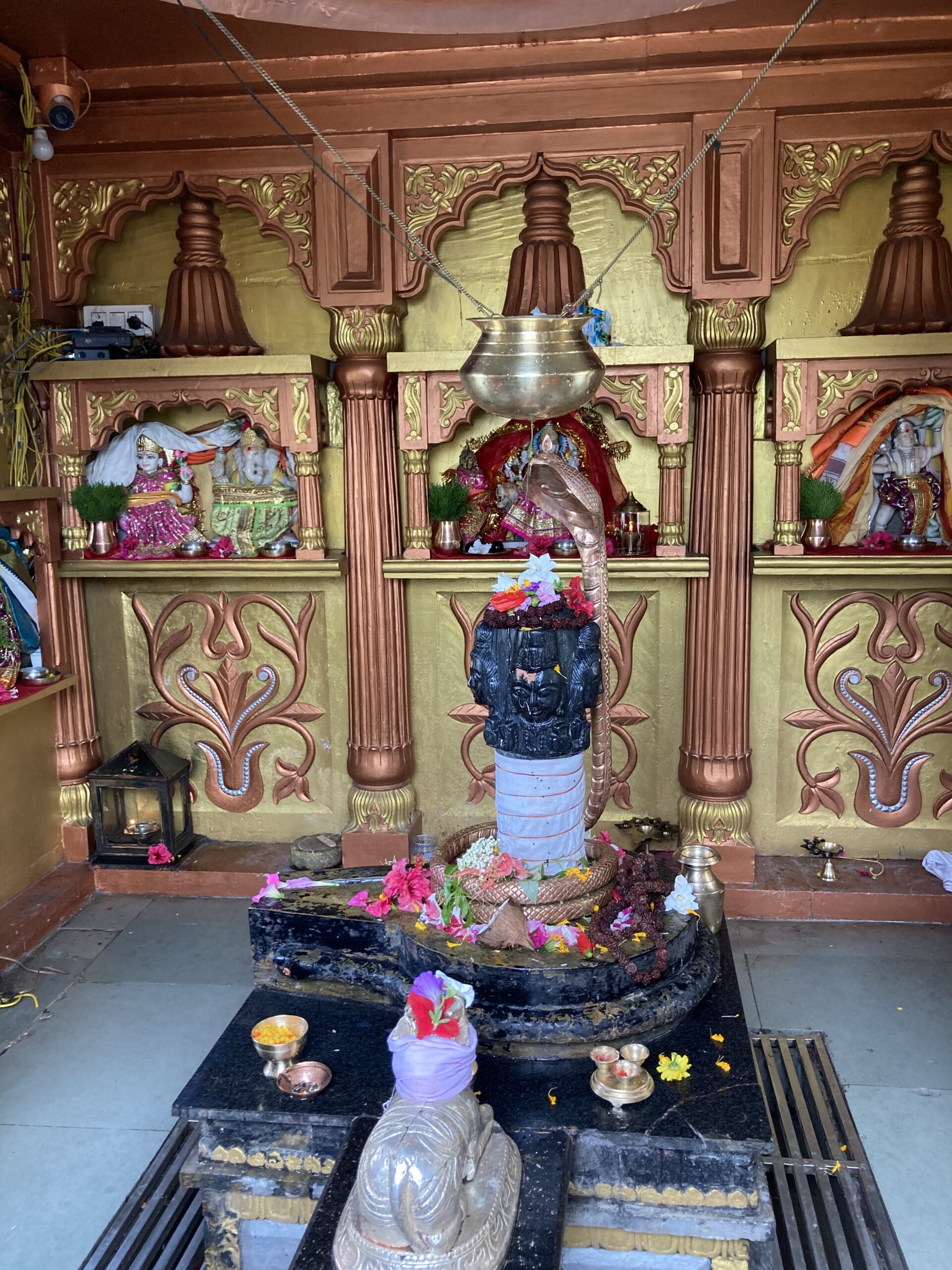
At the little shrine at his feet, the priest put a tika on my forehead, blessed me with the rudraksha beads, gave me a few little yellow flower petals from the flowers draped across the shivalingam in the shrine, which I placed upon the crown of my head, and handed me a few of the sugared sweetcorn, which I duly ate.  It was very special to embrace and engage with the ritual of this Shiva puja.  My guide taught me how to sing the mantra, “Om namaha shiva—-ya”


Shrine at the feet of Shiva

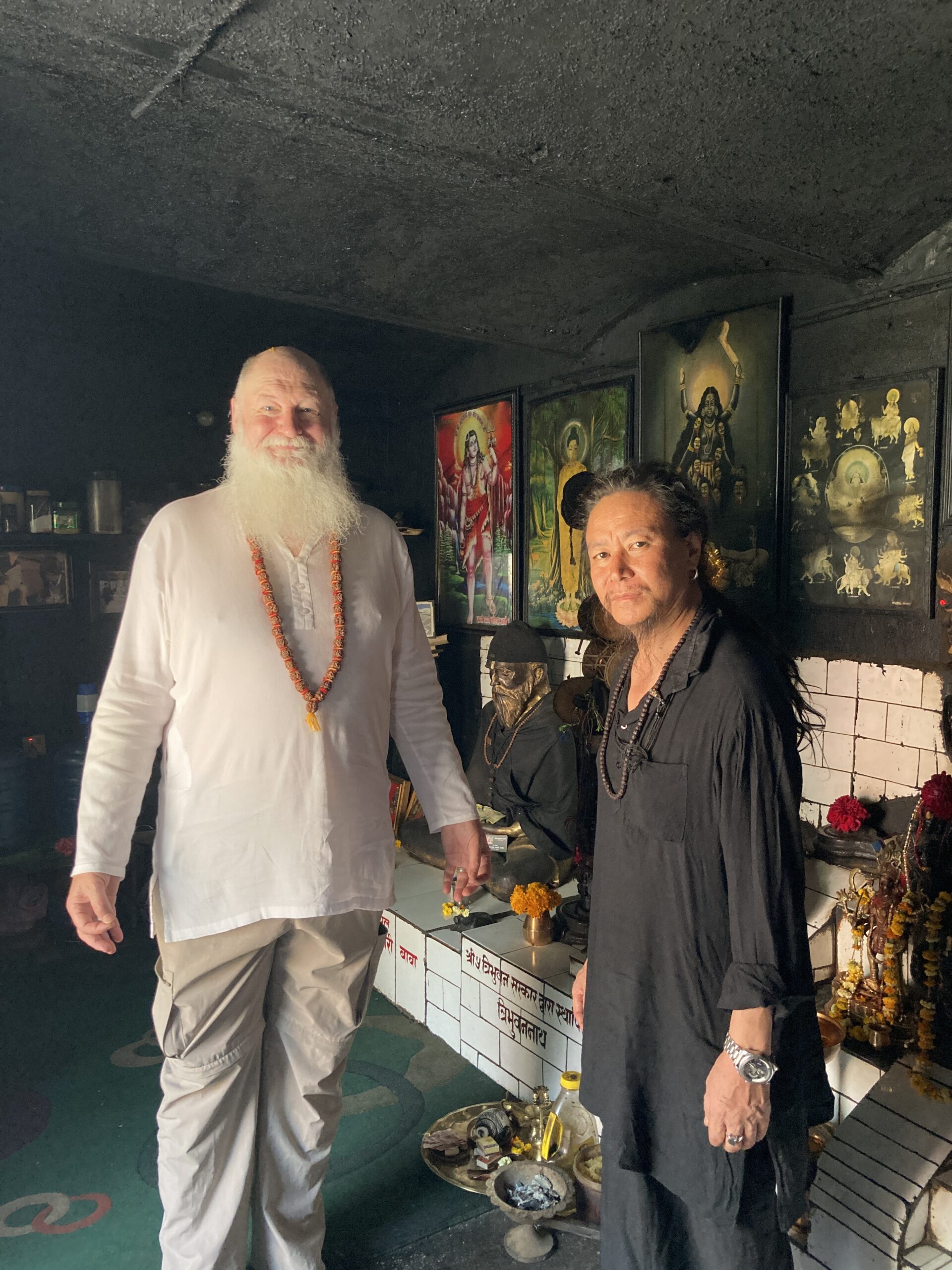
But this was just the introduction. Because we then drove to Pashupatinath.  This huge complex of over 500 shrines to Shiva in his ‘Lord of the Animals’ guise was simply breathtaking, and we began it by going straight to the cave-like shrine of an Aghori Baba Sadhu.  These black-linen clothed holy men follow a very special path, different to the better known white-linen clad ascetic sadhus, and their specialisation is conquering fear.  This is why the aghori sadhu (who has been practicing for 32 years, I am told) has his shrine in the wall overlooking where the bodies of Kathmandu people are prepared for, and then cremated, at the shore of the sacred Bagmati river that runs through this city – Nepal’s Ganges.  I am led into the shrine, and greeted by the sadhu, invited to take off my shoes, and sit facing the seated statue of the Guru Dresh.  A small woman with a friendly smile shows me how and where to sit, with my fingers in the proper rudra (thumb and first finger touching, the other fingers outstretched, both hands resting palm upwards on my knees, and invited to meditate for 15 minutes.  My guide goes to sit at the other end of the shrine, and he and the two women and the sadhu chat quietly.   Occasionally a phone makes a sound.  There is chatter just outside the shrine too.  But somehow none of this matters.  I am soon lost to the world, deep in meditation in this sacred space.  But my back is really not up to sitting in this position for very long, and I begin to shift and feel uncomfortable. Opening my eyes, I turn to look across and my guide calls over saying just to be comfortable and take it easy.  So I lie down, with my knees up, and my elbows on the ground but hands in the air, fingers in the rudra.  This is much better.  But inside, now, it is the mantra om namaha shivaaaaya that runs over and over in my mind.  This is somehow easier than silent meditation.  It is simple.  I lie in this position, with the mantra in my mind, hoping to last for 15 minutes.  At last, feeling a little numb in my elbows, and then realising my hands are tingling with pins and needles, I shift again, and begin to sit up.  I am done.  Looking at the clock on the wall, I realise I have been meditating for 25 minutes.  It is quite something. The sadhu is smiling at me.  He seems quite young to me, perhaps in his late 40s.  His dreadlocks hanging down his back are the same colour as the black cloth draped around him.  His welcoming smile is reassuring.  I am invited to stand so my guide can take pictures, with my phone, of me standing with the sadhu, in particular with the statue of Guru Dresh in the background.

Aghori Sadhu
Aghori Sadhu

Then, suddenly, I am invited to look into the holy of holies – the sacred place at the back of the shrine I did not expect to see.  My guide tells me there is a skull there.  Would I like to see?  I nod, and follow the sadhu into the inner sanctum.  There, on a small desk, deep red all over with glistening Chandan, is a human skull.  I believe it may be the head of the Guru Dresh, who taught the sadhu.  I am deeply moved, my hands together in prayer of thanks, my head bowing, my lips muttering Namaste, and Thankyou.  The sadhu smiles.  Stepping back out into the main shrine, the sadhu puts his thumb on my third eye, presses for a while, and mutters a prayer, and I am blessed.  He does the same for my guide.  We both turn and place NPR500 notes in the little offering dish, and step back out into the sun.  I am completely blown away.  My guide tells me this was a rare experience.  Usually tourists come in for 2 minutes and are gone.  Being invited in to see the skull is almost unheard of – even for locals.  The sadhu, apparently, told him that I had a deep connection with Shiva (for a tourist!), and he was pleased and glad to help me to honour it.  It has been a deeply moving experience.

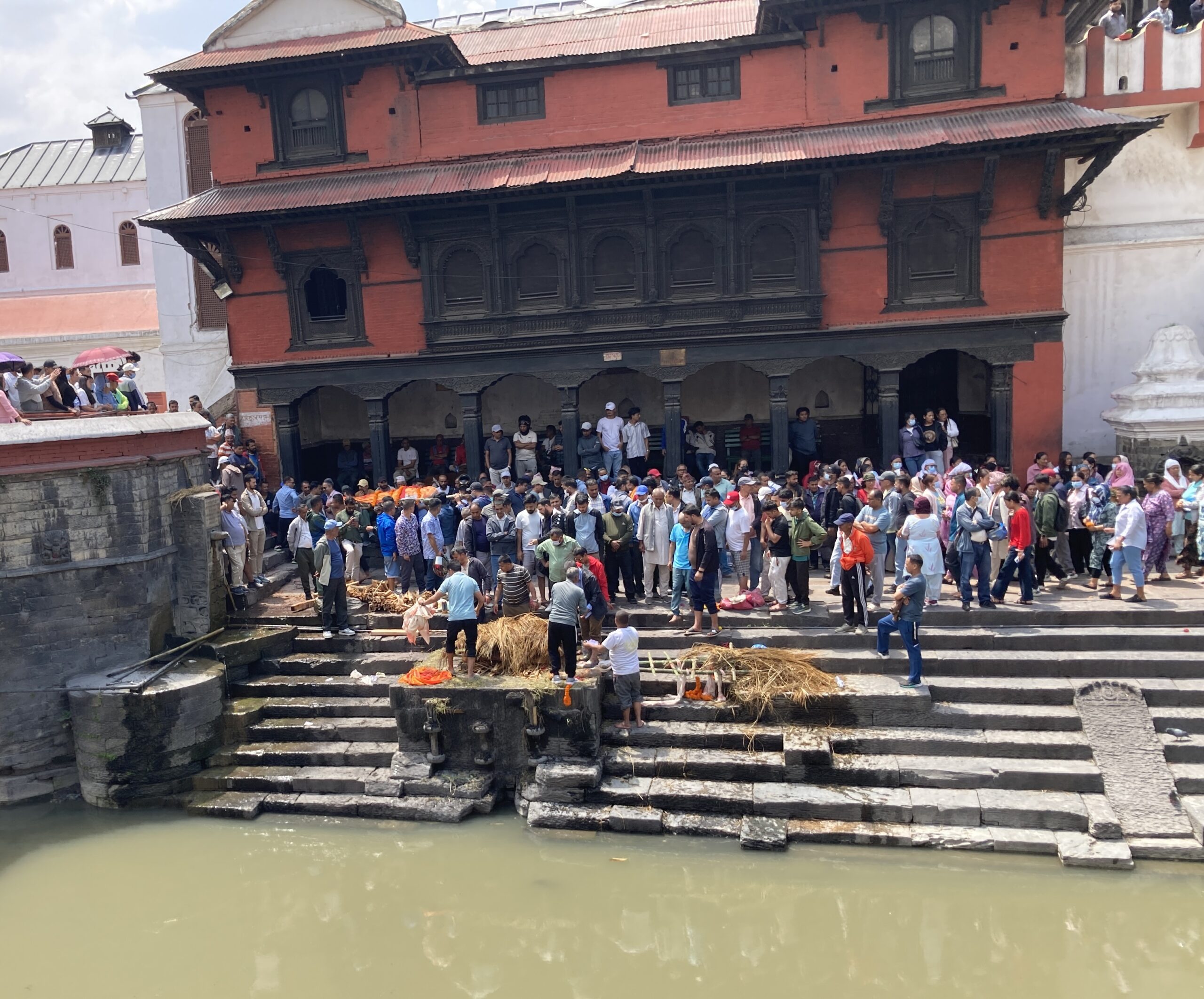
Funeral pyre
Funeral pyre

Out in the sun, we walk across a little footbridge, over the Bagmati River, and stand to watch as families tend to their dead. (The other four of Kathmandu’s rivers flow into the Bagmati, which itself later joins the Ganges.) There are four dead bodies on the paving on the other side of the river, and their families are purifying them with milk, honey, water, and tears, dressing them ready to be carried to the pyre where they are covered with straw, and set alight, in the typical open-air cremation that all the people of Kathmandu may enjoy. It is free – one only pays for milk, honey, incense, etc – and the favoured manner of seeing off the dead.  It takes about 3-4 hours to burn each body, I am told.

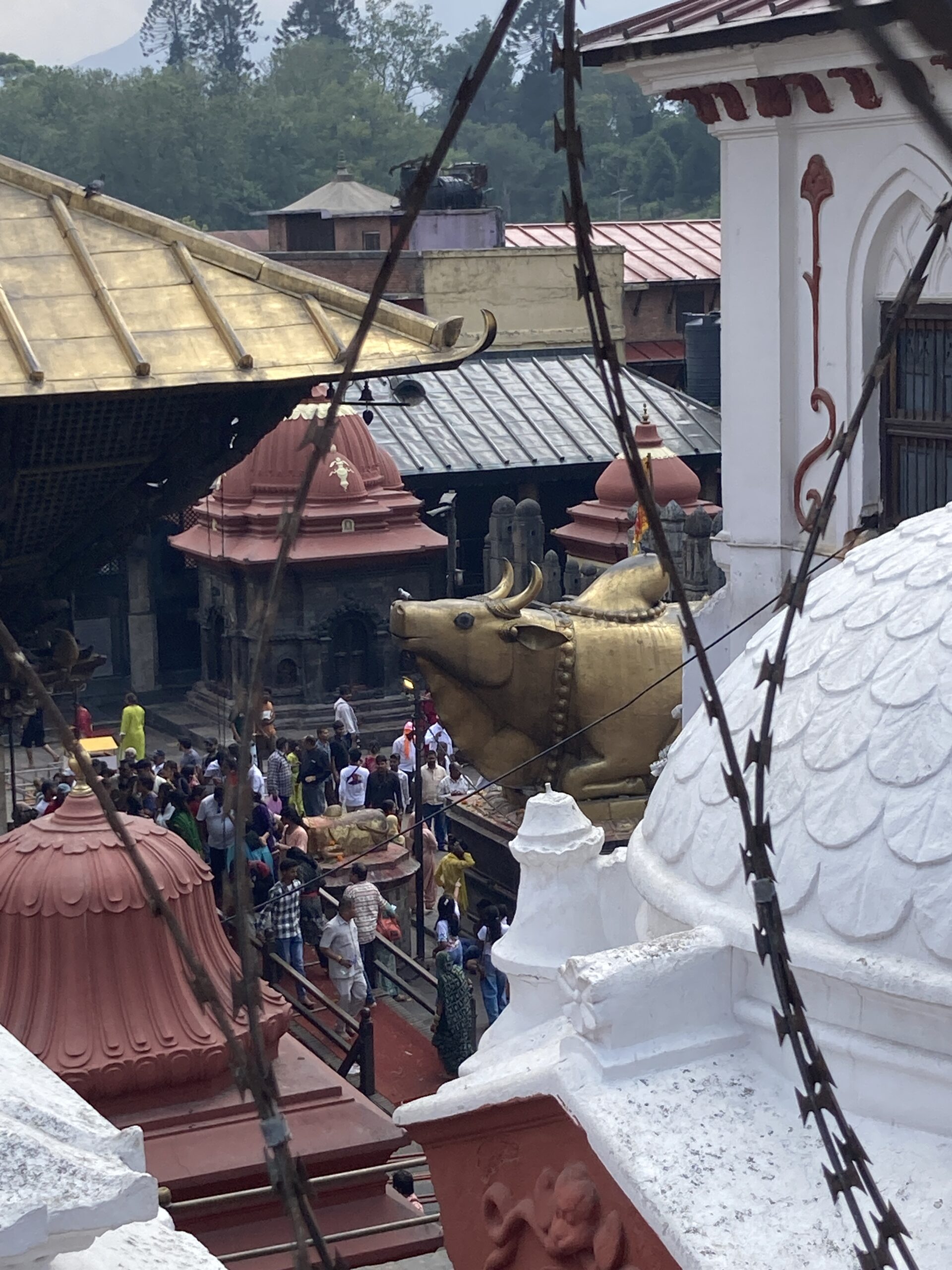
After my experience with the sadhu, somehow all this just seems quite natural, and I am not phased.  It is a serious business, but not I am not discomforted.  We move back across the footbridge, and round to the side of the main Pashupatinath Shrine.  Only genetic Hindus are allowed within the main temple.  Only five sadhus from the south of India, who have been chosen and come to Kathmandu for the last 1400 years, are allowed to touch the self-existing ShivaLingam in the centre of the main shrine.  All I am allowed is a glimpse of the great Bull – shiva’s ‘ride’ – outside the main temple, where people gather on their way in and out of the shrine.

Shiva's Bull Ride
Shiva’s Bull Ride

It has been an incredible morning, and I am glad of the rest and opportunity to have some lunch, before the visit to Boudhanath – the Buddhist Stupa some five minutes away from Pashupatinath.

After lunch, we strolled around the enormous Boudhanath Stupa.  Built in the 7th century CE, by a woman who made bricks with dew water she collected each morning, it is sometimes known as the Dew Stupa. Jaya tells me the prayer flags represent the five elements: Yellow earth; White wind; Green water; Red fire; Blue sky. The Enormous Eyes represent compassion and wisdom to the four directions, and the Third Eye is the eye without illusion.

The stupa is surrounded by shops, making a huge circle of friendly but vibrant capitalism around the solid representation of liberation from all that stuff….  I am – like most – enraptured with all the things, nonetheless – the Buddhist Tat, as one might call it (as opposed to Hindu Tat, Christian Tat, etc) and fork out on a magnificent  Thangka painting of the Kalashakra – the wheel of time mandala – representing the four truths and the journey towards enlightenment: an ‘asset’ for one who meditates.

Finally, then, we arrive at my hotel, and western comforts.

Next ->

Nepal-Bhutan May 2026 #1

Post #1 | Post #2 | Post #3 | Post #4 | Post #5

27/5/26

Travel Writer has been rather quiet on this blog, of late. The blog itself has been pretty quiet! After the profound trip deep into my ancestral past in Ukraine, in October 2019, I have made, in comparison to previous years, almost no ventures out into the wider world; certainly none worthy of blogging.

There was a trip, almost immediately afterwards, to the Hawaiian island of Maui – for a January 2020 conference – involving four flights each way (!) at the end of which I had the opportunity for a day’s drive around the northern tip of the island – the area some years later destroyed by extreme weather! Then COVID struck and all international travel stopped. Or rather, as I did indeed record in this blog, there was one international trip during the pandemic: emigration to Ireland, in January 2021. Since then, apart from frequent hops back and forth between Ireland and the UK for one reason or another (some just for a restful break, most for family and friend visits, once back to the Orkneys again(!) in 2024), there have been a few brief work trips: to Nantes, to Lille, to Sydney (a long way to go for three days!), to Bratislava, to Lisbon, to Nyon near Geneva. All rather civilisationally familiar, european (with a small e) places.

So although travel picked up again, work-wise, from 2023, there has been little in the way of personal, exploratory international travel, and none really worthy of blogging. Four days celebrating my 60th birthday (and Colin’s 50th) in Turkey in March 2023 consisted mainly of a visit to Ephesus, about which there is little more to say, on a personal note, than that I was struck by how my own academic discipline of ‘information systems’, once known as Library and Information Management before it was all digitalised, could be said to have begun at Ephesus, where indexing alphabetically by the first letter of an author’s surname is said to have been invented, by its famous Library’s Roman director, Celsus. And then in December 2024, a conference in Bangkok, which included two days sightseeing, taking in some fantastic Buddhist temples. Perhaps I might have written about what I saw and experienced there. But I have long held the view that, in general, one should write a review of something in terms that are at least appreciative, and rather than writing a bad review (of a hotel, a restaurant, a travel agent, a country) simply decline to go again, or even mention it. On this occasion I wrote a bad review, not worthy of this blog.

Dawn from Himamlaya Drishya Resort

All this changes now. Similar to my trips to Ukraine (2019), Sri Lanka (2017), Japan (2016), and Peru (2010), work has sent me somewhere really quite exotic, for a change, this May, (to a conference where I have given a talk on the Buddhist concept of anatman) and I have taken the opportunity, once again, to properly go on vacation, whilst here, before returning home. So, I am in Nepal -a multi-ethnic, multicultural, multi-religious republic, as it proudly describes itself. Conference is done, and I am now on holiday – for four days here, and then for another four days in Bhutan! Travel Writer’s blog, then, for this trip, begins with my arrival on the 23rd, and my one day of sightseeing on Sunday 24th May, the day before the conference, and continues on 28th when my vacation proper begins.

23/5/26
Collected at the airport by the hotel transit in a nice cosy BYD, I was relieved and impressed. The drive from the airport to the hotel, however, was very instructive. My driver took a ‘secondary route’, perhaps because the main highway is very full.  The state of these roads is appalling. We were frequently reduced to a crawl across rough ground, frequently circumventing half-made gravel tracks. Occasional stretches of concrete road were rarely long. The hills and valleys of the sprawling city make for perilous climbs and sharp bends. My first views the city made it seem to be a vast collection of half-finished buildings, rarely joined up. Shops are everywhere but most sell vegetables and fruit. Dotted in between are global brands like Pizza Hut. A wide range of development, seen from my air conditioned BYD SUV.

Finally reaching the hotel, after unpacking and a shower, I drifted off to sleep at around 10am. It was strange to wake, pick up my ipad, and see it was 10am. That was, of course, in Ireland. Here in Nepal it was now 2.45pm.  The heat in the morning was oppressive. In the afternoon, sitting on the balcony of my room, watching the warm rain, I delighted in the cooler temperatures that come with it, and the thunder!

24/5/26
Here at Dhuilikhel, to the east of Kathmandu proper, where the University is located, I find I am a good 90 minutes (at least) away from both Durbar Square and Swayambanath, the two places I thought I might visit on my first full day in Nepal. This is not just distance, but the fact that the roads are in such a shocking state. This is in part due to the generally low level of development, here; Nepal is one of the 30 poorest countries in the world, in GDP per capita, (and Ireland is currently at No.3). It is also in part due to the massive earthquake 11 years ago, from which the country is still recovering, and in part due to renewed landslides from time to time due to bad weather. In conversation with hotel reception here, I decided on a more local tour, taking in (1) the nearby market and its local Hindu shrine to Gita Mandir, which boasts one of the tallest stone pillars in Nepal, then (2) Devisthan Kali Temple, famous for its 1000 steps, which – fortunately – my car will be able to avoid on a winding lane to the top of the hill where the shrine is built. (3) Thirdly the Namobuddha Buddhist Monastery, and lastly (4) Panauti Indreshwar Mahadev Hindu Temple and Museum. All this will only take up five hours of driving and walking around.

We agree for me to set off at 10am – with the same driver in the same BYD that collected me from the airport. Orun (29) is friendly, helpful, knowledgeable, very local, and although his English is poor the translation apps on our phones ensure we understand each other well enough.

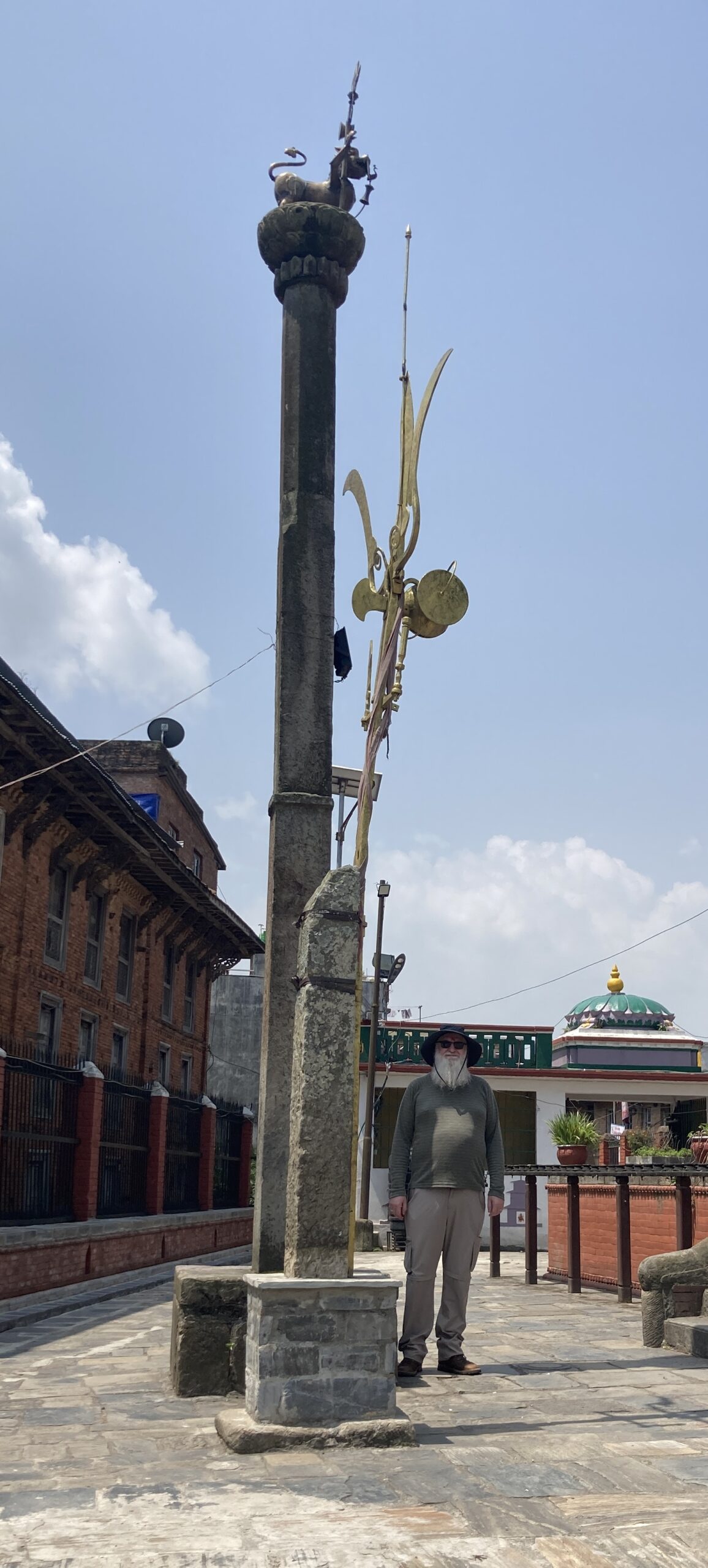
Tall stone pillar
Tall stone pillar at Gita Mandir

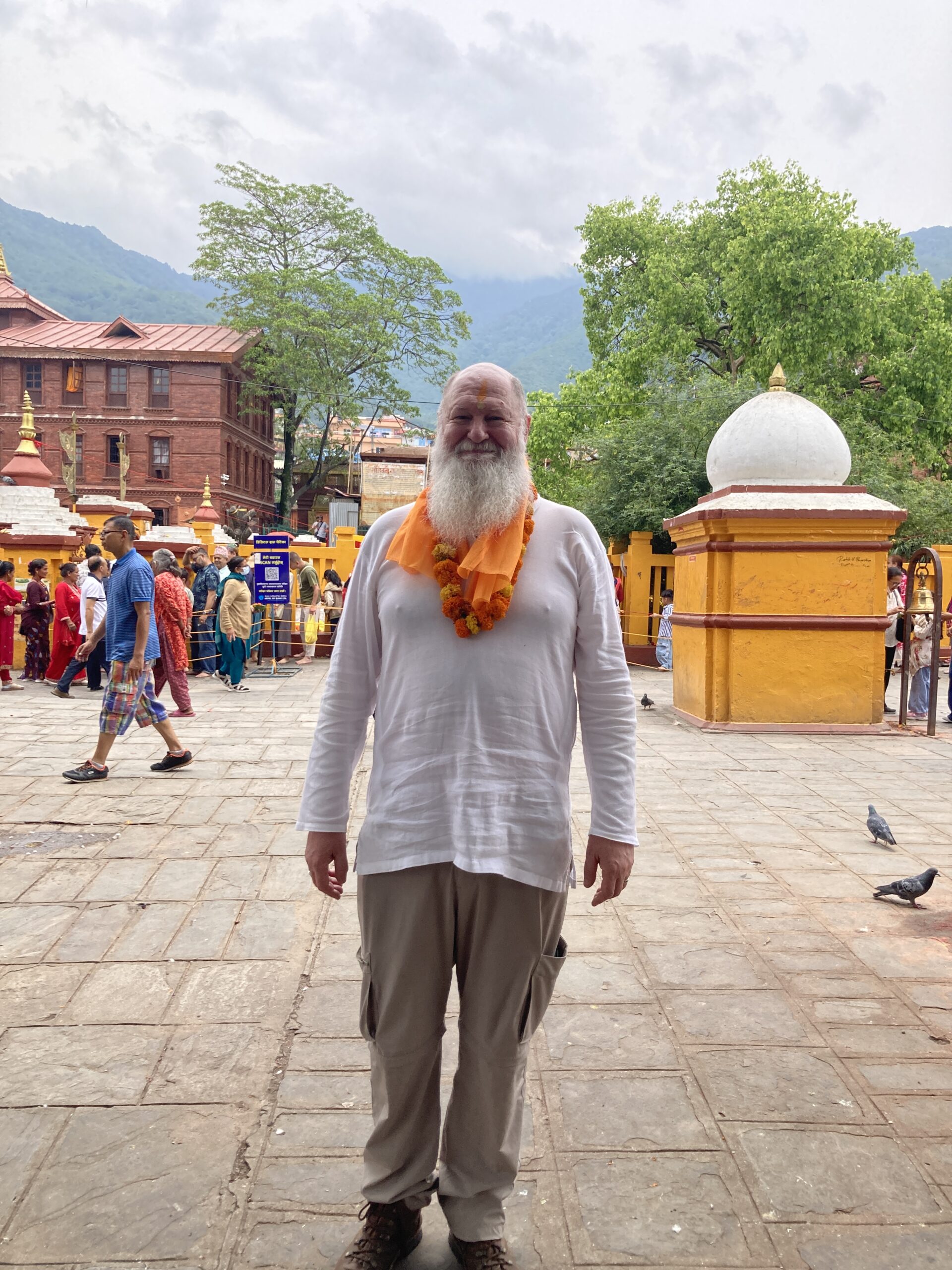
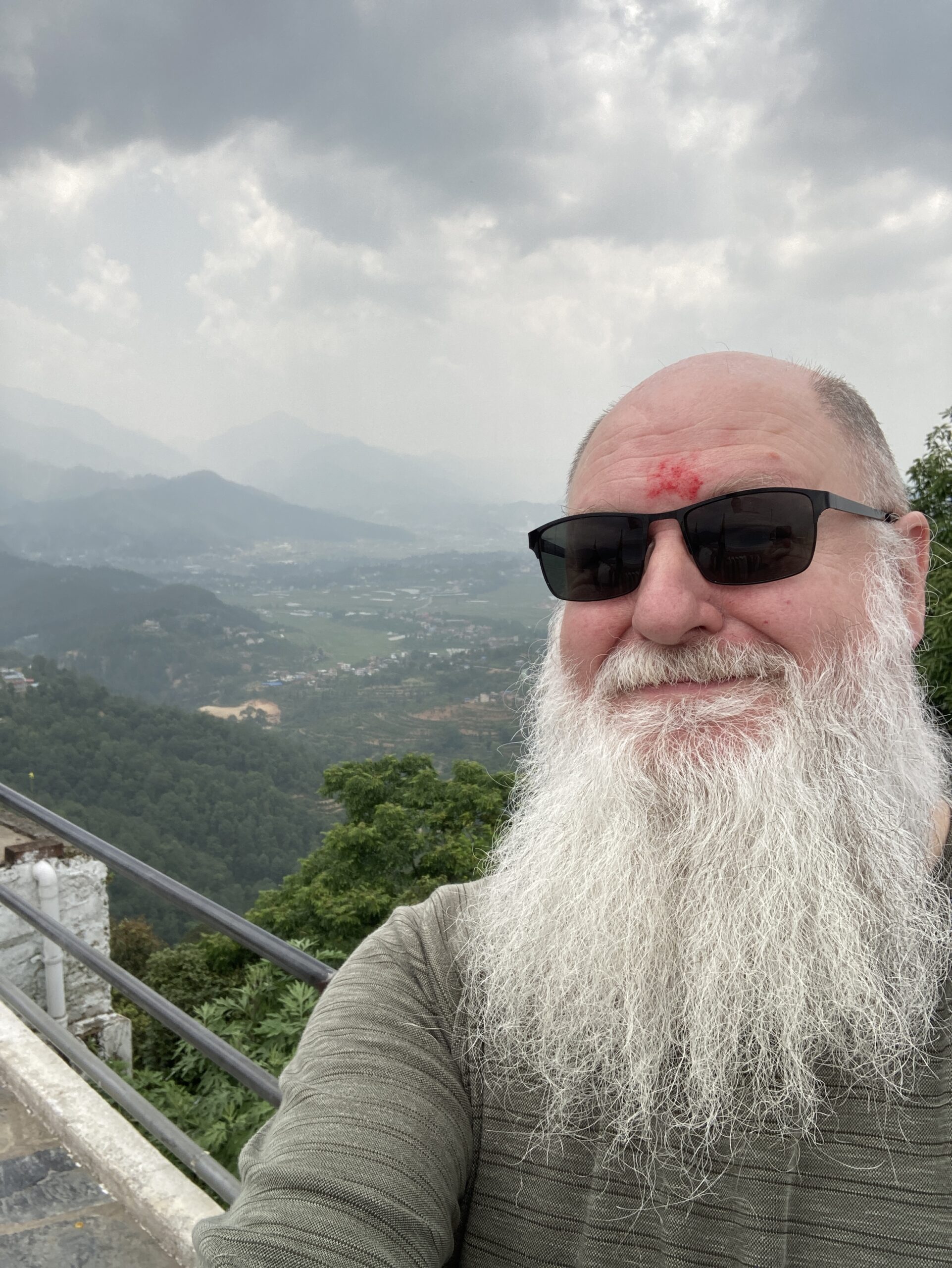
The little market in Dhulikhel is tiny, but boasts a life size statue of a Tiger, a little shrine, and a pool. Nowhere has a Nepali cotton shirt I would like: only typical Western shirts. But on the hill above the shops we visit an equally tiny local shrine: Gita Mandir Temple. There are little shrines to Shiva and to Ganesh on the way in, and a lovely small Temple to Gita Mandir overlooked by the tall stone pillar. The place is deserted. We ascend to the outer court of the Temple: the inner court with the idol is fenced off. Orun touches the stone threshold slab at the entrance with the fingertips of his right hand, then touches his chest with them, and lastly his forehead, in a seamless 1-2-3 gesture honouring the sanctity of the space, as we enter. I follow and do the same, delighted and intrigued by this simple expression of religious feeling. At the entrance to the inner courtyard, by the fence, there is a bowl of red paste. He invites me to add, with the tips of the fingers of my right hand, a bright red Tika on my forehead, “a gift from the Gods” he says, from the bowl of Chandan (brightly coloured sandalwood paste). I’m not very good at it. He does it for me, and I thank him for doing it properly.

Tika
Sporting a Tika

So, for the rest of the day, I proudly sport the daub of bright red Chandan paste on my forehead, between my eyes at the top of the bridge of my nose – known as a Tika – as symbol of my experience of the holy places of this area. I am touched, and already enriched by this small local shrine. I put a NPR20 note into the slot where monetary offerings are made. I am reminded of Japan, here, and the Shinto habit of making an offering of a few coins.

Kali
Kali

Next, we head to the Devisthan Kali Temple. The 1000 steps are indeed a very long and quite steep set of steps up the side of one of the many hills that are scattered across this region. Winding up across it, back and forth like a snake, the concrete lane we drive along cuts left and right through the steps, leading us up to an area where we can park near the top, and get out to complete the last short flight of steps to the Temple. The flat crest of the hill here, at the top of the steps, boasts a statue of the first King of modern Nepal, who united the country. Then intricately carved wooden doors in the distinctive local style, in a small break in an outer wall, grant entrance into the outer courtyard of the Temple, beneath a carved Nag – the cobra. A small open Shiva shrine in the outer courtyard is all we have access to. The inner courtyard, with the Idol of the ancient Crone Mother Goddess Devi – known best in the West as Kali – is locked away in an inner walled shrine to which we neither have access nor any ability to see inside. It is a truly imposing place and I am deeply touched by the Shiva shrine, at any rate, and impressed by the amazing views. Despite not being able to see her idol, it feels as though the ancient Goddess seems very much a living presence here, where she is worshipped by living devotees. We are fortunate to be here when there is nothing going on, and almost no-one here but ourselves, save a trio of small boys.

Then the drive, back down the winding lane and across a little valley – the roads a little better around here I’m glad to say – to another hill, where another winding lane takes us up the side of a wooded hill, up, up, up to Namobuddha Stupa & Monastery – home to large complex of brightly painted buildings and hundreds of monks & peaceful chants. After the quiet of the Devi shrine the crowds of monks, visitors, and tourists here makes for quite a different experience, but we are nonetheless not overwhelmed, and able to experience some parts of the Temple almost alone, from time to time. Taking off my boots each time, we visit the Main Shrine, the Shrine of 1000 Buddhas, and the Shrine to Green Tara.

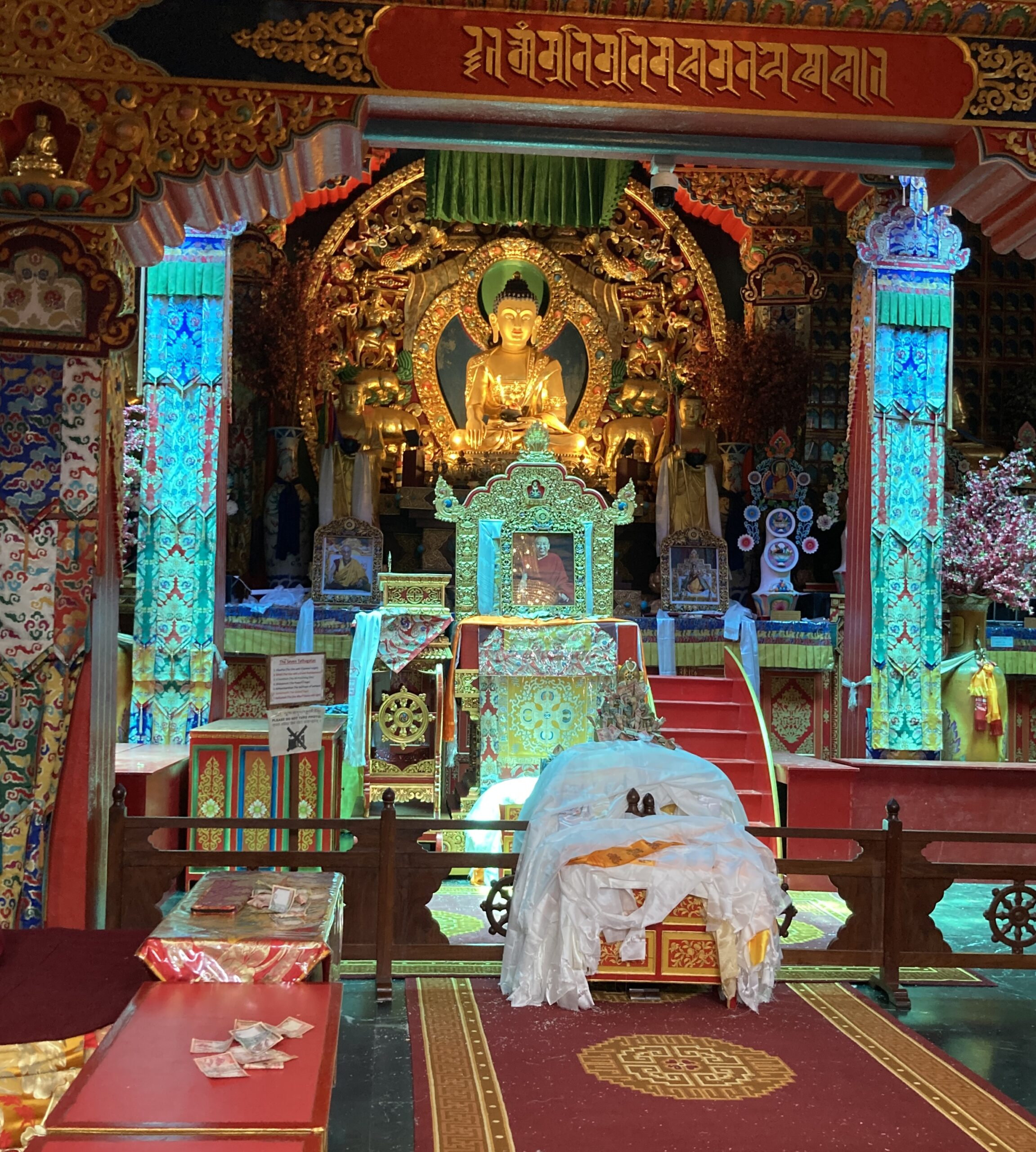
Noma Buddha
Namobuddha main shrine

The main shrine is really amazing. My guide and I take off our shoes and walk up the stone steps, in through the great wooden doors to the main shrine, and walk up the aisle, and stand in front of the central Buddha at the shrine for a good while, silent. There is a line of small shrines in front of one great wide shrine that supports a series of huge Buddha statues. My heart is full. My face is a beaming smile. I am filled with peace. But the only thoughts that pass through my mind are of anatman – the topic of my presentation at the conference here on Tuesday: the Buddhist concept of not-self. I am not, and not being, I am filled with both joy and love, and compassion for both myself and all others. I am enriched, and the boundaries of who I am are wide open; there is no difference between me, and Orun, and the other devotees who now begin to file into the shrine. Noticing them, I am drawn away, at last, and follow my guide off to left of the shrine. A monk leads a group of devotees up the aisle to where we have been standing, explaining things to them in Nepali. As they turn to the left, we see they are filing past the little ‘no entry’ sign to make a tour behind the front pillars, nearer to the big Buddha statues. Following Orun’s lead, we join them in making a (clockwise) tour of the inner part of the shrine. Following my guide, I bow my head and touch my forehead to the white shawls draped across special parts of the shrine. I put a NPR20 note in amongst all the other little monetary offerings that gather like flowers atop the pillars. I follow the devotees ensuring that I touch my forehead to the correct places, as we walk in file around the shrine. I join them in making another small donation of a low denomination note of NPR in one of the little clusters of notes. At the last we return from our tour to stand again in the aisle, for a while, before turning at last to leave the main shrine. It has been very special. Just before we leave, many of the devotees are standing taking photos of the shrine – seemingly with the permission of the monk. Orun whispers to me to join them quickly. I take one picture. It is very precious. We step out through the main doors of the shrine, back to the top of the stone steps. As I return to myself, my Western self, the man in his early 60s on a tourist visit, I am blessed with such an experience. We walk back down the stone steps, put our shoes back on, and out again into the crowds. Next we visit the Shrine of 1000 Buddhas – another very peaceful place – where we make a tour of the lower courtyard, amongst many, many little statues. No thoughts really, just a peaceful emptiness, inside feeling close to, almost merging with what is outside of me. Lastly, the Shrine to Green Tara. Om Tare Tuttare Ture Swaha. My experience from 1989 playing the role of Lepchani in a big community theatre production in Glastonbury returns to my thoughts. The producer/director had a dream about me – this was the way she had created all her shows – and then wrote a script with me as the main character, experiencing the final journey through the six Bardos. She said she had dreamt I was once a monk in a Tibetan monastery. As a Goddess worshipper in Glastonbury, she made the show more about Green Tara than any of the other Buddhist figures. Tara has – since then – on more than one occasion, led me “across the sea of my unknown fears”, and brought me succour when I was afraid, deeply upset, or suffered an emotional blow or loss. At her shrine here, I put a higher denomination Nepali Rupee note at the cluster of offerings. I know what to do now and followed other devotees less slavishly and more for myself and in my own right, worshipping the Buddhist divinity with whom – at least at this moment – I had most affinity. Beaming and serenely at peace, I followed Orun back out to the edges of the temple complex, where we stopped at the Monastery’s tourist shop. Unable to resist, I bought a proper Buddhist Singing Bowl, and some Green Tara Incense. In the car, afterwards, I reflected on the fact that even now, so many years later, a familiar history is still playing out. The academic discipline I fell into, in the decade after that Glastonbury experience, once known as Library and Information Management, before computing changed it completely into information systems, means in some strange way I guess I am still the librarian, that I am here at all because of that continued engagement in the library….

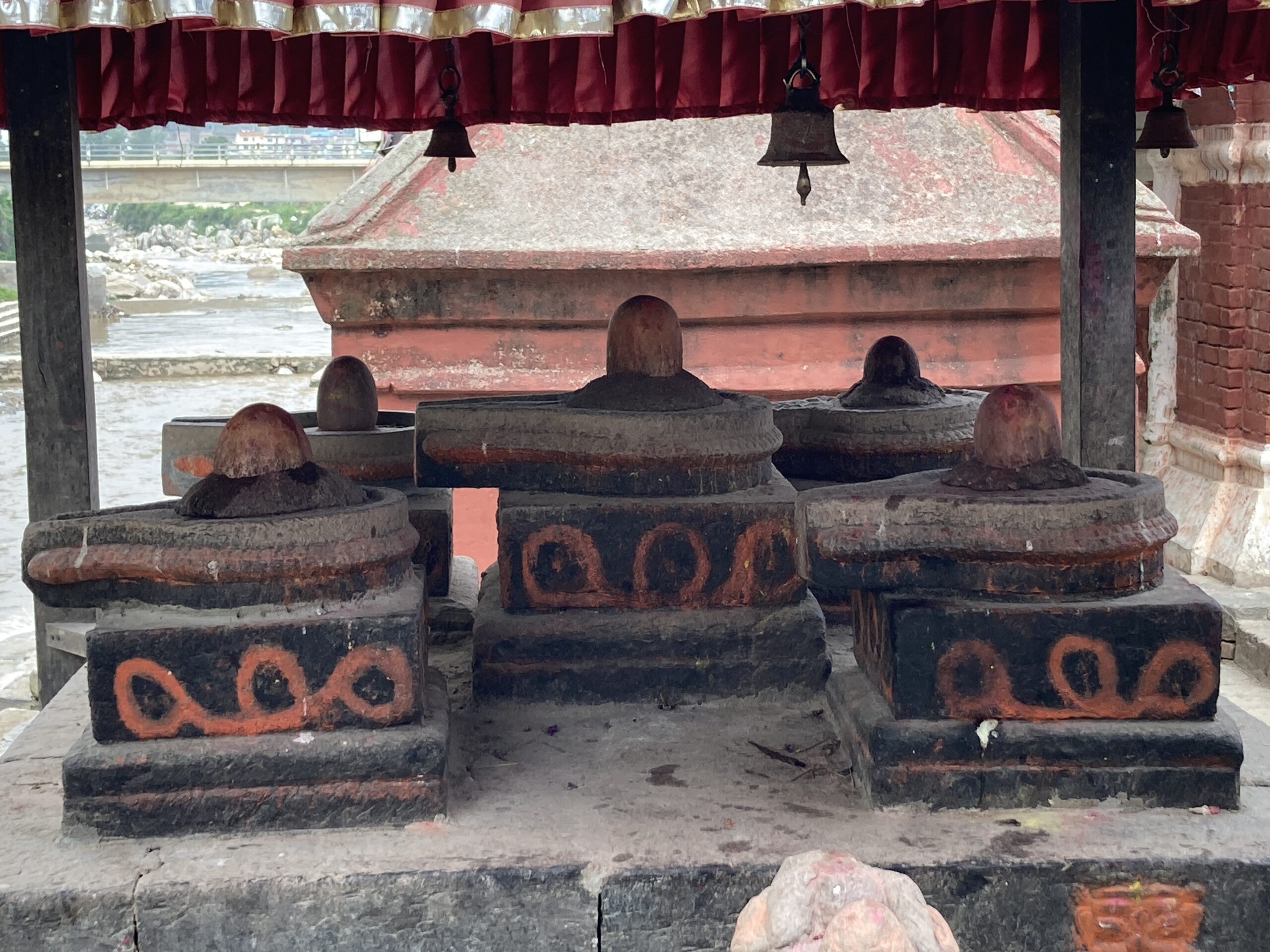
Mahadev
Mahadev shrine
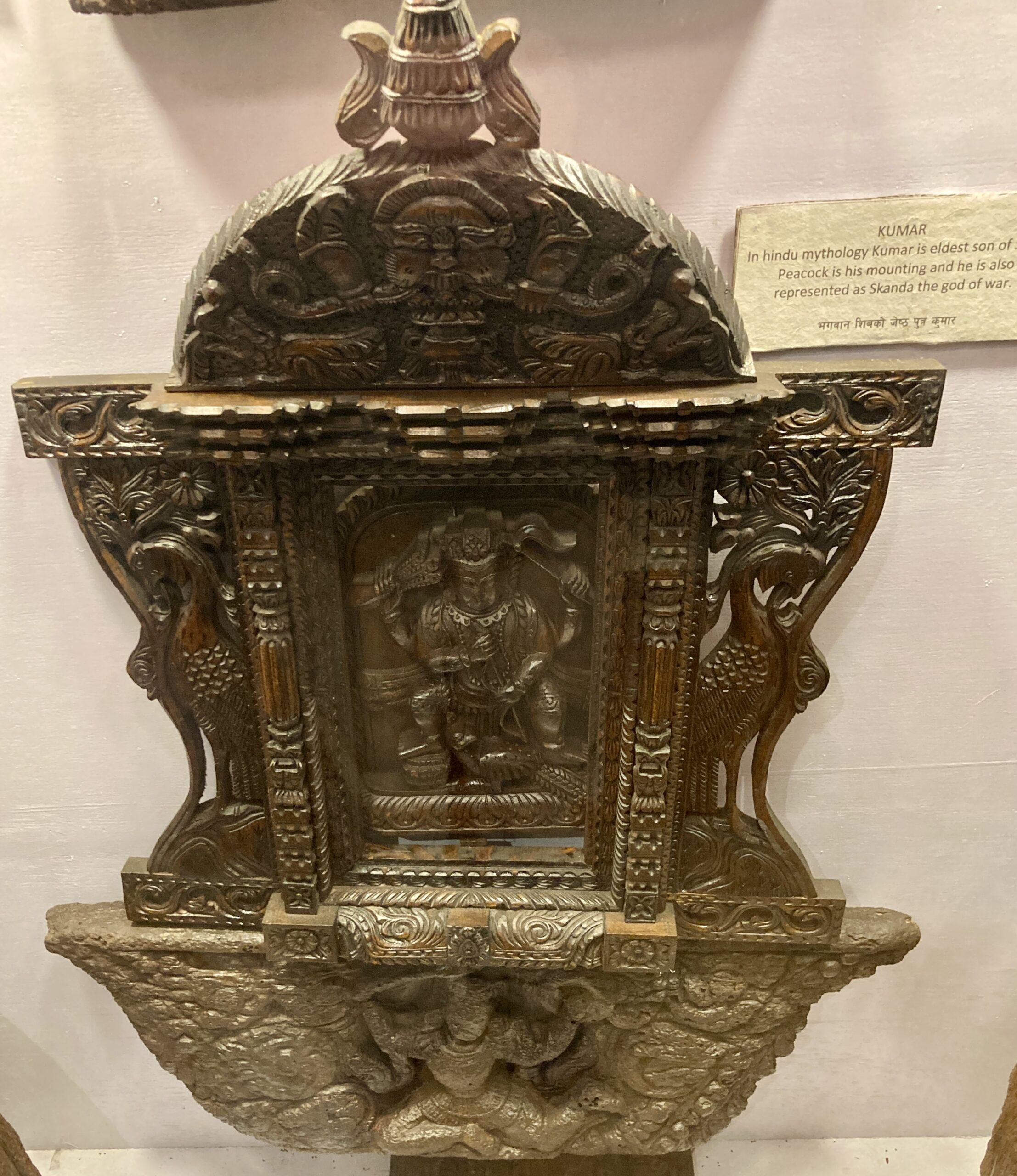
Kumar
Kumar wooden plaque

On the way back to the hotel, then, after this, we stopped for a while at a very, very old Hindu Temple at the confluence of two rivers. Panauti, in Kavre, a historical Newari town known for its ancient temples, culture, and traditions, includes this temple – the Indreshwor Mahadev Temple, one of Nepal’s oldest and largest pagoda-style temples. Mahadev is one of the names of the god I know as Shiva. There is even a museum here, where I spend some time in the cool and relative dark and quiet looking at old items from the Temple. I am also drawn to the Mahadev shrines where Shiva Linga are gathered, and the Bull and Trident make it very clear that Shiva – here known as Mahadev – is the principal god here; god of gods. I have learnt something else new too: in the Museum I discover that Shiva’s eldest son, whom I have known as Skanda (or Murugan in South India) is here known as Kumar. So Mahadev (Shiva) and his son Kumar (Skanda) are worshipped here, at the confluence of two rivers, and – as if to underline this – where the waters meet, there is a pile of logs burning, with a trail of smoke rising from it, and Orun tells me there is a body. I don’t see it. I am not phased by it. But it is my first witness of the Nepali practice of open-air cremation. I tell my guide that in Europe we cremate our dead too, often, but in furnaces, hidden away. I think of my mother, cremated only a few months ago; of my father, cremated 23 years ago now. We drive away, slowly, back up the side of the valley to wind our way over yet another hill, back towards the hotel.

As in Sri Lanka, Hinduism and Buddhism sit side by side here in Nepal.   Yet there seems no contradiction.  It seems to me that, as a European, I might understand it in the following way: the pantheon of Greek Gods – Zeus, Hera, Apollo, Athena, etc, and all their rivalries and strange relationships, were honoured and sacrificed to by the great philosophers of Athens. So too, the pantheon of Hindu Gods – Shiva, his wife Parvati, their sons Skanda and Ganesh – are honoured and worshipped alongside a devotion to the philosophy of the Buddha.  In Japan it is Shinto instead of Hinduism, but the relationship seems similar.  None of these traditions seems as jealous of the strict adherence of its devotees as Christianity.

Next ->

Ukraine October 2019

1911 Census
1911 Census
Kamenets in south west Ukraine

Born in 1874, in Kamianets-Podolskiy, in the Russian Empire (as it was then, now in south west Ukraine), Samuel Kreps left his home town sometime in the early 1890s, in his late teens, to come to London – then capital of the largest Empire the world had ever known.  There, on London Bridge, he met Miriam Marco, from Ukrainian Black Sea port, Odesa, and they married in London in 1898, and had three children, including my grandfather Sydney (nicknamed Solly). His youngest son, Peter, was my father, and I, in 2019, some 120 years later, am the first descendant of Samuel to have returned to Kamianets-Podolskiy since.

Hotel Ukraine, Kiev

The journey of course begins in Kyiv, the capital of what is today the independent state of Ukraine.  ‘Maidan’ – or Independence Square – is where the Orange Revolution of 2004 and the Euromaidan protests of 2014 have helped to carve out a fiercely proud democratic nation from centuries of being occupied by the Lithuanian Empire, the Polish Empire, the Russian Empire, the Soviet Union, and the Nazis.  We stayed, on arrival, in the Soviet era Hotel Ukraine overlooking the square, and enjoyed wonderful views from our balcony.

Alley of the Hundred Heavenly Heroes who died in the Euromaidan revolution
Dytynets

Kyiv is an old place, with a history of pagan peoples with strange stone idols dating back many thousands of years.  On the ancient ‘Kyiv Hill’ – one of several in the heart of the city – a few of these survive, as relics, alongside a modern pagan circle where white-robed worshippers honour the ancient gods to this day.  But the history that is most remembered is of the three brothers who in the 9th century founded the first kingdom – on Dytynets – Kyiv Hill – and then in the late 10th century turned to Byzantine Christianity, and developed their own form of it to which the various Eastern Orthodox churches and many Slavic nations all trace their origins. The City was famously divided between the royals on one hill, the churches on another, and the artisans on a third, with deep canyons in between, and it was only in the 17th-18th centuries that these were brought more coherently together.

Stone Babas on Dytynets
Golden Gate – or ‘The Great Gate of Kiev’

The Great Gate of Kiev, (as Mussorgsky called it,) or the Golden Gate of Kyiv, (as the Ukrainians call it,) was one of three main gates to this city, another being the Jewish Gate, because there were so many Jews living here, and a third being a small gate opening out onto marshes.  The ‘Kievska Rus’ era included great churches in the city bedecked with fabulous mosaics and frescoes.  In the 10th-11th centuries it was the largest and most powerful state in Europe.

St Sophia Cathedral, Kyiv, 1037AD
St Sophia Cathedral, Kiev

But the small gate onto the marshes was the weak spot of the city, and when the Turks and Tartars came to attack, in the 13th century, they waited for winter and walked across the frozen marsh into the city and conquered it.  This was, for the Ukrainians, the first of many such occupations.  For the Lithuanians were soon to take control, and then the Polish, and then the Russian Empire, and then the Soviet Union.

Babi Yar, Kiev 1941

It was during the Soviet era that Kyiv saw probably its darkest days, first with the millions who were starved or simply ‘disappeared’ by Stalin, and then, when the Nazis occupied the city in 1941.  Although probably some 100,000 people were killed during the Nazi occupation, in Kyiv, the worst of all these mass killings took place over two days, when 33,771 Jews were slaughtered, with machine guns, and with the assistance, as our guide told us, of the Ukrainian Auxiliary Police, at Babi Yar.

Babi Yar Memorial

From Kyiv, then, we took the road across country to Kamianets-Podolskiy.  The roads in the Ukraine are in a terrible state, once you get out of Kyiv, and it is slow and heavy going.  But the Autumn colours, mixed with the unprecedented October heatwave (some 10degrees above normal) made for a very interesting journey, both across this broad and fascinating country, and back in time, both to one of the most historic cities of the region, and to my own, family history.

Kamianets-Podolskiy is an incredible city built in and around a stunning ‘island’ of rock.  An earthquake millions of years ago tore apart this land and created a deep ravine in an almost circular shape, making for a perfect space to defend from enemies.  The resulting city, and the castle defending the bridge across to it, became one of the most multi-cultural, multi-ethnic cities of the region, and was, at times, capital of various kingdoms and principalities.

The town has its own ancient pagan origins, of course, with the archaeological museum including both items from an ancient pagan altar -the time of the Trypil culture – and several Stone Babas, too.

Stone Baba, 7th-3rd century BCE

During the Mongol occupation, when Islam was the overarching religion, minarets were built, but not all these were destroyed when the Eastern Orthodox Christian tribes regained control.  Here, uniquely perhaps in all Europe, there is a minaret with a statue of the Virgin Mary on the top, as part of the Roman Catholic Church.  This was the one church that survived the Soviet era, kept as a museum against religion, when all the other churches, mosques, and all but one of the synagogues were destroyed by the Marxist Fundamentalists under Stalin.

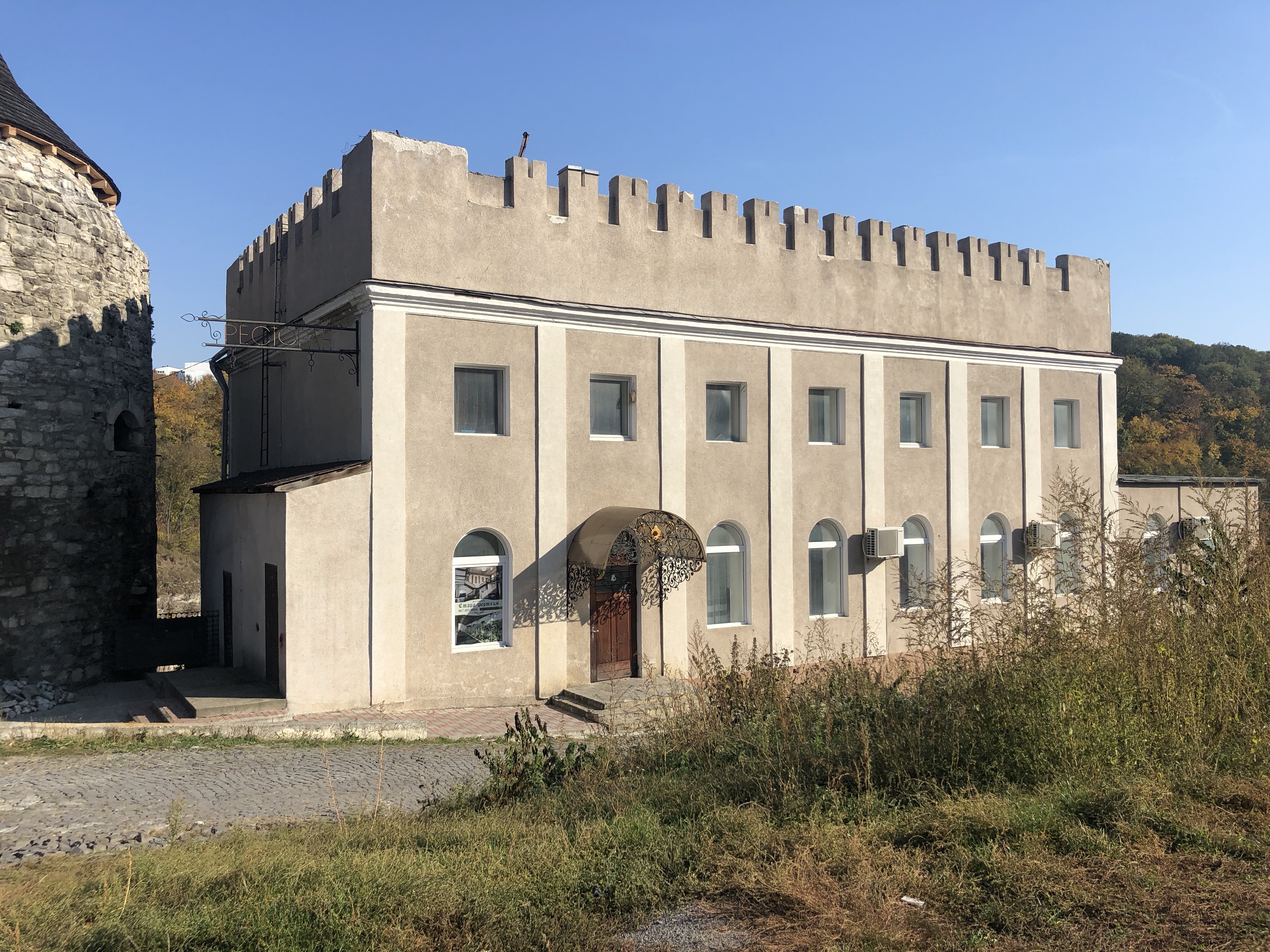
Old Synagogue now a restaurant, on the edge of the island city

Over the centuries between the Mongol and Soviet occupations, there were Armenians, Greeks, Poles, Russians, Jews and Ukrainians all living here in their own ‘quarters’ of the city, all at once, the fortunes of each rising and falling according to which Empire was in charge.  During the Polish empire (very Roman Catholic) the Jews were not allowed to live in the city, and began to live in ‘shtetls’ – small shanty towns – on the outskirts, their trades restricted to certain professions only. Then Russia took possession of much of the Polish-Lithuanian Empire, including Kamanets, now part of what was declared the Pale of Settlement.

View of the castle from the (Polish era) 18th century Jewish Cemetery outside the city

During this occupation by the Russian Empire, by the 19th century, Jews were not only allowed to engage more fully in the life of the town, but had their own quarter in the old city on the ‘island’, facing the castle across the bridge, as well as occupying a large village at the foot of the ravine below the bridge (now the site of a Soviet era power station). Of course, “no Jew could be employed as a teacher, or by banks, by the railroad or in the post office, in telegraph or telephone offices, in the courts or in any capacity by municipal, regional or state subdivisions including the police. Jews were not allowed to serve even as janitors or jail guards.” (Jewish Gen) nor could they travel in Russia beyond the Pale. But life in Kamianets was probably not all that bad. There is, today, both an Armenian Square and a Jewish Square in this part of the old city.

View of the site of the old Jewish village below the bridge, from the Jewish quarter of the old city

The rivers in the ravine – because the area, millions of years ago, used to be a sea – are brackish, and not good drinking water.  There are, therefore, only one or two deep wells where drinking water is available, and, therefore, a limit to the numbers of people the island city can support.  In the late 19th century Kamianets-Podolskiy was very over-crowded.  There were Cossack-led pogroms against the Jews in various parts of the Russian empire, following the assassination of Tsar Alexander II, in 1881, and Jews were expelled from elsewhere to live in the Pale, expanding the population of towns like Kamianets.  Many Jews left altogether, seeking a new life in the West, often passing through London on their way to North or South America, or South Africa, some – like my great-grandfather – staying in England.  I guess coming from such a multi-cultural, multi-ethnic, thriving and crowded city like Kamianets-Podolskiy, London seemed like a home-from-home for Samuel Kreps.   Those Jews that remained in Kamianets-Podolskiy into the 20th century (some 40% of the population in 1939), were all murdered by the Nazis in August 1941.

To crown my visit to Kamianets-Podolskiy, then, I was taken, finally, to the 19th century Jewish cemetery, sadly in very poor condition now, though there are others not far away looked after by Marla Osborn and the Rohatyn Jewish Heritage project.  This was, in many ways, the point of the journey for me.  As I said to Colin, who took the photo, below, there were undoubtedly people there whom my great-grandfather would have known.   I don’t really understand quite why it matters, but it does; it does.  It is important that we never forget.

More photos, as ever, on Flickr.

Orkney Isles 2018

Week 1 of 2

In the summer of 2018, Colin and I returned to the Orkneys.  On our visit in 2015 we had seen pretty much all there is to see on the ‘mainland’ island, and taken the quick and easy crossing to Rousay to see the four chambered cairns in a row there, including the impressive MidHowe.  This time, we’re here for a fortnight, with many of the other smaller islands as our principal goal.

Ness of Brodgar

Ness of Brodgar archaeological site

The first weekend was of course dedicated to revisiting the Ness of Brodgar archaeological site, to see the latest finds.  We were lucky to be here in time for the second of two ‘Open Days’ when the archaeologist, Nick Card, and his team were on hand to introduce all comers to the site, the finds, and a range of demonstration activities.

2018’s finds at the Ness of Brodgar – the year of the polished axe

I headed straight for the latest finds, and exclaimed ‘There it is!’ as I saw the colourful polished stone axe that was found this summer, towards the beginning of this year’s dig.

Nick Card, Ness of Brodgar Archaeologist

As I then looked up, I soon realised it was in fact Nick Card who was standing in front of me, explaining more about the recent finds, and how much he especially liked the smaller, plainer, but exquisitely carved polished axe (to its left in the picture above), which, he told me, was more likely ceremonial, or a gift, whereas the more colourful one showed enough signs of wear to likely have been in use, all those thousands of years ago.

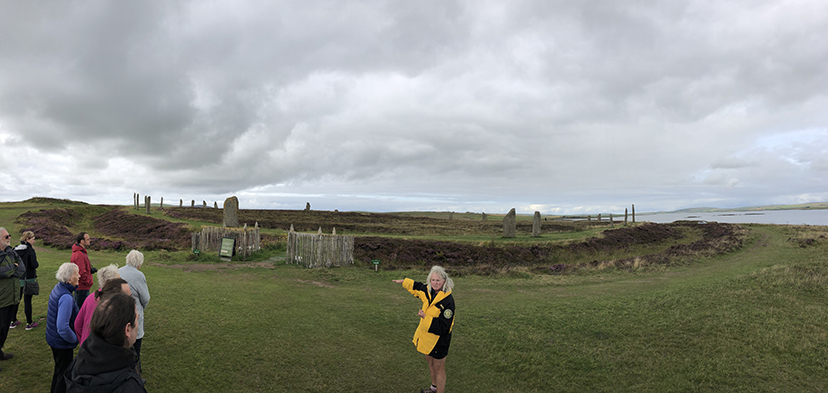
Ring of Brodgar

The Ring of Brodgar

On the next day, we took the Heritage Scotland tour of the Ring of Brodgar, which was really interesting, and introduced us to a whole different way of looking at the ring: the henge (though without an outer bank it is arguably not like any other ‘henge’ monument) when cleared of vegetation, reveals quite light coloured stone, which would have made a clear whitish circle visible for miles around.  It had been dug out in ‘sausage shaped sections,’ possibly by different communities, before each section was finally knocked through to the others, to complete the ring.  Moreover the stones seemed also to come from various parts of the island, erected upon the ring nearest to their origin, perhaps representing, or erected by the same communities who had dug that section of the ring.  The monument becomes more like a community space, perhaps for meetings (where marriages, for example, could be arranged) or some kind of parliament, or perhaps where markers of special events in that community could be laid, from time to time.  In this way, the ring becomes a process, rather than a finished monument with a purpose.  All fascinating stuff.  But of course no-one really knows….

Isles of Westray and Papay

Map of Westray and Papay

Our first big excursion from the ‘mainland’ of Orkney was to the Westrays.

We took the car ferry from Kirkwall to Rapness, and drove slowly up to Pierowall – the only town on Westray – where we had a room in a lovely B&B for the night: No.1 Broughton.  Our host cooked us a very nice dinner.

The Pierowall Stone


On Westray, there were two principal visits to make: the Westray Heritage Centre, where one can find, on display, the Pierowall Stone, a stone decorated in a very similar manner to those found in Knowth, Ireland, found in the local quarry;

The Westray Wife

and the Westray Wife, one of three figurines – the only representations of humans found in any Neolithic dig in Orkney, unearthed at the Noltland Links neolithic site, near to Grobust beach, in 2009.  Here – faintly – one can see the ‘eye-brow’ motif on the face of a human figurine for the first time.

Noltland Links archaeological site, Westray

This site was a second visit, where we were fortunate enough to be given a free – if quick – guided tour to the site, where there are a wealth of both neolithic and bronze age buildings, being gradually uncovered by wind and rain, as the sand dunes are gradually denuded in a shift in weather patterns that first revealed the archeaology beneath in the early 2000s.  There are decorated stones here, paved walkways between the houses, and thousands of finds awaiting dating and -eventually – display.

Decorated stone at Noltland Links archaeological site, with the ‘eye-brow’ motif
Noltland Links archaeological site, Westray
Logan Air flight from Westray to Papa Westray

The following morning we took the shortest scheduled flight in the UK – the 2 minute journey to Papa Westray – known as Papay by the locals. Here we stayed at the Beltane House Hostel – a community run affair built recently with good funding and very comfortable.
Knap of Howar, Papa Westray

On Papay there are again two principal sites to visit, the first of which we saw on the first day as part of the all day tour with the Papay Ranger, and second on a special trip he took us on, by boat, on the following morning. The first notable site is the Knap of Howar, a Neolithic dwelling similar to, but slightly older than Scara Brae, and was inhabited between 3600BC and 3100BC.  [For comparison, the Great Pyramid of Giza was completed c.2560BC, and the henge at Stonehenge – the first part of that monument, was constructed in 3100BC, the final site completed about 1600BC .]  The Knap of Howar is very impressive, showing very fine masonry, the distinctive ‘dresser’ style internal furniture, and walls (now surrounded by earth to help keep them up) several feet thick and high.  The two buildings are all that is visible of who knows how much more.

South Cairn on the Holm of Papa

And secondly the Holm of Papa, a tiny island off Papay where there are two cairns, the most impressive of which, the South Cairn, with a new concrete roof, includes in its SE chamber three wonderful neolithic carvings.  It is likely, in the fourth millennium BC, that the sea-level was lower, and the Holm of Papa a rise, beyond a low-lying, possibly marshy area of Papay, rather than a separate island.  It is possible even Papay was connected to Westray.

The carvings in the cairn, along with chevrons and dots, also display the ‘eye-brow’ motif common to many of the decorated stones in this area.

Decorated stone inside South Cairn on the Holm of Papa, with ‘eye-brow’ motif
Decorated stone in the South Cairn on the Holm of Papa

Sri Lanka, September 2017 2/2

Mihintale

Piper and Drummers with offerings at Mihintale

I planned to come to Mihintale to be here for the New Moon (at 11am GMT 20/09/17). I did not know whether there would be any ceremony to witness. Poya – The Full Moon – is a national holiday each month. I was very pleased to see a few people with a horn player and two drummers like at the Galadari conference (only no dancers this time). They brought a golden covered tray with small pots of food offerings to each of the special places at the top of this mountain. I followed them to take pictures at each place where they made their offering and to clasp my hands in prayer and meditate celebrating the New Moon. At the last, they beckoned me forward: I touched the lid as I had seen others do, but again he beckoned, saying ‘take it’. I had noticed them taking turns to carry it. So I took the tray, reverently, and I carried the tray up to the altar of the central stupa (the spot where Buddha sat in meditation on his third visit to Sri Lanka), placing it on the altar and, as I had seen them do at the bigger stupa above, lifted the lid to make the offering. We all stood back to clasp our hands in prayer, as the horn player and drummers played. Then they beckoned me to take it up again, and carry it through to the private area past the guards. As we walked, one asked me, “Are you Buddhist?”  I hesitated, and said merely, “I try.” They liked this.

Stupa marking the spot where Buddha sat in meditation on his third visit to Sri Lanka

I followed the guard up into the office where I put down the tray, and fresh food offerings were placed in the pots. Then they beckoned me one last time to carry the tray again through to the relic house, and place it at the high altar. This was a very beautiful inner sanctum, with elephant tusks, rich cloths, and a seated Buddha with an altar in front with flowers, and room for the tray. Such a privilege and honour, to stand with the monk, the musicians, the followers, hands clasped, mind still, at the very moment of New Moon, at the crest of Mihintale. Thanking the monk for the honour, he said “Buddha bless you,” and I went back to the public area, beaming.  Easily the highlight of my trip!

Wilpattu

Vedda Cave Carvings

The Wilpattu National Park is famous for its leopards. Eco Team Big Game Safaris offer a night in a large square tent inside the park, with candlelit fireside dinner, and a jeep safari to see the animals. A 16month drought ended with rains a few days before my arrival, so there were plenty of insects (!) but this wasn’t so much of a problem. The inner tent has a double bed with a mosquito net! What I found difficult was the heat. Since arriving in Sri Lanka I have been in air-conditioned hotels. This was my first experience of a true Sri Lankan night. I had no appetite at dinner, and barely touched my food, drank less than half my can of beer. In the day, it had been 34′. Thankfully i had descended from Mihintale before it reached 30′, but my visit to the Vedda Cave Carvings was a river of sweat. At Wilpattu, at night, it did not fall below 28′. I sat in front of the fan in the settee area of my tent, sweating, for a while, then retreated from the moths and flies to the inner tent, inside the mosquito net, the second fan playing gently against the net as I tried to sleep.

Luxury Tent at Wilpattu

Awaking at 5.15am, as instructed, I was at the meeting tent at 5.30am for my jeep. Some other guests, (Dutch, German, Australian, French, two Chinese girls) all got into the jeeps they had had the previous evening. Asking about mine, the staff there seemed unaware that I had booked a safari. Perhaps slightly shorter tempered than usual, (I had barely slept, just hoping the night would be over soon) I showed them the email, proving my booking. They got onto the phone with their manager, who assured me my driver was now on his way. The staff there said it was his mistake. He arrived a minute or two later blaming the driver for miscommunication. All-in-all not a great start: this was easily the most expensive outing of my trip, and wasn’t turning out too well thus far.

Location screenshot at Wilpattu

At the park, we were joined by a very friendly and knowledgeable Park Guide, and made off into the National Park. I saw Spotted deer, the National Bird – Jungle fowl; a Stork billiard kingfisher and various Kites and Eagles, Monitor lizards, and Jackals. Of the dozen or so jeeps out on safari this morning, however, only one was lucky enough to see a leopard, for a few seconds, and no-one saw any bears. I, however, along with my guide, was fortunate enough to witness – for about three seconds (too short a time to get to my camera) – a Tusker! Of all the elephants I have seen here in Sri Lanka this was the only one with tusks – and big 3-4ft long tusks they were too. My guide said this was very rare indeed. He was clearly excited. I also saw Wild buffalo, Grey headed fish eagle, and Green bee eater birds. I’m no David Attenborough so offer no wildlife photos from here. See what I managed to snap on Flickr.

Mannah

The salt flats of Mannah Island

Leaving Wilpattu late morning, meeting up with my driver Rohana again, we made for the last excursion of my trip – Mannah. This part of Northern Sri Lanka is mostly Tamil. Tamils are more Muslim, Hindu and Catholic, and less Buddhist, than the rest of the country. The Buddhas here seem mostly to do with the large police and army presence, underscoring the victory of the majority over the ethnic minority separatists only a few years ago.

Thiruketheeswaram Shiva Temple

Along the way were two more temples – the great Catholic Church complex at Maddhu, and the Thiruketheeswaram Shiva Temple. The former, to be honest, I found rather dull, but (from the crucifix and Jesus-pendant in the car) I guess my driver is from the Christian community here, and he was clearly interested to visit this place. As I told him, I have been to Jerusalem and to the Vatican – ‘so you see plenty churches,’ yes. The Thiruketheeswaram Shiva Temple, on the other hand, is something I have never experienced before, but, in a different way, was also rather disappointing.

Me shirtless at Thiruketheeswaram Shiva Temple

The Temple was ‘under renovation’, with no access inside; all the statues from inside were arranged in a great shed outside the Temple, but there was no access inside the shed either. What was strangest, in the 33′ heat, was that to enter the complex at all, one had to not only remove one’s hat and shoes – which I am used to now from the Buddhist temples – but one must also remove one’s shirt!

Mannah itself is an island promontory jutting out into the Indian Ocean, petering out into a series of islands that then at last become a new promontory jutting out from southern India. This is known as Adam’s bridge, and the beach where this begins was my final visit of the day.

Location Screenshot at Talaimannah
Me at the tip of Mannah Island – the beginning of Adam’s Bridge

Tomorrow begins the long journey back south, for a last night, at Negombo, before the flight home, with just a couple more temples along the way.

Manavari and Chilaw

The Shivalingam at Minavare, called the Ramalingam

To break up the long journey, a little research revealed a fascinating Shiva Temple at Manavari, just short of Chilaw, where we could stop for lunch. This little known temple in fact houses one of only two Ramalingams in the world (the other in India), so called because the Shivalingam venerated inside this temple was made, according to the chronicles, by Lord Rama himself. Here, the Hindu priest sat on the steps of his temple, speaking with two or three devotees, and welcomed me with a warm smile, beckoning me in to visit, and to take photographs. Reverently, I entered, and soon discovered at the back of the temple the inner sanctum where the Ramalingam was kept, draped in a cloth. Returning to the steps, I smiled and said, “Ramalingam” and the priest nodded smiling, enthusiastically explaining that this lingam was 10000 years old!

Ardhanarisvara at Minavare

I asked him if there was also an Ardhanarisvara statue here – perhaps I did not pronounce this properly, or it is known to him by another name. I explained by saying “Shiva, Pavarti” and miming the two together by clasping my hands and threading my fingers together, hoping this would convey the hermaphroditic union of the God and Goddess in one deity that is Ardhanarisvara. He nodded, explaining there was one on the left hand side of the temple. I looked, and found an old blackened statue there, but was not sure this was the one I sought.

Kali Kovil, Chilaw

Shortly further down the road, at Rohana’s suggestion, after lunching in Chilaw – a rather hot but very tasty Sri Lankan rice and curry – we also stopped at Chilaw’s Kali Kovil Temple. Here, I caught the eye of the Hijra (the third gender of the Indian subcontinent, often a specifically religious one, and clearly a much respected devotee here) who took it upon him/herself (perhaps after seeing me put notes into the donation box) to show me around, introducing me to each of four different statues, beckoning me to photograph each.

Kali at Chilaw Kali Kovil

Then s/he brought me forward to the altar, instructed me to bow, placed his/her hand upon my shoulder, and proceeded to chant a blessing for me -helpfully explained here and there in English- for good fortune on my travels. I was most grateful! What an honour, on this trip, to have received, without seeking it, the blessing of both a Buddhist Monk and a Hindu Hijra, at their Temples. I am blessed indeed! Just outside the Kali Temple, at a stall packed with Indian brass statues, I spotted a heavy brass Shivalingam, and with the aid of my driver, Rohana, paid not too handsome a price for it, to bring home as a keepsake of my Hindu blessing.

Negombo

Sunset from my room at the Heritance, Negombo

At last, then, to the Heritance Negombo – a wonderful beach hotel just 20minutes taxi ride from Colombo airport, for my final night, and a fantastic sunset view from my bedroom.


The New Moon, rising above the Heritance Negombo, on my last night in Sri Lanka

Sri Lanka, September 2017 1/2

I was fortunate enough, in September 2017, to attend an academic event in Colombo, Sri Lanka.

Dancers at the Galadari Conference centre

As in the past, I took some annual leave whilst in the country, as soon as the work was over, to get outside the hotel and conference centre and actually see something of the country itself – especially of its rich history, many thousands of years old, and of its rich flora and fauna. It is not, however, a rich country, financially, and even after the shrinking of its value since the summer of 2016, the British pound still goes a long way here: there were many times I felt very privileged, and the tips I gave, though seemingly small to me, meant a lot to those who received them. You can haggle, but when the price is £3, why bother to argue it down to £2.50?

After my week in the very nice, but corporate hotel/conference complex in Colombo (where a plush dinner is £15), I spent a couple of nights at Jungle Tide – the retirement villa Homestay of two old friends from the theatre world, where I received a warm and comfortable welcome.

Jungle Tide

Homestays are like Bed and Breakfast, but they’ll cook dinner for you too, and make you welcome in the lounge. This was just the antidote I needed to the working week in Colombo, perched in the mountains above Kandy, treated to the fireflies in the evening, monkeys squabbling in the trees. The large rat snake (so called because it eats rats) that I disturbed on the path in the morning – thick as my arm and probably as long as I am tall – gave me a fright, but all they eat is rats, so I wasn’t in any danger. At least it wasn’t a python – which of course can kill with a single bite!

Sad to say, it is still illegal in Sri Lanka to be gay. A legacy, no doubt, of colonial times. In this, as in many parts of the world, same-sex relationships in a variety of forms were commonplace before the arrival of the bigoted and discriminatory Christian Europeans. But here, perforce, I have had to retreat, quietly, back into the closet, for a couple of weeks, answering questions like “Are you married” with an affirmative that then describes my spouse with a female pronoun. Yes, “she” is well, but could not join me this time. Yes I will bring “her” next time. Sadly, with two sisters in their late sixties running Jungle Tide in the absence of my theatre friends, already used to this from Colombo, I stayed in this temporary holiday closet, not wanting to risk spoiling the enjoyment of the homestay with a challenge they might not welcome. Who knows, they may have been very accepting, but I did not want to run the risk. With the Sri Lankans, I am not prepared to take any such risk.

Kandy

Between my two nights’ stay at Jungle Tide I took a tuk-tuk ride down into Kandy itself. The tuk-tuk is ubiquitous in Sri Lanka: a sort-of three-wheeler moped taxi, mostly open air, not very fast, and driven largely by mad people!

Skull and cross-bone rivets are all the rage on tuk-tuks

Don’t even think about hiring a car and driving anywhere yourself in this country: the roads are insane. What you do is hire a car and driver – I got one from reputable company Mahaweli, arranged for me by my theatre friends at Jungle Tide, and driven by mid-late 20s man-of-the-world-in-the-making, Rohana. Mahaweli are a company whose owner-director is only 38, and all his employees between 25 and 35. Rohana answers the phone with “Hello, Sir” all the time, perhaps especially with his employers as much as with potential clients. (The phone rings all the time while we are driving, and there is no hesitation to answer and talk while at the wheel, here.) He is a very friendly, helpful, hospitable fellow who has tried really hard to make me welcome and to ensure I enjoyed my stay, and learnt about the country and enjoyed its hospitality. I would certainly recommend Mahaweli – and Rohana – to any tourist in Sri Lanka, including gay men such as myself, missing their husbands at home. I have no idea what his reaction might be to this knowledge, but didn’t want to risk the potential estrangement a bad reaction might bring. What a gay couple holidaying together here might do, I have no idea. But this country has so much to offer, that these personal questions are, when you are a solo traveller at least, relatively easy to set aside.

The greatest attraction at Kandy is the Temple of the Tooth – a reliquary temple for one of the teeth of Siddharta Gautama Buddha, brought to Sri Lanka in the 3rd century BC.

Inside the Temple of the Tooth
Sun and Moon Motifs on the outside of the inner shrine of the Temple of the Tooth

Whoever holds it holds the governance of the country. After some years in Anuradhapura – the ancient capital for many centuries – it came to Kandy, the last Sri Lankan kingdom to hold out against the European colonial powers, and, after some time in British hands, it is kept again in this fantastic temple by an artificial lake in the high mountain town of Kandy. The majority of the Sinhalese are Buddhist.

Journey north from Kandy

Aluvihare Cave Temple

At Aluvihare Rock Temple, in Matale, the moment when Buddhism was first written down in Sri Lanka, in the 2nd century BC is remembered both in a fantastic cave temple, and in a superb giant Buddha sculpture on the hillside.

Also present in Sri Lanka, however, are many Hindus, Muslims, and Christians (in that order) and a good deal of harmony between them all. (The ethnic tensions between the Sinhalese and Tamils, many centuries old, the latest chapter of which ended bloodily some years ago, is less religious than it is ethnic). There is plenty of syncretism between the prevailing, largely Theravada, but in parts Mahayana Buddhism, and the Hinduism that exists alongside it. The Nalanda Gedige Temple, for example, from a thousand years ago, shows two faces: one Buddhist, one Hindu, as an example of the harmony between the two traditions in Sri Lanka.

Buddhist facia at Nalanda Gedige
Hindu facia at Nalanda Gedige


Islam arrived during the ascendancy of the Mughals in India, and Christianity – in the form of Catholicism – arrived with the Portuguese.

In Buddhist Temples in Sri Lanka, therefore, it is not uncommon to see many aspects of Hindu culture absorbed into the local form of Buddhist practice. Krishna, Ganesha (known here as Pulyar), and Shiva are all present both in their own shrines and in the Buddhist temples. Here also, is the Hindu Goddess of Rain and Fertility, Sri Muthumariamman.

Sri Muthumariamman Hindu Temple
Five faced Ganesh at Sri Muthumariamman Temple
Shiva Lingam at Sri Muthumariamman Temple


Dambulla Cave Temples

Amongst the best Buddhist temples, of course, are the caves. At Dambulla, where one must climb high up to the top of a small mountain, up many stone steps, to reach them, are four natural and one man-made cave all exquisitely painted inside and filled with statues of the Buddha at various stages of his life-story. These are particularly impressive, and testimony to the devout following of Buddhist practice for many centuries – and still today – in this country.

Inside Dambulla Cave Temples
Outside Dambulla Cave Temples

Sigiriya

Traditional Village life in Sri Lanka

Traditional Sri Lanka village hut, where I had lunch

After leaving Jungle Tide, and visiting temples along the route north to Sigiriya, I was treated to an interesting experience of pre-colonial traditional village life in Sri Lanka, through a ride on a traditional bullock cart to a (man-made) lake, and a boat ride across to a lakeside village where locals prepared and served traditional Sri Lankan food – the traditional way. This was the idea of my Mahaweli driver and guide, Rohana, and it was amazing to see how it is all done, how simple, and how delicious it all turns out. Alongside the South American introductions (tomato, chilli) were the older, local foodstuffs: fenugreek, salt, mustard seeds, lime, turmeric, lentils, okra, onion, a local kind of pumpkin, fresh water tilapia fish, the ubiquitous curry leaves, and the incredible coconut which produces oil to cook with, the flesh to spice and eat as a salad, and the milk to make the rich sauces of the vegetable curries – along with the leaves to make the roof, the half-shell cups to drink from, and many more uses beside.

Traditional rice and curry lunch
Boat ride with Rohana
Boat ride with Rohana, my driver
Bullock cart ride
Bullock cart ride

Kaudulla National Park

My Mahaweli guide, Rohana, through friends of friends, asking for someone who knew about the animals and could please someone such as me, with lots of information, and who had a good, safe vehicle for the jungle, got a recommendation, got his number, and managed to book a fantastic guide for us for an Elephant Safari.

Me with 1959 Land Rover Defender

I confess I felt very proud of our 1959 vintage black Land Rover Defender, as we passed the touristy Mitsubishi jeeps (all 2-wheel drive and not very comfortable) on the dirt tracks. We were also taken into Kaudulla park, rather than Haburana, as the elephants move, each year, from the latter to the former, when the late September rains begin. This year, they have come early (nowhere escapes climate change) and so the elephants are on the move already – the males, or ‘bulls’ on their solo journeys – sometimes blocking the minor roads around the park – and the herds of females and their offspring in family groups.

Solo Bull Elephant on the roads outside Kaudulla National Park
Solo Bull Elephant at Kaudulla National Park

We arrived by the lake shortly after several of these solo male elephants and three family groups had emerged from the jungle onto the grassy plains around the lake, and were amongst only three or four jeeps of tourists to witness these amazing animals up close.

Untitled

As we left, dozens more jeeps were arriving in the park, and I was very grateful to our guide for knowing not just where to be, but when, to witness these extraordinary creatures. On the way there, and on the way back, he also stopped frequently, with keen eyes, to point out the red-faced macaques in the trees by the road, black faced grey langurs, peacocks and peahens, and even a crested hawk eagle.

Black faced grey langurs at Kaudulla National Park
Crested hawk eagle at Kaudulla National Park
Peacock, peahen, and red-faced macaque at Kaudulla National Park

Rarest of all, on our way out, standing in the back of the land rover, I was first to spot a billiard kingfisher – and our guide was really impressed that we had had the opportunity to see one – and that I had spotted it!

Billiard Kingfisher at Kaudulla National Park

It was truly an incredible privilege to see all these fantastic animals, and an absolute delight to do so from what was clearly the best vehicle around, and probably the best guide!

Our guide with his landcover at Kaudulla National Park

Sigiriya Rock

Sigiriya Rock

Staying at the Zinc Sigiriya – once the ‘Resthouse’ and now fully renovated and newly marketed to the global market – I rose very early to climb the famous, UNESCO World Heritage Site Sigiriya Rock. The site opens at 7am, and it is wise to begin one’s climb straight away, to be on the top at 8am, and making one’s descent by 8.30.

Sigiriya Rock

The heat is such that a visit any later in the day invites both exhaustion and burning for northern European white skin. The rock is the vanity project of a 5th Century CE royal usurper, defeated in battle by the ‘rightful’ king, who temporarily transferred the royal capital from Anaradhapura to this pleasure-palace-cum-fortress for the length of his reign. As a feat of urban planning and architectural folly it is perhaps in many ways unsurpassed, and remains immensely impressive a millenium and a half later.

The many, many steps up are nothing compared to a climb up Mount Misen in Japan , taking only 30 minutes, but the final section up fire-escape-style metal steps is definitely not for the faint-hearted: if you have any kind of vertigo that makes you quiver up a ladder, this UNESCO World Heritage Site is probably not for you.

Steps onto Sigiriya Rock
One of the two surviving paws of the Lion’s Gate
View from the top of Sigiriya Rock
Me atop Sigiriya Rock
View of the gardens from atop Sigiriya Rock

I was not the only one quite fearful on this stretch of the climb, both up and down, and you have to steel yourself to brave the trip. The rewards, however, at the top, are very well worth it. The views across Central Province are astounding and unmissable, and the extraordinary brick architecture of the citadel palace built upon the flat-topped summit are a wonder to behold, even now, some 1500 years later.
Back at the hotel, after a shower and a good breakfast, I made ready and embarked on our journey to Anaradhapura. On our way, we took a detour down rural country roads, past local country shrines to Pulyar (Sri Lanka’s name for Ganesh) where the locals pick a twig of leaves to hang by the shrine and pray for a safe journey.

Pulyar Shrine

Aukana

Aukana Buddha

Just past here, our destination was Aukana – the largest rock-carved Buddha in all Sri Lanka. This enormous statue of the standing Buddha, hand raised in blessing, and the rock-hewn water cistern nearby, are contemporary with the palace at Sigiriya Rock (late 5th century CE) and although somewhat out of the way, well worth the visit if you have time. Here, the orange robed monk, with impecable English, clearly a very well educated and highly intelligent man, personally welcomed me and showed me around the site, as the coach of local children came and went. He was clearly pleased to see an international tourist and I would recommend any visitor to the country to make the time to come here. It is a very special place with a fantastic ambience, and I was deeply moved by the exquisite carving and serenity of this enormous standing Buddha sculpture.

Me with the monk at Aukana Buddha

Anuradhapura

The largest brick building in the world

After Aukana we headed on to another UNESCO World Heritage Site: Anuradhapura. This time I stayed at the Rajarata Hotel. This was a good hotel – not unlike Zinc Sigirya – although offering hot water for people to make their own coffee with sachets of Nescafe is for the rooms, not for the breakfast buffet, please! Dinner, however, was very good here, as it had been at Zinc Sigiriya.

I then spent all day – from 8am to 3pm – with Jagath, a guide whose excellent English and understanding of the sites made the whole experience exceptionally interesting, despite the crushing heat (a very humid C29-31 most of the time.) I kept applying sun block and spraying anti-mosquito spray, but still got a bit red, and several bites. (You have to take your hat and shoes off to get into/near to the Buddhist shrines.) Jagath was extremely informative, and Anuradhapura is simply incredible.

The Samadhi (meditating) Buddha in the 2nd Monastic Complex – from the 1st century BC

The village of Anuradh was founded by a King’s minister (called Anuradh) in about 600BC, and only later became a city (a ‘pura’) in 300BC when Buddhism was introduced to the country, when pagan Sri Lankan King Devanampiyatissa was converted to Buddhism, and his people with him. Anaradhapura was the place, shortly after, where a clipping was brought from the Bodhi tree under which Gautama Siddharta, the Buddha, had reached Enlightenment. Relics of the Buddha’s body, of objects from his life, and of things associated with him, form the three different kinds of relics, nearly all of which are buried in sacred caverns (called relic chambers), and then enormous solid brick domes are erected over those chambers. Atop the domes, where once were a kind of fence, there are now square or rectangular boxes, and above these, where once were parasols one atop another, there are now cylindrical columns. Crowning the pinnacle of the columns there are now bright crystals ( – possibly lightning conductors in their day – ) where once there was a simple pillar next to the fence.

The 2nd largest brick building in the world

This religious architecture is called a STUPA, and is completed by three rings around the base of the dome, representing the Buddha, his life, and his Enlightenment. The main stupa at the First Monastic Complex at Anuradhapura, originally built around 100BC, contains many such relics, and is the largest brick built building in the entire world. (Nearby, at the 3rd monastic complex, the Stupa there is the 2nd largest brick building in the world and is estimated to have 93million bricks in it, which would be enough to build a wall from London to Edinburgh.) The biggest is repainted every June.  The second biggest has just been restored, from being covered in greenery.  Beside the main stupa in the First Monastic Complex, from that original cutting brought to Sri Lanka around 300BC from the tree in Northern India under which the Buddha gained Enlightenment around 600BC, is a giant fig tree – the very same Bodhi tree. It is, thus, the oldest chronicled tree in the world: now 2600 years old. So this oldest tree in the world, and the largest brick building in the world, together form the centrepiece of the First Monastic Complex of Anuradhapura.
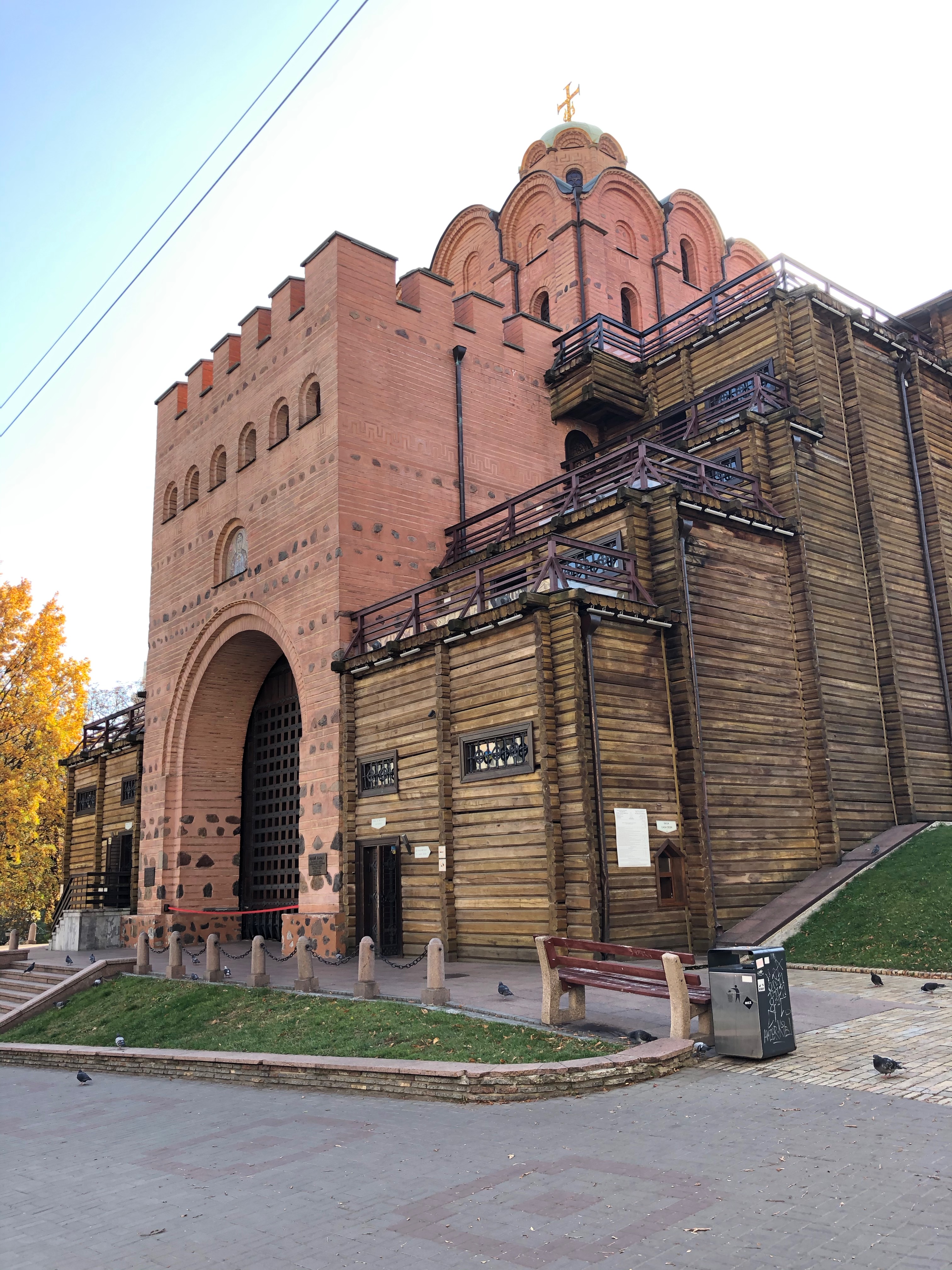
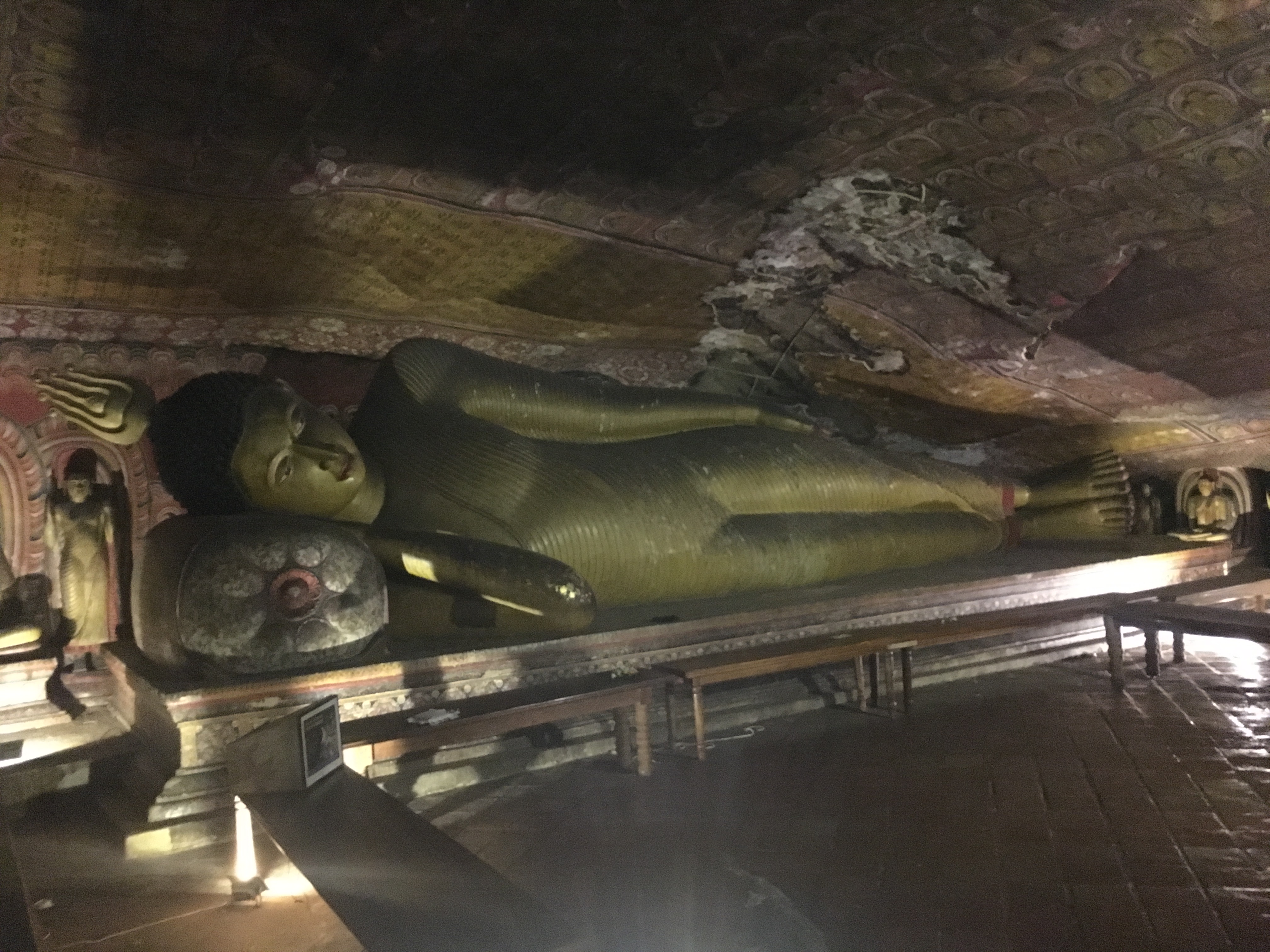
The Bodhi Tree
The Samadhi (meditating) Buddha in the 2nd Monastic Complex – from the 1st century BC

The Second Monastic Complex is a city where 5000 monks lived, worked, meditated, ate, slept, and welcomed international visitors from around Asia for study and sharing. There are a further six or more such complexes, which were sub-schools of the Second Monastic Complex, some of which remain buried in the jungle, some just beginning to be excavated. The site, in short, is vast – literally a kind of Ancient Rome or Athens in Sri Lanka, but entirely devoted to the Buddhist philosophy and way of life. It finally came to an end, in the 10th century AD, when Sri Lanka was invaded from South India, and the great city was completely destroyed and burned. The capital moved to Polonuwara (where I don’t have time to visit on this trip) briefly, and then to Kandy, which, at last, fell to the European colonialists.

The ‘Moon Stone’
Door Guardian

In the Second Monastic Complex I had time – amongst the vast area of living quarters and shrines – to visit some special places selected by my guide: the finest ‘moon stone’ in Sri Lanka, the finest ‘door guardians’, and both the largest water cistern and the pair of most attractive water cisterns. The sandakada pahana, or ‘moon stone,’ named after a half-moon, is a semi-circle laid at the entrance to many different Buddhist sites around Sri Lanka. There are a series of semi-circular rings. The outermost ring is of fire: the experience of the world, of desire, and the pain and suffering that go with it. The next ring is of elephants, lions, horses and bulls – the four animals that represent the four pains of life: birth, ageing, ill-health, and death. They are also the four stages of life: growth, energy, power and forbearance. The next ring is a twisted creeper, representing the tortuous routes one must sometimes take to put aside desire in search of one’s true happiness. Then the next ring is of Thorn Birds or Swans; in Sri Lankan mythology the Thorn Bird can magically separate milk and water. This symbolises, then, the moment when the follower of Buddhism begins to discern the true happiness from the fires of the world. At last, then, in the inner semi-circle is reached: a semi-circle of lotus flowers, and the radiant inner happiness of nirvana. Thus, at the entrance to a Buddhist site in Sri Lanka, stepping upon the ‘moon stone’, one is stepping upon the path to Enlightenment. It is the cycle of Samsara – from worldly desires to the achievement of Nirvana.

There are, of course, lots more photographs on Flickr.

Japan trip #8 – Nara

Todai-Ji Buddha
Todai-Ji Buddha

I began my trip to Japan – it seems like a long time ago! – with a visit to pay my respects to one of the first Emperors – Nintoku-tenno-ryu – the legendary Emperor of the 5th century, when Shinto was supreme and the shrines of Ise Jingu and Izumo Taisha already in their prime.  But this was around about the time that Buddhism first arrived in Japan, and in Kyoto already I had seen shrines and temples side by side, exhibiting the famed co-existence, and even syncretism, of the two religions in this country.  So it seemed appropriate, on the last day, to visit the greatest Buddhist temple in Japan: Todai-Ji, in Nara, where in a great hall there resides the largest statue of the Buddha I have ever seen – at 49ft 2in high a UNESCO World Heritage Site and the largest statue of the Buddha Vairocana in the world – known to the Japanese as simply Daibutsu.

Kosagu Taisha
Kosagu Taisha

Right next to it, however, amongst all the deer (Shinto messengers of the gods) roaming the great Nara Park, lies the Kosagu-Taisha Shrine, perhaps the third, alongside Ise Jingu and Izumo Taisha, of the greatest Shinto Shrines in Japan.  Here, at the very last, I cleansed at the fountain, and worshipped in the proper way at the gate of the shrine, and thanked Japan for all that it has given me over the past two weeks.

Deer in Nara Park
Deer in Nara Park

Nara Park – particularly on a Sunday – however, is a bit like the Tower of London: thronged with tourists from all over the world, but also with worshippers from all over Japan, and, in truth, I am, at the last, getting a bit ‘shrined-out,’ if I am allowed such an expression. Having taken in these two great sights, therefore, I decided to forego the rest of the shrines and temples around the Park, and get the bus back to Nara Station, the train back to Osaka, and the subway back to Shin-Osaka, for a final meal at the Marriott, and an early night for an early start heading for the airport.

Me at Izumo Taisha
Me at Izumo Taisha

It has been a truly amazing trip, taking in some of the most awe-inspiring sacred places I have ever had the privilege to visit, and pay my respects to.  Both Shinto and Buddhism are living and thriving religions, side-by-side, in Japan, (alongside capitalism, which thrives right next to both!) and the co-existence, mutual respect, humility and harmony of these faiths – and of the Japanese people – and the meticulous care of the truly beautiful buildings and gardens where these religions thrive, have really impressed me.  The news from the UK, and from the US, during my stay here, has been so depressing, in comparison.  It is no wonder to me that Japan is now one of only 10 countries in the whole world that is fully at peace, and not engaged in some external or internal war.   Long may it remain so.

Oyster gratin
Oyster gratin

One thing I will not forget is the hospitality and friendliness of the Japanese people, and their amazing food!  It is difficult to pick out one ‘best’ meal during the last two weeks: the first dinner at Iseshinsen was memorable for the sheer number of wonderful dishes; the sashimi dinner at Iberaki unforgettable for freshness, flavour, and of course the sashimi whale; the sushi dinner at the Imperial Hotel (as well as being one of the most expensive meals I’ve ever eaten) was similarly memorable for the freshness of the fish – and the delight and expertise with which the master chef prepared each sushi morsel for me before my eyes; finally, of course, the multi-course oyster extravaganza at Yamaichi on Miyajima was an eye-opening wonder of culinary delight.  I suspect the Japanese restaurants at home in the UK won’t quite meat my expectations after such delights, but I’m sure I’ll be trying them out!

A large number of photographs from my entire trip are available to view in my Flickr account, with brief descriptions of each.

Previous –>